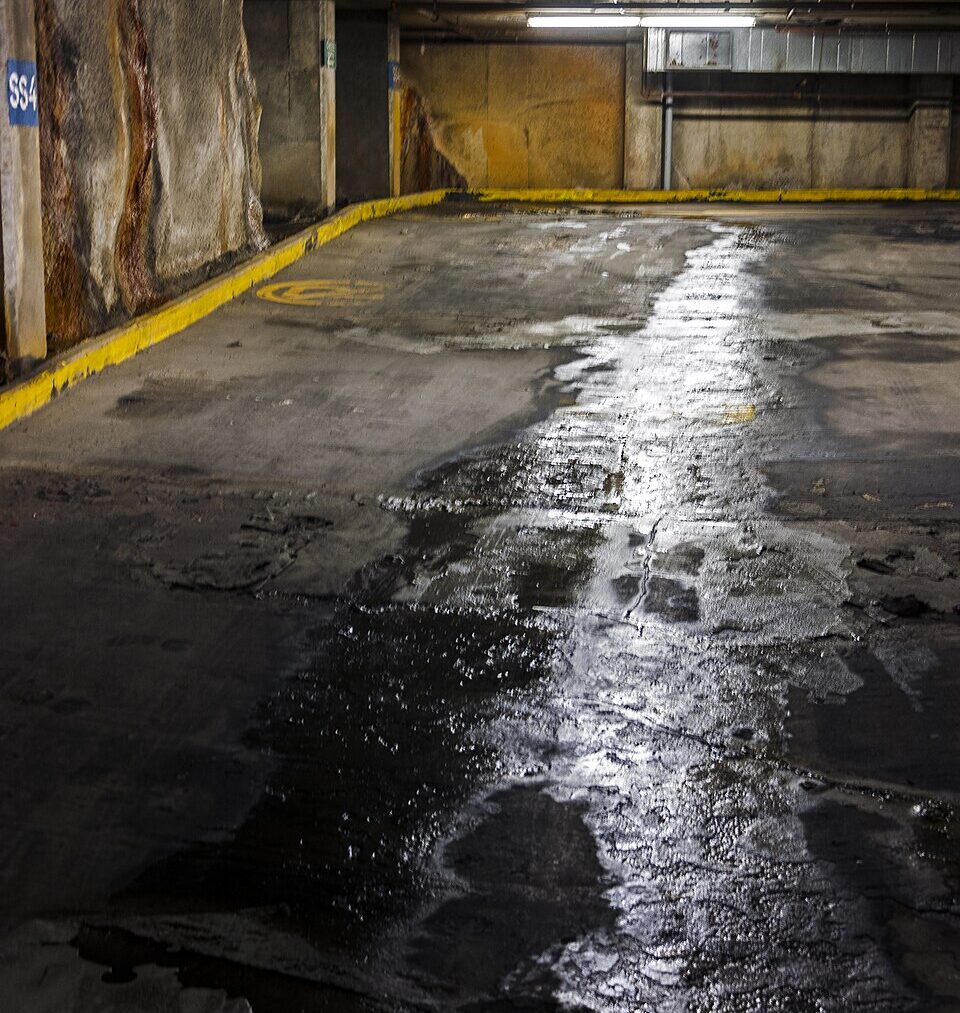
A concrete ramp spirals two stories down before the first support column even appears.
Rebar cages wait stacked against a bare wall, each one destined for a single car-sized slab.
No apartment sits above this level yet, but its future cost is already being decided down here.
Every inch of excavated concrete adds a line item that never shows up on a lease.
That line item just got a number nobody expected.
Why a parking space now costs more than most people’s first car
Digging a hole underground and reinforcing it against the weight of a building above is simply expensive work. Underground parking needs excavation and structural support, plus ventilation and fire systems that a surface lot never requires, and that difference shows up directly in the price.
So the underground space has become some of the most expensive square footage in the whole building, rivaling facades and mechanical systems as a cost driver.
Developers cannot shrink that cost by building smaller units, because the parking requirement is fixed to the unit count, not the unit size. Because of that, the mandate itself, not the car that eventually parks there, is what drives the number. Cities require a fixed count of spaces per unit regardless of whether every resident actually owns a vehicle.
What that looks like on an actual apartment block
Picture a mid-size apartment building going up in a dense American neighborhood, the kind with a commute-friendly location near transit that should make a car optional. Zoning code still frequently requires more than one space per unit, built below grade because there is no surface land left to spare.
That requirement turns into a very specific tax on the smallest, cheapest units in the building. It squeezes hardest on exactly the housing stock a budget-conscious renter would normally seek out, the studios and one bedrooms meant to be the most affordable option on the block.
In Los Angeles, the math turns almost absurd. The city’s parking minimum for one bedrooms, set at 1.5 spaces per unit, adds about $97,000 to an apartment when built underground, a 31 percent increase to the cost of constructing the 1-bedroom itself at $309,000 .
Even a new car sharpens the point. As of 2025 a new car costs, on average, about $50,000 , meaning a single mandated parking stall underground now outprices the vehicle it is built to hold.
How researchers actually built this number
A new UCLA analysis pulled 2025 construction cost data from 17 US cities and found that parking costs have risen substantially faster than inflation since 2012, with underground spaces now among the priciest square footage in the whole building.
The report, titled “No Such Thing as Free Parking,” was written by Ellen Schwartz, who manages the UCLA Center for Parking Policy , part of the university’s Institute of Transportation Studies. The analysis combined fresh construction cost estimates from Rider Levett Bucknall with the actual parking minimums written into zoning law across all 17 cities.
That pairing surfaced wide gaps between places with loose requirements and places still locked into older, stricter ratios. It found that underground parking now averages $73,000 per space, up roughly 50 percent since 2012 after adjusting for inflation .
The analysis also found that residential parking mandates raise studio and 1-bedroom apartment construction costs by over 30 percent, making lower-cost housing harder to build , a burden landing hardest on renters with the least room in their budget.
Where the mandate is already being torn up
Not every city still enforces these rules, and the pushback has picked up speed in recent years. In August 2025, the Denver City Council eliminated parking minimums for new buildings, following the lead of other cities such as Boulder, Longmont, Austin and Minneapolis that have all recently abolished parking minimums .
Yet repeal does not instantly cut costs. Existing buildings already carry their sunk parking costs, and developers in many metro areas still voluntarily build extra spaces to satisfy lenders or buyers who expect them.
Removing the legal floor only opens a door. It does not force anyone through it.
Meanwhile some newer regulatory layers are adding cost back in even where minimums have eased. The report points to rising labor and materials costs alongside seismic standards and EV charging mandates as forces still pushing per-space prices upward regardless of local parking policy.
What this means for anyone hunting for a lease
None of this shows up on a rental listing, which is exactly the point. The cost gets buried inside square footage a tenant never walks through, so a renter comparing two similarly sized studios in different cities is often comparing two very different parking mandates without ever knowing it.
That hidden math connects to broader patterns in how Americans move through their own cities, including the slow dip tracked around holiday travel habits and the steady reshuffling of office attendance that drives so much urban parking demand in the first place.
Fewer daily drivers theoretically should mean fewer mandated spaces, yet zoning code often lags years behind actual behavior. The more hopeful read is that this gap is now measured precisely enough to argue about, which is new.
Cities that have already repealed their mandates give planners elsewhere real comparison data rather than theory, and that is usually how expensive, invisible rules eventually get rewritten.
