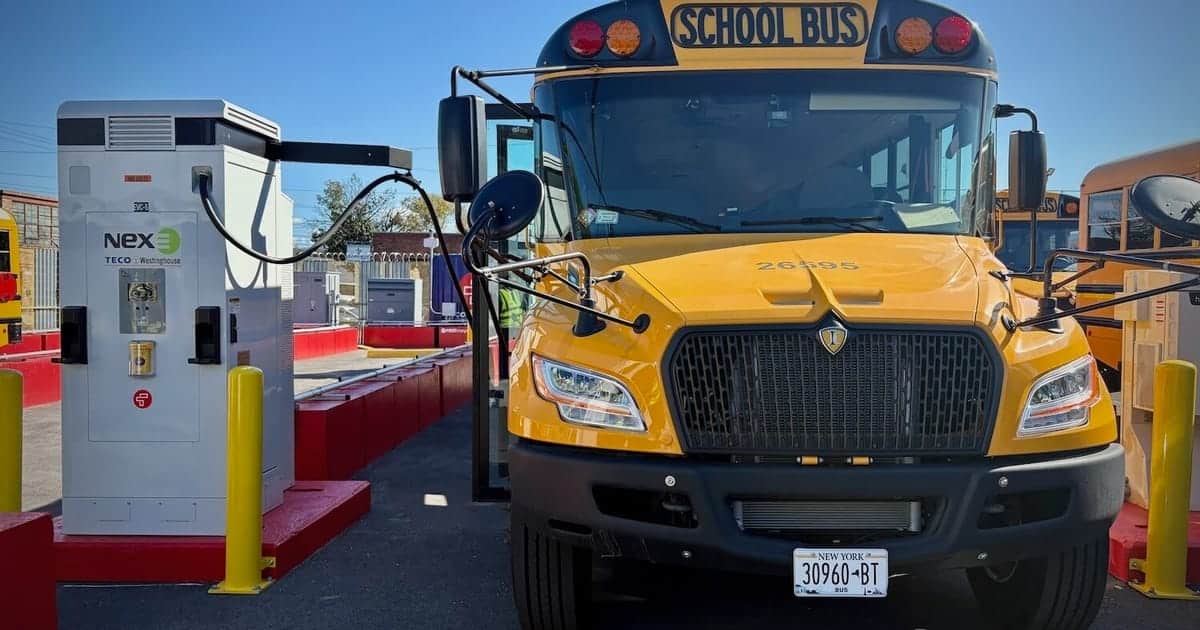
A fleet of electric school buses in Brooklyn is being wired to send power back into New York City’s grid, with the operator aiming to supply up to 10 megawatts of capacity within a few years.
The project, run by bus operator First Student and utility Con Edison at a depot in East New York, marks one of the most concrete vehicle-to-grid efforts underway at a major urban utility.
A $9 million pilot completes its first phase
First Student and Con Edison are advancing a $9 million pilot that offers a cleaner commute for students and a power boost to the urban grid.
First Student’s trenchless charging system cost about $945,000 to install over four weeks in East New York, according to Con Edison. The aboveground charging infrastructure saved nearly 20% in project costs and accelerated the timeline by a month.
Forty additional battery-powered buses will be delivered to East New York between now and June, according to First Student.
First Student received about $2 million in funding from the New York State Energy Research and Development Authority’s incentive programs to help pay for six new buses and to retrofit four diesel buses to run on battery power in East New York.
Bus batteries wired to discharge back to the grid
The bus chargers are already equipped with hardware and software that allow the company to discharge extra power to Con Ed’s system.
At the East New York depot, two of the buses have 3-kilowatt solar arrays on their roofs that can supply power to the bus batteries and the depot’s larger battery unit.
“Our goal is to create additional vehicle-to-grid capability, facility-to-grid capability, up to 10 megawatts over the next couple years,” said John Kenning, CEO and president of Cincinnati-based First Student, in comments reported by Canary Media.
“That will help make the grid more resilient,” said Vicki Kuo, Con Edison’s senior vice president of customer energy solutions.
Why the timing matters for summer peaks
Con Edison has forecasted that electric buses, trucks and other commercial electric vehicles will add more than 100 megawatts of electricity demand in its territory by 2030.
The buses having the capability to send power back to the grid could be particularly valuable during the summer when people crank up their air conditioners, putting a real strain on the grid.
The strategy echoes other efforts to shift and reshape electric load around peak demand, including Con Edison’s own residential charging program, which GCN has reported shifts load off peak.
It also follows a similar logic to fleet charging sites in other cities, where GCN previously covered how depots add grid load that utilities must plan around.
Bus fleet electrification is accelerating nationally
Across the United States, more than 8,500 electric school buses were in operation as of June.
New York has statewide zero-emission vehicle mandates, though their deadlines were recently pushed back five years, and New York school districts now have until 2040 to comply with an all-electric school bus mandate.
First Student’s electric buses run for a full school day on a single charge.
The company has not yet set a firm date for when the East New York fleet will begin regularly discharging power back to Con Edison’s system, but both companies say the second phase of the project, focused on testing that bidirectional capability, is already underway.
