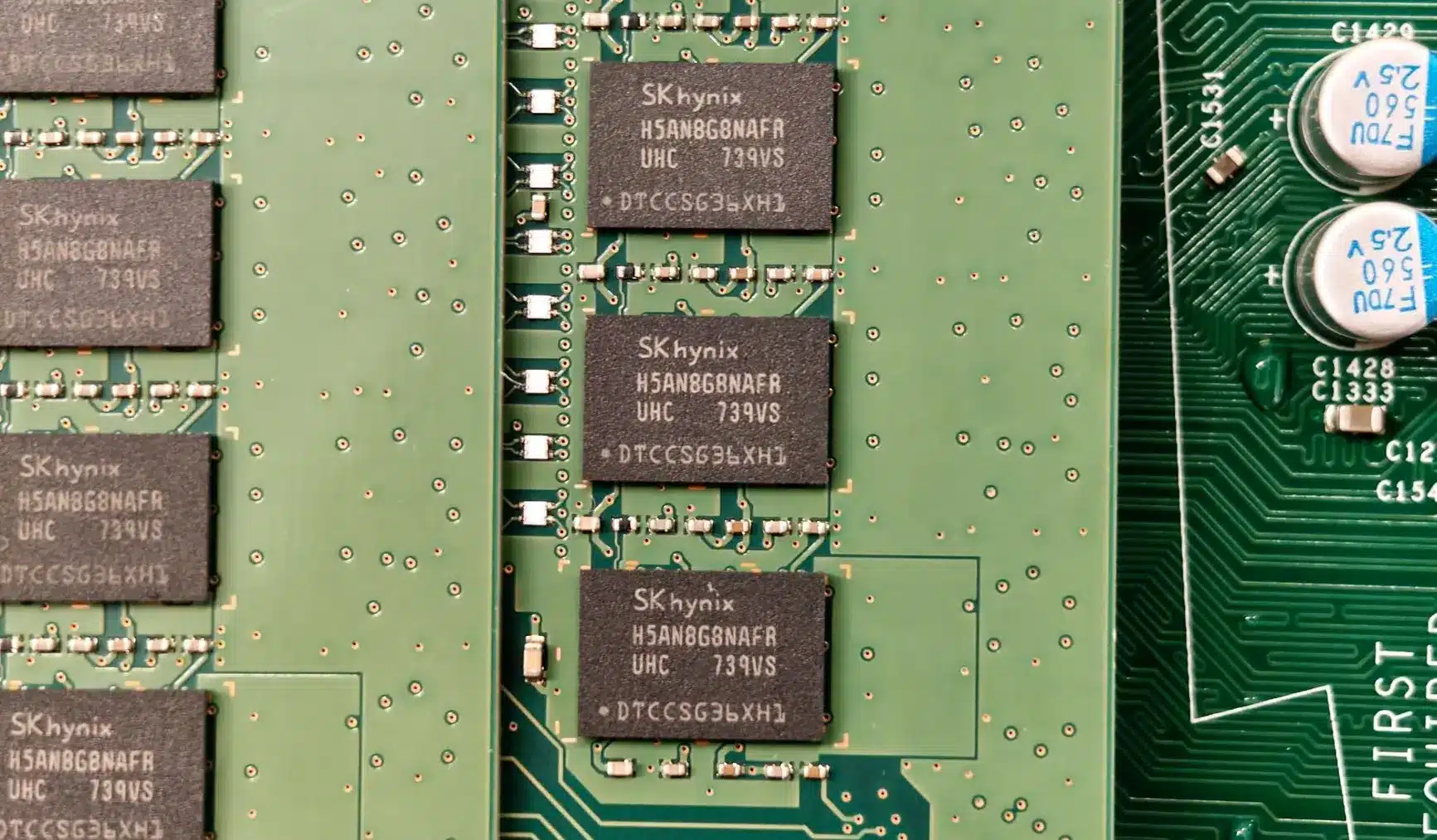
A plain memory chip that sat in nearly every laptop sold a year ago now costs more than double what it did last fall.
No new feature explains the jump.
The chip itself has not changed.
What changed is who gets to buy it first.
Three companies make almost all of the world’s advanced memory, and all three have quietly stopped treating ordinary computers as the customer that matters most.
Why a plain chip suddenly costs so much more
The mechanism is simple and it has nothing to do with scarcity of raw silicon. Every memory factory has a fixed amount of wafer space, and artificial intelligence accelerators now need a very different kind of chip carved from that same space: high bandwidth memory, or HBM, the stacked memory that sits directly next to AI processors.
HBM is far more wafer intensive than the memory inside a laptop. Recent reporting cites a Micron executive saying HBM production for AI accelerators consumes approximately three times the wafer capacity of standard DRAM per gigabyte , because of the extra stacking and bonding steps involved. That means every slab of capacity a factory redirects toward AI memory removes roughly three times that amount from the pool that would have gone into PCs, phones and game consoles.
So when demand for AI memory exploded, manufacturers did not need to lie or ration on purpose. The disequilibrium stems from manufacturers’ reallocation of production capacity toward high-bandwidth memory for AI data centers, which commands higher margins than conventional DRAM , and the supply left over for everyone else shrank on its own. That is the entire shift in one sentence: a reallocation, not a true shortage of raw material.
What that reallocation looks like on a factory floor and a store shelf
Picture a fabrication plant that used to split its output fairly evenly between server memory and the commodity chips that go into a $700 laptop. Today that same plant is running lines increasingly dedicated to HBM destined for AI server racks, because an AI accelerator maker will sign a multiyear contract at a price a laptop brand simply cannot match.
That pressure has already reached consumer shelves. The average price of 8-gigabit DDR4 DRAM used in PCs rose 5.77% to $27.50 in October from $26 in September, according to market research firm DRAMeXchange, marking the 19th consecutive monthly gain.
And it is not slowing by much. Pricing trackers report that TrendForce forecasts conventional DRAM contract prices up 10% to 15% in Q4 2026 , even as the pace of increase moderates from the much steeper jumps seen earlier in the year, when TrendForce first forecast conventional DRAM contract prices up 55-60% quarter on quarter for Q1 2026, then revised that to 90-95% .
The numbers behind the squeeze, and who is cashing in
The scale of this year’s run is what separates it from past memory cycles. Analysis published by Deloitte found that costs for AI server dynamic random-access memory roughly doubled during the first quarter of 2026, with an expected fourfold increase for the full year .
Those gains flowed straight to the three companies that dominate the market. SK Hynix reported during its October earnings call that its HBM, DRAM, and NAND capacity is “essentially sold out” for 2026 , much of it already committed to meeting demand from Nvidia for AI accelerators, while Micron has confirmed its entire 2026 HBM capacity is fully committed through fixed-price contracts and is scaling production for next-generation AI platforms.
Samsung has moved the same direction. By the second quarter of 2026 its HBM market share had climbed to 33%, up from 21% in the first quarter , a jump that shows how fast a company can gain ground once it commits fab space to the highest paying buyer.
None of that happened by accident. Forecasts tracked across the year show contract DRAM prices rising in waves, including a first quarter stretch when TrendForce revised its Q1 2026 forecast for conventional DRAM contract prices from 55-60% to 90-95% quarter on quarter , a pace the firm itself treated as unusual even by the standards of past memory cycles.
Where the shift still runs into limits
Even so, this is not a story where every buyer loses equally. Hyperscale cloud companies that sign long term supply contracts, the kind discussed in recent GPU network deals, lock in volume years ahead and absorb price swings far better than a laptop brand buying on the spot market.
Smaller device makers face the sharpest squeeze, and their profit margins run thin, too thin to quietly eat a doubled or tripled memory bill, which is why industry reporting increasingly points to visible price increases or trimmed specifications on entry level laptops and phones rather than quiet absorption.
Because new fabrication capacity takes years to build, this imbalance will not correct itself quickly. Deloitte does not expect meaningful new fabrication capacity to come online until 2029 or 2030, since memory fabs take years to plan, permit and build , and a reader comparing laptop prices today is comparing them against a memory market that has not yet found its ceiling.
What it means for anyone buying a computer next
For ordinary shoppers, the practical effect is a visible markup on machines that otherwise look unchanged from last year. The same processor, the same screen, and the same chassis now carry a heavier memory bill built into the sticker price.
That is also reshaping buying habits further up the chain. Enterprise buyers managing fleets of machines, similar to the kind of software tracked in recent office laptop reporting, are increasingly negotiating memory configurations months ahead rather than ordering on demand.
The upside, such as it is, belongs to the three memory makers themselves, whose earnings have climbed alongside the shortage they are managing. For everyone else, the lesson of this year’s memory market is less about a single company’s strategy and more about how thoroughly one technology trend can reach into the price of something as mundane as a laptop.
Whether that squeeze eases next year likely depends on how quickly new fabrication capacity comes online, and on that question, the companies involved have so far offered caution rather than relief.
