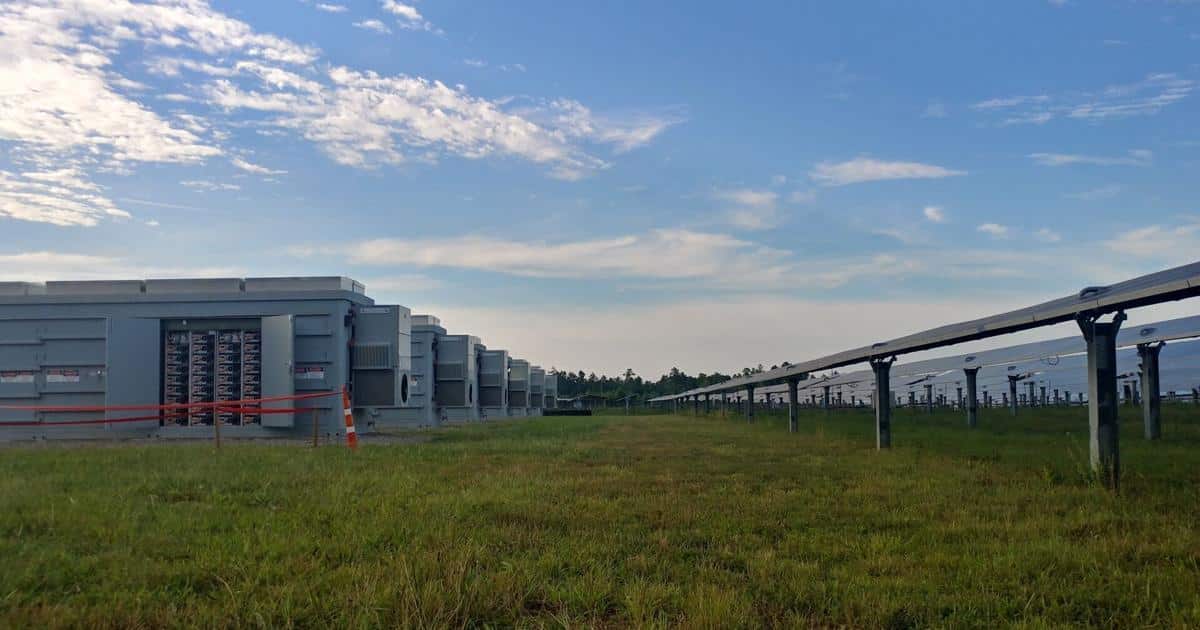
A row of steel cabinets hums quietly behind a chain link fence outside a Texas substation.
Inside each one sit thousands of lithium cells, stacked and wired to soak up extra power and release it hours later. No flame, no spinning turbine, just a switch flipping back and forth thousands of times a day. Engineers call this the fastest growing slice of the American grid, and this year it crossed a threshold nobody had reached before. The question is what actually let it happen so fast.
How a battery farm turns a surplus into a payday
The mechanism is simpler than most people assume. A grid battery is really just a very large, very fast switch sitting between the power lines and a wall of cells, and it earns money by exploiting a gap in price that exists almost every single day.
So when solar floods the middle of the afternoon and electricity gets cheap or even free, the battery charges. Then, once the sun drops and demand climbs into the evening peak, it discharges that stored power back onto the grid at a much higher price. Solar photovoltaic and storage facilities enable operators to store power when wholesale electricity prices are low and discharge electricity when prices are high, allowing power producers to capture larger profits. That spread, cheap afternoon power sold back expensive at night, is the entire business model.
Because batteries can flip from charging to discharging in a fraction of a second, they also get paid for a second job: steadying the grid’s frequency instant by instant. A gas plant needs minutes to ramp up. A battery needs almost none, which is why grid operators increasingly call on them first.
That combination, cheap arbitrage plus instant response, is what pulled in the money. Falling cell prices made the hardware cheaper every year, while wholesale price swings from solar’s daytime glut made the arbitrage trade more profitable than it had ever been.
Inside the buildout racing across Texas, California and Arizona
Walk the length of one of these sites and the scale becomes obvious fast. A single utility scale project can now cover dozens of acres with rows of cabinets instead of a handful of buildings, each row wired into a shared inverter station that feeds straight into the transmission network.
Texas has become the center of gravity for this buildout. Texas alone accounts for 53 percent of planned 2026 battery storage capacity additions, with California following at 14 percent and Arizona at 13 percent. That is a level of concentration rarely seen in any other part of the power business.
Even so, the story is not only about Texas. California’s grid operator has leaned on paired solar and batteries to flatten its evening demand spikes, while newer projects across the Midwest and Southeast are starting to copy the same playbook on a smaller scale.
Which is why developers keep describing this moment the same way: batteries have gone from a side project bolted onto solar farms to a stand-alone asset class that utilities plan around years in advance.
What the federal numbers actually show
The hardest evidence comes straight from the agency that tracks every power plant in the country. By the end of 2025, the U.S. power system had operational battery storage capacity of 43.6 gigawatts (GW).
During the first six months of 2026, operators added another 8.3 GW of battery storage capacity, reaching nearly 52 GW of nameplate battery storage capacity, based on EIA’s latest Preliminary Monthly Electric Generator Inventory. That marks the first time the national fleet has ever crossed the 50 gigawatt line. And the pace behind it is just as striking as the total itself.
According to the federal energy data, utility-scale battery storage capacity in the United States grew at an average annual rate of 70% over the last three years, driven by rapid utility-scale solar deployment and wholesale price arbitrage . Few other pieces of grid hardware have ever compounded that fast for that long.
Developers are not slowing down either. Operators anticipate bringing an additional 54 GW of battery storage capacity online over the next two and half years, according to plans they report to us. Plans for additional capacity coming online in the second half of this year total 14 GW. If even most of that lands on schedule, the fleet could nearly triple from where it stood at the start of last year.
Where the growth still runs into real limits
None of that means every project sails through without friction. Interconnection queues, the waiting line projects sit in before they can actually plug into the grid, remain badly backed up nationwide.
And thousands of gigawatts of proposed storage are still stuck waiting for approval despite recent federal reform efforts.
Tax policy has shifted underneath developers too. New supply-chain restrictions tied to foreign content rules took effect at the start of this year, meaning battery energy storage projects beginning construction in 2026, at least 55% of project costs must come from non-FEOC sources to qualify for federal credits.
That is reshaping which projects actually get built where, and on what timeline. Some developers are rushing financing through before stricter rules bite, while others are redesigning supply chains to keep sourcing components that still qualify.
Even the arbitrage math that makes batteries profitable has a ceiling. As more batteries pile into the same market chasing the same price gap, that spread naturally narrows, and some analysts warn a few regional markets could eventually see more storage than demand can profitably support.
What the milestone means for the grid ahead
Even with those limits, the 50 gigawatt mark is not a finish line so much as a proof of concept. It shows that a technology dismissed a decade ago as too expensive for grid-scale use has become one utilities now build around rather than bolt onto afterward.
So the practical effect shows up on ordinary bills and ordinary evenings. Fewer gas peaker plants need to fire up during the worst hours of summer demand.
Meanwhile, fast-reacting storage fleets have already started blunting the price spikes that once hit grids during extreme weather.
That shift will not happen overnight everywhere, and some regions will feel it years before others. But the federal data now shows a fleet that did not just grow, it crossed a real threshold, and the next one is already being built.
