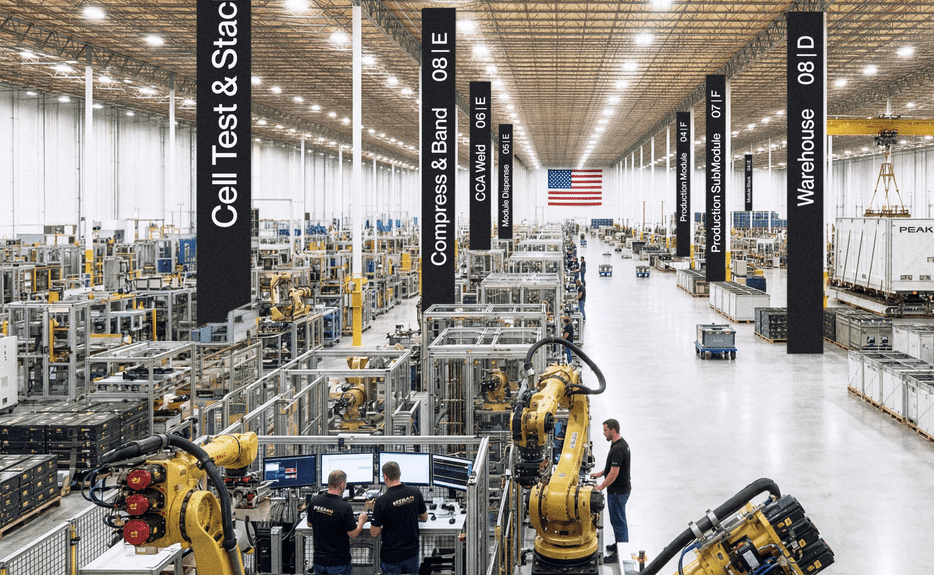
Peak Energy, a Burlingame, California based grid storage developer, said it expanded its Series B financing round to $157 million to accelerate construction of what it calls the first US factory dedicated to grid scale sodium-ion batteries.
The company announced the upsized round on November 24, building on a previously disclosed $108 million raise from October.
What the new funding covers
Peak Energy said the expanded round comprises $132 million in equity financing and a $25 million debt facility from HSBC . The additional capital is earmarked for scaling manufacturing at a planned assembly plant in Sacramento, California, where Peak Energy intends to build containerized battery systems using sodium-ion cells rather than the lithium iron phosphate chemistry that dominates today’s grid storage market.
The company has said its sodium-ion platform can reduce energy storage costs by 20% compared with conventional systems while delivering more than 99% uptime , and is designed to begin shipments in the first quarter of 2027.
Founded in 2023, Peak Energy is led by co-founder and CEO Landon Mossburg, and the company says its team includes professionals with previous experience at Tesla, Enovix, and Fluence .
A $71 million facility in Sacramento will create 239 jobs and support 6 GWh of customer commitments , including an agreement with Jupiter Power and a cell codevelopment partnership with General Motors in which the sodium-ion cell will be developed in General Motors’ Michigan battery labs, where GM will retain exclusive manufacturing rights .
Why sodium-ion is gaining ground
Sodium-ion technology has moved from a laboratory curiosity toward commercial deployment this year as developers look for alternatives to lithium-based cells. A recent Wood Mackenzie analysis found sodium-ion batteries are approaching cell-level cost parity with LFP technology, with supply agreements exceeding 70 GWh worldwide.
The same research noted that in the United States, tariffs of approximately 58% on energy storage cells imported from China, combined with production tax credits under Section 45X of the Inflation Reduction Act, are encouraging domestic sodium-ion battery manufacturing .
Analysts still caution that the chemistry remains unproven at scale for stationary storage. Wood Mackenzie’s study found that for energy storage projects currently under development, LFP remains the most commercially mature option for storage durations of two to four hours , meaning regional supply-chain and trade barriers present near-term headwinds to sodium-ion deployment at scale.
That means sodium-ion developers like Peak Energy must demonstrate reliability before winning broader utility confidence.
Sacramento plant details
Peak Energy selected the Sacramento area for its factory after a nationwide site search, settling on a location within the Metro Air Park.
Earlier reporting on the site selection described a 183,000 square foot facility capable of producing 4 gigawatt hours of battery systems annually, enough to power 4 million homes once fully ramped , and supported by a $10.5 million CalCompetes tax credit, which was awarded in May 2026 .
The plant is designed as a system assembly operation rather than a cell fabrication site, meaning Peak Energy will receive finished sodium-ion cells from overseas suppliers and integrate them into large containerized storage units for grid operators and data center customers.
Why it matters for the grid
The expanded funding round arrives as US grid operators face rising demand from data centers and electrification, pushing developers to diversify beyond lithium-ion chemistries that depend heavily on Chinese supply chains.
Sodium is significantly more abundant than lithium, and backers of the technology argue it could ease a bottleneck that has slowed storage deployment nationwide, a trend GCN has tracked as battery storage capacity continues climbing toward federal targets.
Grid-scale sodium-ion remains a small fraction of the broader storage market today, and Peak Energy’s Sacramento plant has yet to ship a single commercial unit.
Whether the newly expanded financing translates into on-schedule production in 2027 will serve as an early test of whether sodium-ion can scale commercially the way other emerging battery makers have attracted investor interest this year.
