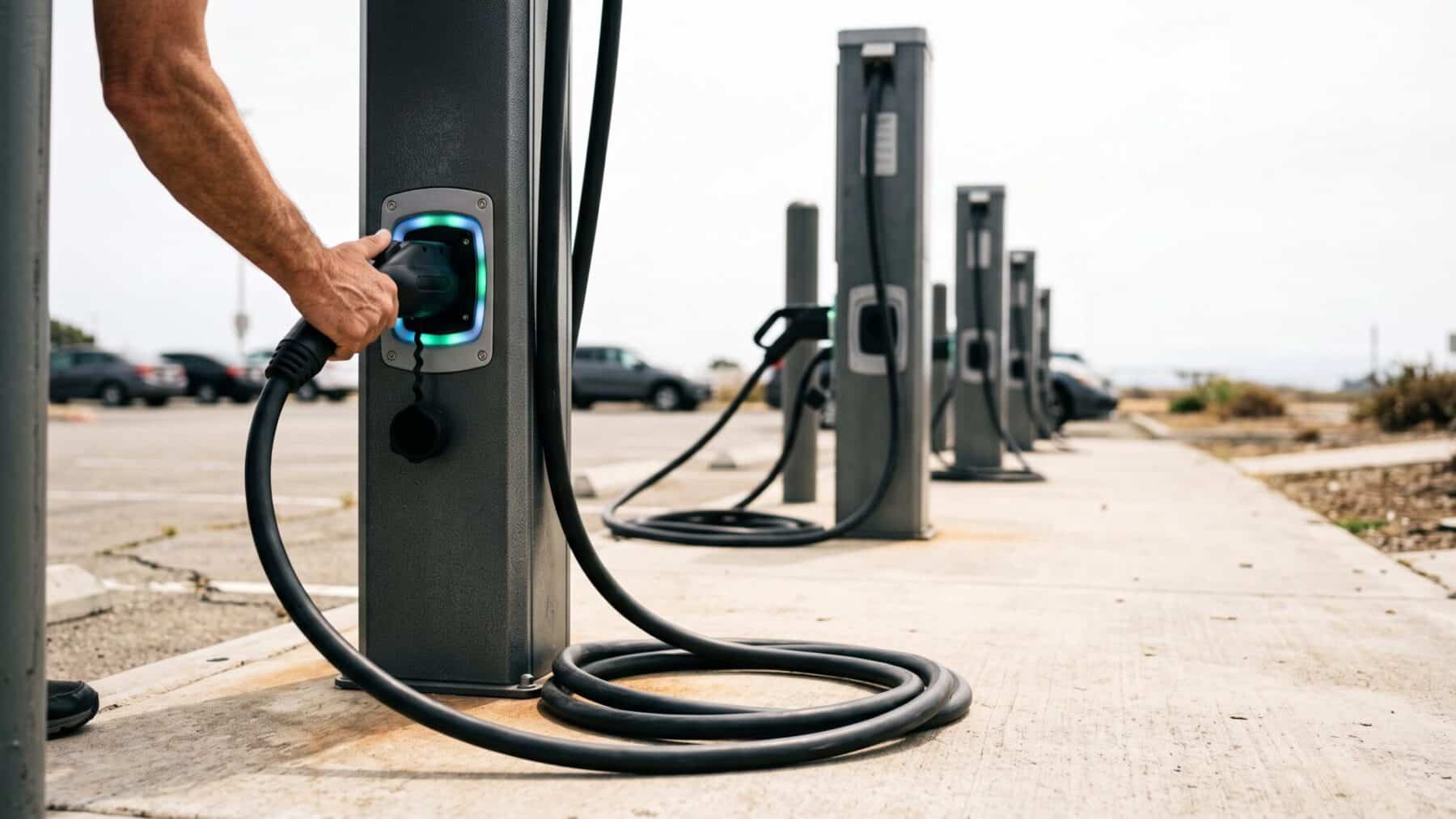
A single afternoon storm rolled through a San Diego fast-charging depot last summer.
Four drivers plugged in at once. The electricity bill that arrived three weeks later was thousands of dollars higher than the month before. The energy used was almost identical. Only the peak minute had changed. That is the demand-charge problem, and it is now splitting the US market in two.
Why one bad minute on the meter can wreck a whole month of revenue
Demand charges work differently from a standard electricity bill. A utility does not simply total up the kilowatt-hours a site consumed; it reads the single highest 15-minute power spike during the billing month and multiplies that peak by a per-kilowatt rate. For most commercial buildings that peak is predictable and flat. For a fast-charging station it is chaotic.
A DC fast charger draws 50 to 150 kilowatts at full power immediately, for the entire session. Two running simultaneously create a spike that is often larger than the entire building load that preceded charger installation. One busy Tuesday afternoon can define the entire month’s bill, even if the station sits idle for the next three weeks.
That math has made demand charges the central threat to fast-charging profitability across the country, pushing California’s regulators into a live experiment in redesigning them entirely.
Three utilities in one state, and three different answers to the same billing problem
California carries roughly 30 percent of all US electric vehicle sales, which means the state’s three dominant investor-owned utilities face the demand-charge problem at a scale no other grid region has matched. Each has landed on a different rate philosophy. That fragmentation is the real story: there is no longer one demand charge to plan around.
One approach goes furthest. Southern California Edison’s commercial EV rates (TOU-EV-7, TOU-EV-8, and TOU-EV-9) are energy-only, with no demand charges at all, until the end of 2029, with charges expected to return January 1, 2030. That gives charging operators more than three years of billing certainty, a window wide enough to build a business case around.
The second approach replaces the per-kilowatt charge with a subscription. PG&E lets a site reserve a block of kilowatt capacity and pay overage penalties for exceeding it. As long as the site stays within its subscribed capacity it pays a flat monthly fee. The bill becomes predictable, but the incentive to manage peaks survives.
San Diego Gas and Electric uses the same subscription logic but has been phasing out EV-specific discounts since 2025, with the discount disappearing completely by January 2032. As of January 2026, the subscription price for loads above 150 kilowatts runs roughly six dollars and sixty cents per kilowatt per month. That is the competitive cost of certainty.
The numbers behind the shift and where the evidence comes from
These are not regulatory proposals. They are published, in-effect rates, and the California Public Utilities Commission summarizes the commercial EV rate landscape across all three utilities, confirming Southern California Edison’s demand-charge-free period and PG&E’s subscription-based alternative.
The behavioral evidence backs the redesign. EV customers on time-of-use rates conduct the large majority of their charging outside on-peak hours, shifting load to overnight periods when spare grid capacity exists. That load pattern spreads costs across more kilowatt-hour sales without proportionally raising peak capacity requirements.
Research into managed charging finds that shifting part of the charging load to off-peak periods can substantially reduce maximum depot power demand. That reduction is the ceiling the new rate structures are trying to reach. For large-load grid connections, federal regulators have separately been pressing operators to justify the capacity they claim, adding another layer of pressure on how stations are sized and billed.
Published CPUC documents describe the goal of the rate redesign as giving charging operators cost certainty without removing the price signal that keeps peaks manageable.
Where the California model breaks down and who it leaves behind
California’s three-way split does not travel. Outside the state, classic per-kilowatt demand charges remain the rule. A charging company that engineers its stations around Southern California Edison’s energy-only billing faces a completely different cost structure the moment it crosses into Nevada, Texas or the Carolinas.
Even inside California the subscription model creates its own exposure. Operators that set their subscription tier too low can find themselves hit with the exact kind of bill shock the new structure was supposed to prevent, if a busy weekend pushes the depot past the reserved block.
Some states are experimenting with a different lever: discounting the demand charge for qualifying EV charging customers rather than restructuring it entirely. Multiple models, multiple markets, and none of them fully portable. The broader rate-hike environment facing US utilities sharpens that calculation further, since every approved base-rate increase lands on top of whatever demand-charge structure an operator is already navigating.
What the market looks like from here and what is still unresolved
The direction of travel is clear even if the destination varies by zip code. Utilities are replacing the traditional per-kilowatt demand charge with subscription tiers, capacity reservations and overage penalties. The incentive to manage peak draw is preserved; the unpredictability of the old bill is reduced.
But the clock is visible for operators in Southern California Edison’s territory. Demand charges return in 2030, and stations built today on a no-demand-charge cost model will need to retrofit battery storage or load-management software before that date to stay profitable.
The EIA’s Annual Energy Outlook projects that overall electricity demand grows significantly through 2050, with EV and data center load accounting for much of that growth. The rate structure utilities choose for charging stations today will shape whether that load arrives at the worst possible moment or spreads evenly across hours the grid can handle.
For now, the operator who understands which billing model governs each site holds a real cost advantage. That knowledge gap, more than the chargers themselves, is where the next round of winners and losers in the fast-charging market will be decided.
