Something unusual happened to America’s power grid last year that most electricity customers never saw on their bills.
Battery storage installations surged to levels the industry had never recorded in a single year, and the money behind that surge traces back to a single provision buried deep in a federal law most Americans associate with inflation, not electricity.
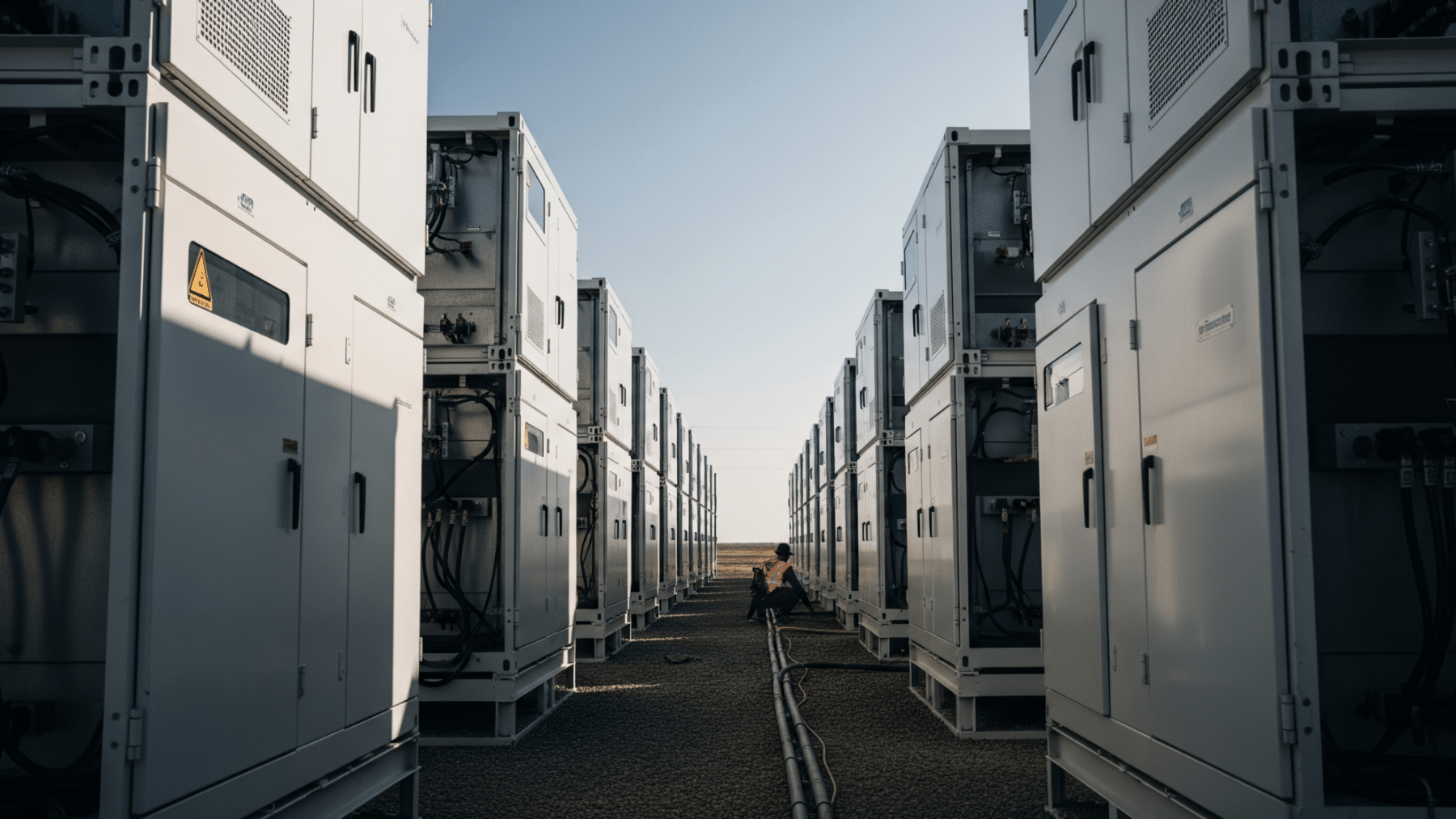
Understanding how that happened means following the money from a Washington conference room to a flat Texas field full of white metal boxes humming at grid frequency.
A number that stopped grid analysts mid-sentence
The U.S. Energy Information Administration tracks every megawatt of new power capacity added to the American grid, and its 2024 data landed with unusual force inside the storage industry.
Grid-scale battery storage additions in the United States hit 10.4 gigawatts for the full year 2024, the second-largest generating capacity addition after solar, a figure that dwarfed anything the sector had previously recorded in a twelve-month period.
That is enough capacity to power millions of homes for hours during a peak evening demand event, the exact window when grid managers have historically had the fewest options.
The year surpassed previous records, highlighting the sector’s rapid expansion, with analysts at research firms describing the pace of growth as outside their prior forecast bands.
What the grid actually looks like when batteries take over for an evening
To understand why the record matters, it helps to picture what a grid operator actually does at 7 p.m. on a hot summer evening.
Solar generation collapses the moment the sun drops below the horizon, and natural gas peaker plants spin up to cover the gap, burning fuel at some of the highest prices of the year.
Battery systems charge during the afternoon solar surplus, then discharge precisely into that evening gap, flattening the price spike and reducing the need for the most expensive gas generation on the system.
California demonstrated this most visibly: throughout the summer of 2024, battery storage reliably discharged to support the grid during the evening net-peak hours, with discharge rising from around 6,000 MW in the spring to more than 8,000 MW by summer, right at the exact hour the grid usually starts straining. California’s grid operator subsequently set a new single-day peak battery discharge record of 8,300 MW after the state surpassed 10,000 MW of installed storage capacity.
That record, and dozens like it in other states, created the commercial proof of concept that accelerated developer pipelines everywhere else on the grid.
Why developers suddenly found the financing far easier to close
Building a large battery project and building a large solar farm look similar from the outside: both involve enormous capital costs, long permitting timelines, and decade-long revenue contracts.
But for most of the last decade, solar and wind developers could claim a federal Investment Tax Credit on their projects from day one, while standalone battery storage could only access that credit if it was physically co-located with a renewable generator and charged from it.
Historically, federal tax credits were only available for storage systems that were paired with renewable energy generation, such as solar power. The IRA extended the eligibility of tax credits to standalone storage systems, which made purely standalone storage projects significantly harder to finance beforehand, because lenders and tax equity investors required the credit to make the numbers work at commercial interest rates.
Developers who wanted to build a battery on its own, at a substation or inside a city, had to structure deals around the gap in a way that solar never faced.
The one sentence in the Inflation Reduction Act that changed the math
When Congress passed the Inflation Reduction Act in August 2022, the most consequential line for the storage industry was not in any of the headline summaries.
The law extended the standalone ITC, making standalone storage systems eligible for a 30 percent investment tax credit for the first time, regardless of whether they were paired with solar or wind.
That single change restructured the entire project finance model for standalone storage overnight.
Tax equity investors, who had previously passed on standalone battery deals, began competing for allocations in projects that had previously struggled to close. Financing timelines shortened. Developer pipelines exploded.
The result is visible in the EIA’s 2024 installation data and in projects like the 1-gigawatt-hour Ohio battery that broke ground next to a corridor of data centers. The project will be the largest battery built to date in the 13-state PJM Interconnection grid and the largest east of the Mississippi River once complete.
Solar had enjoyed its own standalone ITC for decades. Storage waited more than three decades after the first utility-scale batteries were demonstrated before it got the same treatment.
Where the pipeline goes from a record-breaking year
The IRA’s storage credit did not arrive without uncertainty, and developers are watching Congressional budget negotiations closely for any changes to the law’s energy provisions.
But the pipeline already in motion is large enough that capacity growth from battery storage could set a new record in 2025, with operators reporting plans to add 19.6 gigawatts of utility-scale battery storage to the grid, and analysts expect further growth beyond that if interconnection queues move on schedule.
FERC has separately ordered grid operators to overhaul their large-load interconnection rules, a procedural change that storage developers say could meaningfully shorten project timelines in congested markets.
For ordinary electricity customers, the practical effect is more capacity available during the hours when grid stress, and electricity prices, peak most sharply.
The white metal boxes humming in flat fields across Texas, California and Ohio are no longer a niche technology waiting for a tax fix.
They are, after one sentence in a 2022 law, the fastest-growing segment of the American power grid.
