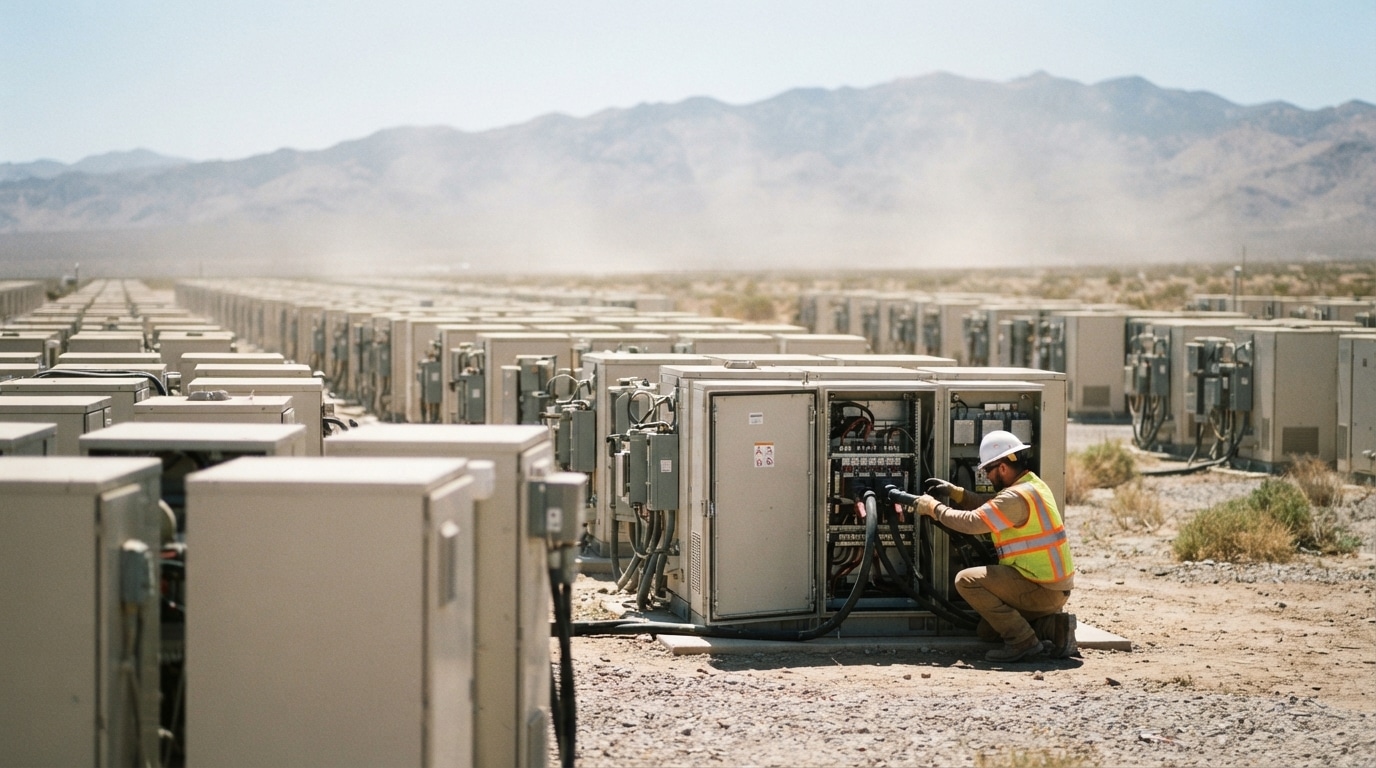
A California battery project is on track to double in size by November, with the additional capacity expected to become operational in November 2026 and, if completed as planned, making it the largest power storage facility in the United States, according to the U.S. Energy Information Administration’s latest analysis of national battery capacity.
AES Corporation’s Bellefield Solar and Energy Storage Farm in Kern County is already one of the country’s most closely watched grid-scale assets, and its second-phase expansion is a focal point in that EIA analysis.
What Bellefield already is
The Bellefield Solar and Energy Storage Farm began operating in December 2025 with 500 MW of solar PV and 500 MW of battery storage.
Located on former agricultural land near California City in Kern County, the first phase unites 500 MW of photovoltaic generation with an equally powerful 500 MW/2,000 MWh lithium-ion battery system, a four-hour storage window that shifts surplus midday solar into the evening demand peak.
The project has a 15-year power purchase agreement (PPA) with Amazon. To assist in construction, AES used Maximo, its AI-enabled robotic system, which the company says improved the safety, speed, and accuracy of solar module installation.
Maximo is a robotic arm that performs solar panel installation in what AES claims is half the time and cost of conventional methods.
Phase two and the national record at stake
Bellefield is a two-phase project, with each phase including 500 MW of solar and 500 MW of four-hour battery-based energy storage, for a total of 2,000 MW of installed capacity. Once completed, the 2,000 MW Bellefield project is expected to be the largest solar-plus-storage facility in the United States.
Once Bellefield is completed, the 2,000 MW project, 1,000 MW solar and 1,000 MW/4,000 MWh BESS, is expected to be the largest solar-plus-storage facility in the US.
More than 700 union jobs were created during the construction of Bellefield 1, and approximately 1,000 union jobs are expected to be created at the peak of construction of Bellefield 2.
AES has disclosed that it is contracting with US or South Korean suppliers for approximately 80 percent of its 2026 and 2027 battery needs, and the company disclosed that it had imported all the batteries required for its projects coming online in 2025.
Context: US storage at a record 52 GW
The Bellefield expansion comes as the EIA’s latest report shows national battery storage hitting a new milestone. During the first six months of 2026, operators added 8.3 GW of battery storage capacity, reaching nearly 52 GW of nameplate battery storage capacity, based on the agency’s Preliminary Monthly Electric Generator Inventory.
That pace of growth, tracked by GCN when the EIA projected nearly 65 GW by year-end, reflects an industry expanding faster than almost any other power sector.
Operators anticipate bringing an additional 54 GW of battery storage capacity online over the next two and a half years. Plans for the second half of this year total 14 GW, followed by 26 GW in 2027 and 14 GW in 2028.
The national buildout is being shaped by other large facilities as well. Florida’s Manatee Energy Storage Center, completed in December 2021, combines a 74.5 MW solar facility with 409 MW of battery storage and currently ranks as the second-largest battery storage project in the country.
Nevada’s Gemini Solar Hybrid facility, operational since 2024, integrates 690 MW of photovoltaic capacity with a 380 MW battery storage system. Bellefield’s combined 1,000 MW of storage, once phase two is complete, would surpass both facilities on the storage measure alone.
Supply chain and broader market forces
Utility-scale battery storage capacity in the United States grew at an average annual rate of 70 percent over the last three years, driven by rapid utility-scale solar deployment and wholesale price arbitrage.
Lithium-iron phosphate batteries now account for the majority of utility-scale deployments. While less energy-dense than rival chemistries, LFP batteries are typically cheaper and better suited to more frequent cycling.
For Bellefield specifically, cost and schedule risk has been a live concern since US tariffs raised battery equipment prices. AES’s decision to pre-import battery hardware and lock in supply contracts is directly relevant to whether the November completion target holds.
If the second phase comes online on schedule, Bellefield will set a new US benchmark: 1 GW of dedicated battery storage, at a moment when the country’s grid is absorbing new storage at a rate never previously recorded. That record trajectory is also visible in the GCN report on 8.3 GW of new batteries landing on the grid in the first half of 2026.
Construction on Bellefield 2 is on track to be completed in 2026, and construction progress will be the key variable to watch in the months ahead.
