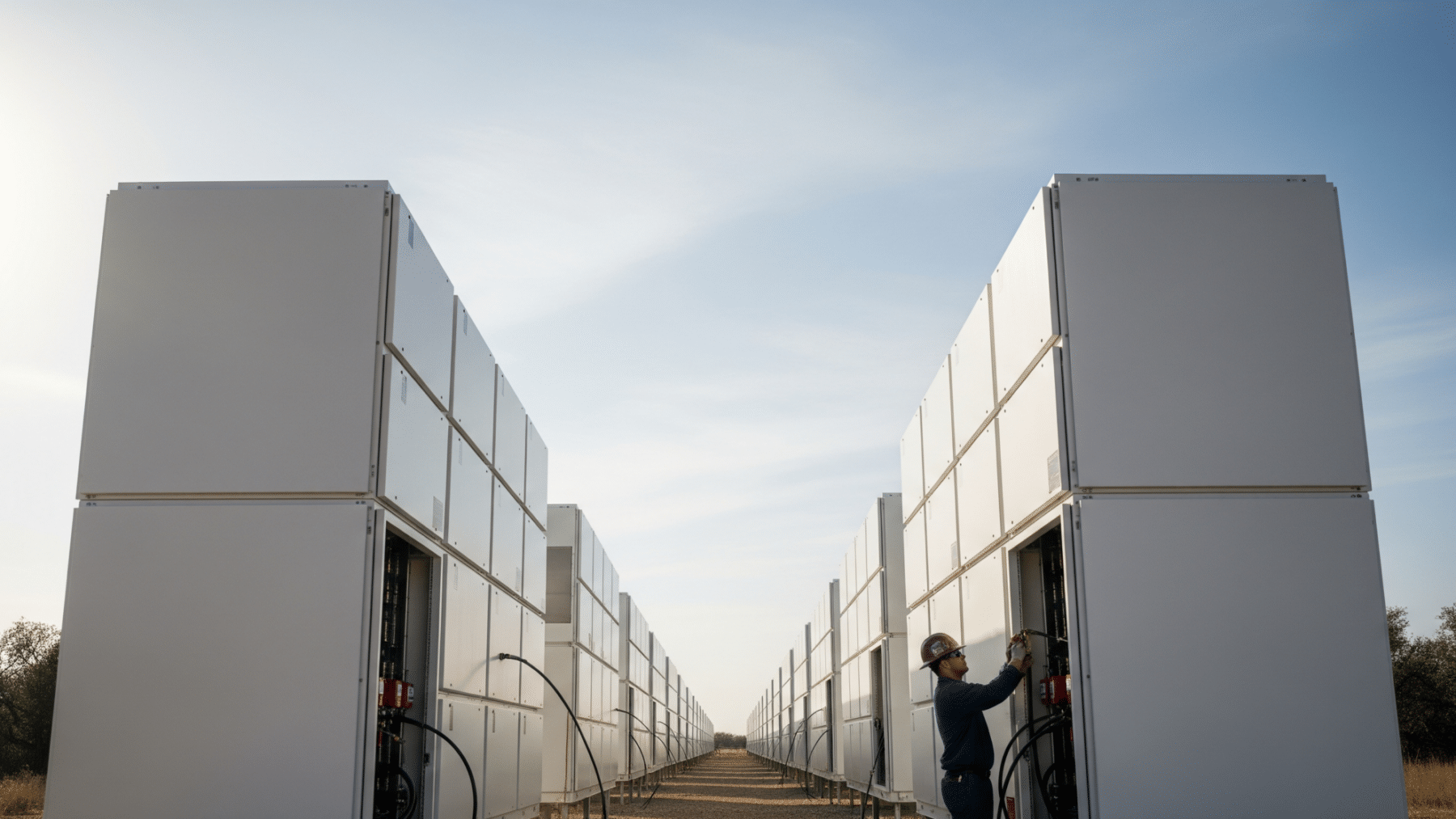
The United States is on track for its biggest year ever in battery storage construction, with developers planning to add 24 gigawatts of utility-scale capacity to the grid in 2026. That ambition is now running directly into a new federal law that ties billions of dollars in tax credits to where battery components are made, and much of the global supply chain does not yet qualify.
A record build on paper
Developers plan to add 24 gigawatts of utility-scale battery storage to the U.S. grid this year, up from a record 15 gigawatts added in 2025, according to the Energy Information Administration’s February 2026 analysis based on its Preliminary Monthly Electric Generator Inventory. U.S. battery storage capacity has grown rapidly over the past five years, exceeding 40 gigawatts total. The planned 2026 additions would represent a roughly 60 percent year-over-year increase in a sector that has already grown sharply for several consecutive years.
Battery storage accounts for 28 percent of all planned 2026 utility-scale capacity additions, second only to solar power at 51 percent, according to the EIA’s Preliminary Monthly Electric Generator Inventory.
About 80 percent of planned 2026 battery additions are concentrated in three states: Texas at 53 percent, California at 14 percent, and Arizona at 13 percent. Based on the 24-gigawatt planned total, those shares translate to approximately 12.9 gigawatts for Texas, 3.4 gigawatts for California, and 3.2 gigawatts for Arizona. Texas’s dominance reflects the rapid pairing of storage with the state’s fast-expanding solar base.
The largest solar project expected to come online this year, Tehuacana Creek 1 Solar and BESS in Texas at 837 megawatts, will also carry an additional 418 megawatts of battery energy storage capacity.
Supply-chain rules reshape the economics
The record construction pipeline is taking shape at the same moment a sweeping new federal law is rewriting the rules on who can claim the tax incentives that make most large projects financeable.
The One Big Beautiful Bill Act, enacted on July 4, 2025, introduced new foreign-entity-of-concern restrictions on investment tax credits and advanced-manufacturing production tax credits for energy storage projects, even as it spared battery storage from the accelerated sunsetting applied to wind and solar generation.
For storage projects beginning construction in 2026, at least 55 percent of a project’s costs must originate from non-prohibited foreign entities to qualify for the investment tax credit. That threshold rises to 75 percent for projects beginning construction in 2030 and after. Under those provisions, companies with ties to China, Russia, North Korea, or Iran can be classified as prohibited foreign entities.
The battery energy storage industry is especially sensitive to these restrictions given the longstanding domination of the battery supply chain by now-restricted producers.
The law also includes a recapture provision allowing the government to claw back the investment tax credit if certain payments are made to a prohibited foreign entity after a project is placed in service. Treasury and IRS guidance has begun addressing key provisions, but interpretive questions remain.
This kind of policy-driven cost uncertainty is also adding pressure to retail electricity markets. As GCN has reported, grid tariff structures and rate cases are already shifting infrastructure costs onto customers across most of the country.
Demand driving the build regardless
Relative certainty around tax policy for battery storage and demand from large load customers are among factors driving the country’s energy storage boom, according to analysts tracking the sector. Data centers and industrial facilities seeking firm, on-site power backstops have emerged as a particularly strong source of new procurement contracts.
FEOC-compliant battery storage projects retain access to investment tax credits through 2033, giving developers a substantial runway if they can secure qualifying supply chains. Projects that commence construction after 2026 are subject to the new FEOC percentage requirements. Domestic manufacturing capacity has expanded in recent years, though sourcing cells and critical minerals from non-restricted suppliers remains the central operational challenge.
The scale of the grid transformation underway has already drawn regulatory scrutiny at the federal level. The compounding pressure of large new loads and storage resources on transmission infrastructure prompted FERC to order all six U.S. grid operators to justify or overhaul their large-load interconnection rules.
What comes next
The U.S. electric grid is on track for a record-breaking year as developers plan to add 86 gigawatts of new utility-scale capacity in 2026, according to the EIA’s Preliminary Monthly Electric Generator Inventory. The policy question hanging over the second half of 2026 is how many projects in the pipeline can demonstrate the supply-chain compliance needed to capture the federal credits that underpin their financing.
Developers that locked in qualifying battery supply agreements before mid-year are best positioned. Those still negotiating equipment contracts face tighter timelines and higher landed costs as tariffs on imported battery components remain elevated.
