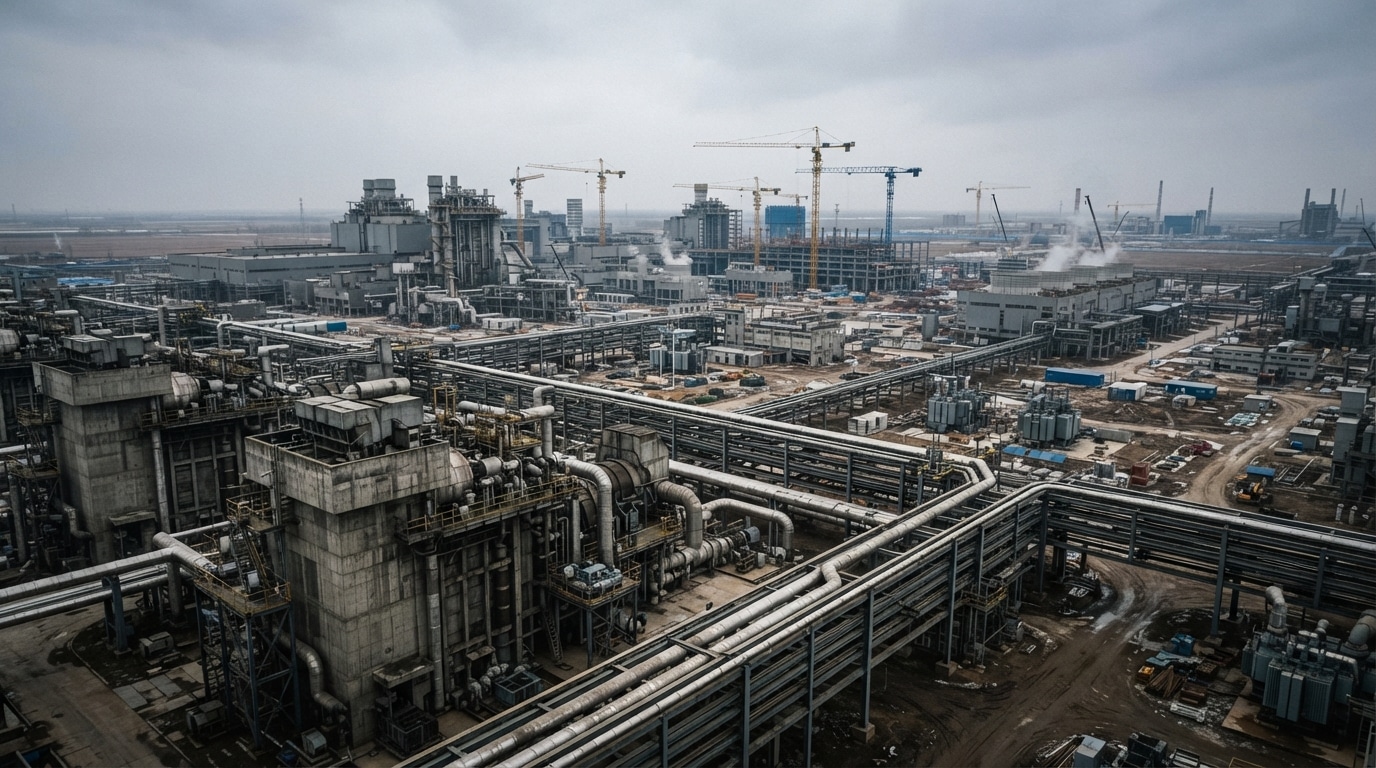
Miles of salt left behind by an ancient sea sit nearly a mile beneath the farmland of eastern China.
For decades, brine pumped through wells dissolved those deposits and left behind hollow chambers the size of cathedrals. Engineers then repurposed those abandoned voids for something the salt mine’s original operators never imagined: filling them with air.
The result, fully commissioned in early 2026, became the largest compressed-air facility on earth. What makes a system like this actually work at grid scale?
How pressurized air turns an empty cavern into a power plant
The system works by compressing air and injecting it into underground salt caverns during periods of low demand, typically at night, then releasing that stored air during peak hours to drive turbines and generate electricity. The principle is old enough to be taught in high school physics. The engineering challenge was always doing it at a scale that could actually move a grid needle.
The Huai’an plant uses non-supplementary combustion high-temperature adiabatic compression, based on molten salt and pressurized thermal water, reaching roughly 71% conversion efficiency, according to Harbin Electric, the project’s primary equipment supplier. Earlier compressed-air plants burned natural gas to reheat the air before it entered the turbines, which meant they were never truly fuel-free. This plant burns nothing.
Heat generated during the compression stroke is captured in molten-salt tanks, stored, and returned to the air stream on the way back out. That closed thermal loop is what separates this generation of compressed-air storage from anything built before it.
The caverns themselves: hollow chambers adapted from a salt mine nearly a mile down
The project features two 300 MW units utilizing roughly 980,000 cubic meters of salt caverns located 1,150 to 1,500 meters underground. That depth matters because pressure increases with depth, meaning more air molecules can be packed into a given volume of rock, raising the energy density of the whole system without adding a single square meter of surface footprint.
Salt is the preferred host rock for this technology for a reason engineers call creep-sealing. Salt formations flow slowly under geological pressure, so tiny cracks and fractures close over time rather than widening. A cavern carved into salt is, in a meaningful sense, self-repairing.
The first 300 MW unit reached full-load operation in December 2025. Unit 2 then achieved grid connection at the first attempt in late January 2026. Running the two units in sequence let engineers validate each machine independently before committing the full cavern system to commercial dispatch.
The numbers behind the record and what they cost
With 600 MW of installed capacity and 2,400 MWh of storage, the Huai’an Salt Cavern project is now the world’s largest compressed-air energy storage facility, surpassing a 300 MW plant in Hubei province that had held the record since January 2025. The gap between the two record-holders signals how fast this corner of the storage industry is moving.
The project cost approximately $520 million and is expected to generate 792 GWh of electricity per year, roughly equivalent to the consumption of around 70,000 American homes. Shanghai Electric confirmed in its press release that the plant was fully commissioned with both units delivering full-load power generation at the first attempt.
For a storage plant, a machine that produces no net new electricity but reshapes when existing power is available, that annual throughput is a striking figure. As global storage shipments nearly doubled in the first half of this year, the Huai’an record underscores a parallel trend: not every breakthrough in storage is a lithium-ion story.
Where the technology hits its limits
A 71% round-trip efficiency sounds impressive in isolation. But the most advanced lithium-ion grid batteries regularly post efficiencies above 90%, meaning that for every 100 units of electricity pushed in, roughly 90 come back out. Compressed-air systems lose more in the thermal and mechanical conversion steps, and even the molten-salt heat recovery at Huai’an does not close that gap entirely.
Geography is the other hard constraint. Salt caverns of the right depth, volume, and impermeability do not exist everywhere. The United States has promising geology along the Gulf Coast, in parts of the Midwest, and in Kern County, California, where a federally backed 500 MW project has received a conditional loan commitment from the Department of Energy. But siting a plant where the salt is may not align with where the grid needs storage most.
Huai’an’s lead may already be short-lived. A 700 MW project in Sanmenxia’s Shanzhou district is already in development, with nearly twice the energy storage capacity of the current record-holder.
What this record means for the longer race in grid-scale storage
The Huai’an plant fills a specific gap that lithium-ion batteries are not yet positioned to fill: long-duration discharge measured in hours rather than minutes. Where a standard four-hour battery project runs flat by the dinner-hour peak, a cavern full of compressed air can keep turbines spinning across a full overnight window.
That asymmetry matters most during multi-day heat waves or wind droughts, when solar and wind both underperform simultaneously. As the US grid absorbs its own storage surge, after 8.3 gigawatts of new batteries landed on the US grid in a single half-year, planners are beginning to ask what backs up the batteries. Compressed air in deep salt does not require the lithium, the cobalt, or the cell manufacturing pipeline that dominates current supply-chain debates.
Every cavern must still be individually mapped, prepared, and tested before a single compressor runs, and permitting timelines run longer than for surface battery installations. Even so, BloombergNEF data shows compressed-air storage is among the least expensive long-duration storage options for discharge durations beyond eight hours. The world’s largest just proved the machine works. The question now is how many geologies will let others build one.
