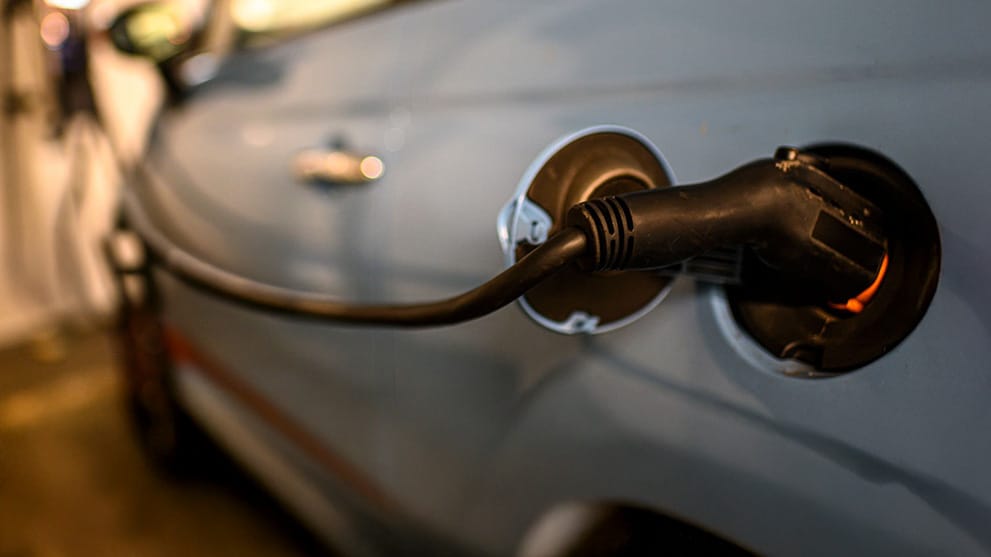
A driveway in Northern California holds something most neighbors cannot see.
A parked electric truck is quietly sending power back into the house instead of just taking it from the wall.
The charger hums low, almost unnoticeable.
Inside, the lights stay on during a blackout drill without a generator ever starting.
Multiply that single driveway by only fifty more across an entire state, and you have the real scale of one of the most ambitious grid experiments running today.
So how does one parked car end up acting like a backup battery for an entire house?
How a car becomes a backup battery for the whole house
The mechanism is simpler than it sounds. A bidirectional charger swaps the one-way flow of a normal home charging box for a two-way path, letting electricity move from the grid into the car’s battery and then back out again when needed. Software built into the charger and the vehicle decides when to pull power in and when to push it back out.
So instead of sitting idle most of its life, the battery becomes a second, mobile power source the house or the grid can call on. That only works if the charger, the car’s electronics and the utility’s control software all agree to talk to each other.
Because every automaker built its own system, a charger that works with one electric truck can refuse to recognize a different sedan. That incompatibility problem is one of the main reasons this technology has crawled instead of sprinted toward ordinary driveways: despite initially high expectations, the V2X pilots have proven difficult to get off the ground, with early deployment delayed by a persistent lack of commercially available, certified bidirectional vehicles and compatible electric vehicle supply equipment .
Inside the pilot that is slowly adding cars and brands
Pacific Gas and Electric runs the largest residential version of this idea in the country, a Vehicle-to-Everything pilot that seeks to study new ways for residential customers to turn their electric vehicles into mobile backup batteries and grid assets . The utility recently added electric vehicle supply equipment from dcbel and Wallbox to its V2X pilot program, which offers up to $4,500 in incentives to homeowners who enroll with an eligible vehicle/charger combination .
That expansion matters because the vehicle list used to be short. Vehicles compatible with the new solutions include the Nissan Leaf, Volvo EX90, and Polestar 3 when paired with the dcbel Ara charger, as well as the Kia EV9 and Kia EV6 paired with the Wallbox Quasar 2 charger , alongside the American pickup trucks and SUVs that dominated earlier bidirectional pilots.
Even so, the household incentive is the real headline. PG&E offers cash incentives up front for installing eligible equipment, including $2,500 upfront ($3,000 for customers in disadvantaged communities) , a far larger carrot than most states offer for any single home energy upgrade tied to an electric vehicle.
The growth number that shows how slow this market really moves
Here is where the hard evidence gets interesting. As of PG&E’s mid-term regulatory reporting in September 2025, the residential V2X pilot had signed up just three residential customers, none of whom had systems interconnected with the utility’s grid . Paperwork had outpaced hardware by a wide margin.
Ten months later, the picture had shifted but not transformed.
A spokesperson from PG&E shared with pv magazine USA that the utility had 51 V2X pilot program customers interconnected to the grid as of July 2026 , up from zero interconnected the year before. That is real growth, but it is measured in dozens against a state with well over a million registered electric vehicles.
So the pilot is proof of concept rather than proof of scale. PG&E’s next regulatory update on the program was expected around the end of September 2026, and future filings should show whether hookups are finally accelerating.
Where the bottleneck actually sits, and why it is not the car
None of this slow growth comes from a lack of demand for backup power. California households have lived through repeated wildfire driven outages, and a car that can run a refrigerator and lights for days is a genuinely attractive pitch to anyone who has lost power before.
Instead, the friction sits in installation. Bidirectional chargers require an electrician, a compatible panel, and often a transfer switch, work that can take weeks and cost thousands of dollars even after the rebate.
That installation bottleneck is the same one slowing managed charging programs more broadly, the kind utilities are testing as they try to shift EV load off peak hours through software rather than hardware swaps.
Grid demand from electric vehicles is also growing slower than it once did. Electric cars drew nearly 14 billion kilowatt-hours in the first half of this year, and that was well below the 13% to 24% growth rates reported in recent years , giving utilities more room to get the technology right before scaling it.
What a slow pilot still proves about the road ahead
None of this means bidirectional charging is failing. A jump from zero interconnected customers to fifty one over ten months is the kind of early growth curve that often precedes faster growth once installation gets simpler and cheaper.
That is why the expanded vehicle list matters more than the incentive dollar figure. Every automaker added removes one more reason a household says no.
Even so, the honest read on the numbers is patience. Fifty one homes do not reshape a grid, but they generate the real-world data utilities need before asking regulators to fund this at real scale. The next regulatory update, expected this fall, should tell whether that curve is finally bending upward.
