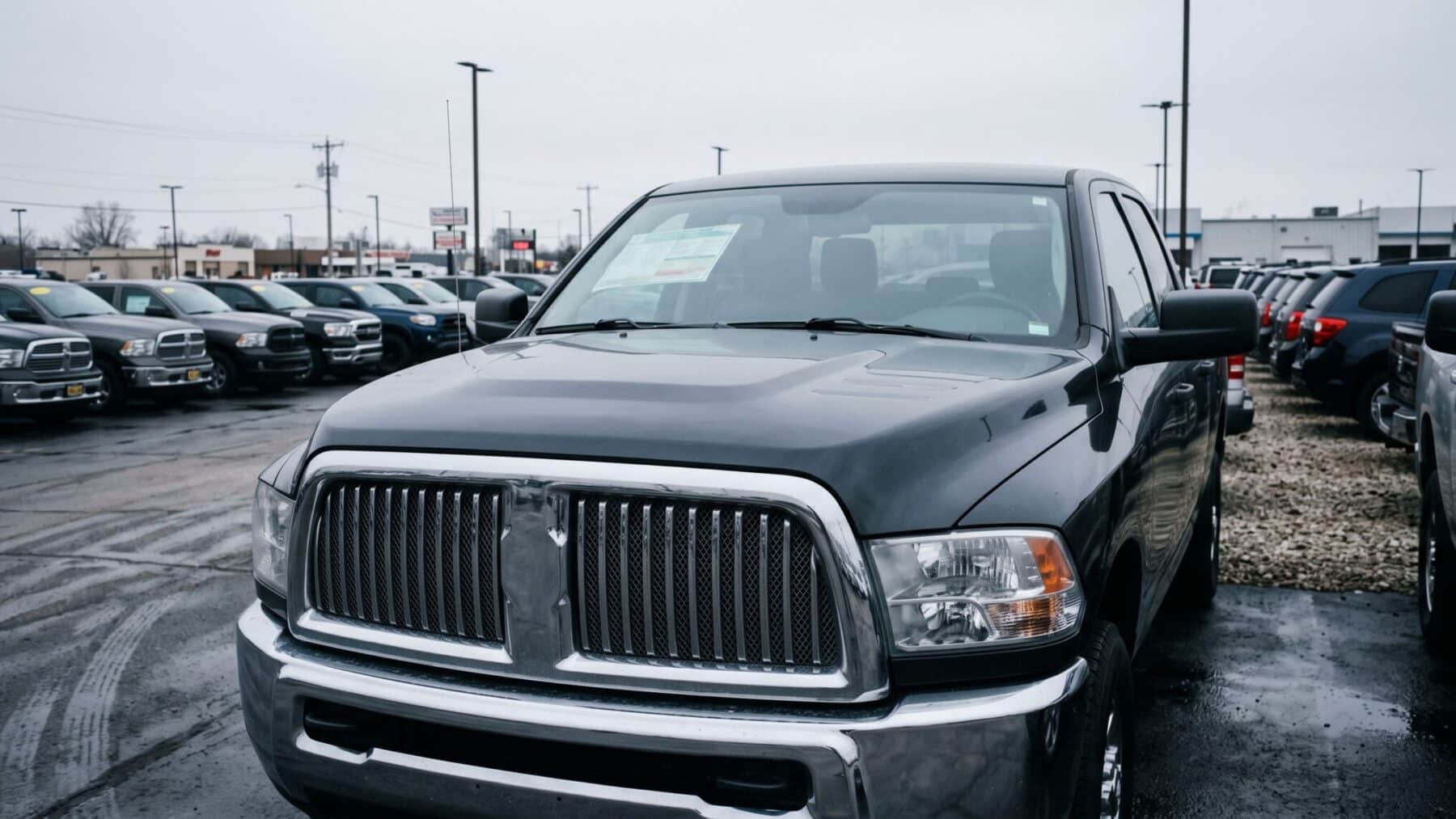
Walk onto any US truck lot right now and the sticker in the window looks almost reasonable.
Scroll to the bottom line, though, and a single mandatory charge has swelled to nearly $2,800. It cannot be haggled down. It cannot be declined. It applies whether the buyer lives next door to the factory or across the country.
The question every truck shopper is suddenly asking is: when did the shipping fee become the price increase?
How a non-negotiable add-on became the industry’s favorite tariff valve
Every new vehicle sold in the US carries a destination and delivery charge, a fee that covers the cost of moving the finished truck from the assembly plant to the dealership. Automakers set it centrally, average it across all delivery distances, and print it on the window sticker as a fixed, non-negotiable number. Buyers cannot opt out, even if they live a mile from the plant.
That structure makes the destination fee an unusually clean lever. Raising it costs the automaker nothing in terms of advertised MSRP, avoids triggering the comparison-shopping backlash that a sticker hike generates, and lands on every single unit sold. Because the fee sits below the headline price, most buyers absorb it without registering it as a price increase at all.
“They are hiding some of the tariff costs in the destination charge,” said Sam Abuelsamid, Vice President of Market Research at Telemetry. “Because you can’t opt out of the delivery charge even if you live next to the factory and pick up your vehicle at the gate. It should just be part of the price.”
What the numbers look like on America’s best-selling trucks
Since April 2025, one major domestic automaker increased destination fees three times on its flagship full-size pickup line, moving from $1,995 to $2,795. That is an $800 spike, a 40 percent rise in under a year. Ford matched that $2,795 figure on its own full-size trucks, meaning the fee is now identical across the two largest domestic truck sellers.
The flagship full-size pickup’s base trim is listed just under $40,000 before the mandatory $2,795 destination fee is added, pushing the real starting point toward $43,000 before any options. That distinction matters enormously to a buyer who spent weeks negotiating the sticker down only to find the fee sitting entirely outside that conversation.
One major Japanese truck competitor is asking just $2,095 for its full-size pickup. That leaves a $700 gap between domestic leaders and their import rival on this single line item alone.
The verified revenue math behind the fee shift
The average destination fee across all new vehicles climbed to a record high of $1,551 in 2025, up from $961 in 2015, according to data from Kelley Blue Book parent Cox Automotive. That industry-wide drift understates the acceleration happening on high-volume truck platforms, where the fee increases are sharpest and the sales figures are largest.
One domestic automaker sold roughly 828,000 F-Series pickups in 2025. A $200 increase for the coming model year extrapolates to $165.6 million in additional gross revenue if sales hold near that level. A rival domestic automaker’s two full-size pickup nameplates combined for more than 930,000 units, so an $800 increase amounts to nearly $750 million in potential additional gross revenue.
Neither figure requires a single change to any advertised starting price.
The broader tariff bill has cost automakers many tens of billions of dollars, based on automaker financial disclosures. As GCN has reported, those costs have reshaped the entire market: Ford’s Q2 sales fell 10.3 percent as tariff pressure and supply disruption squeezed volume simultaneously. Destination fees are proving to be one of the few ways to recoup losses without triggering a direct volume response from buyers.
Where the strategy runs into its own limits
The fee approach is not without friction. Industry analysts point out that automakers may be profiting off these fees, and consumer trust erodes when a mandatory charge swells past the point that feels like shipping and begins to feel like a surcharge by another name.
The increases are coming mainly from domestic manufacturers, which creates a visible competitive gap. Some European brands charge as little as $1,175 to $1,250 for most of their lineup, less than half what the largest US truck sellers now charge. That gap is already reshaping the value conversation at the dealership level.
There is also a structural ceiling. Even as list prices have climbed, dealers have absorbed a portion of the gap through negotiation and discounting. Dealer margin compression cannot continue indefinitely, and destination fees cannot substitute for that cushion.
As GCN has noted, hybrids grabbed a record 16 percent of new US car sales in Q2, suggesting buyers are already pivoting toward segments where the tariff impact is smaller.
What this means for anyone buying a truck in the months ahead
One major domestic automaker has said it will face up to $5 billion in gross tariff-related costs this year, while another has cited a $3 billion gross hit. Both figures are too large to absorb through destination fees alone, which means additional pricing levers are likely to follow.
Analysts expect trim-level cuts, dropping the cheapest configurations, and option-packaging changes that move desirable features into more expensive bundles. Neither move will show up as a sticker hike on the nameplate buyers already know.
The tariffs carry no sunset clause, meaning they cannot be revoked until the administration changes course, a court intervenes, or a new administration takes office. Price relief may be a long way off.
For anyone in the market now, the most important number on the window sticker may not be the one in the largest font. Checking the destination line before negotiating anything else is the single most concrete step a buyer can take to understand what the truck actually costs.
