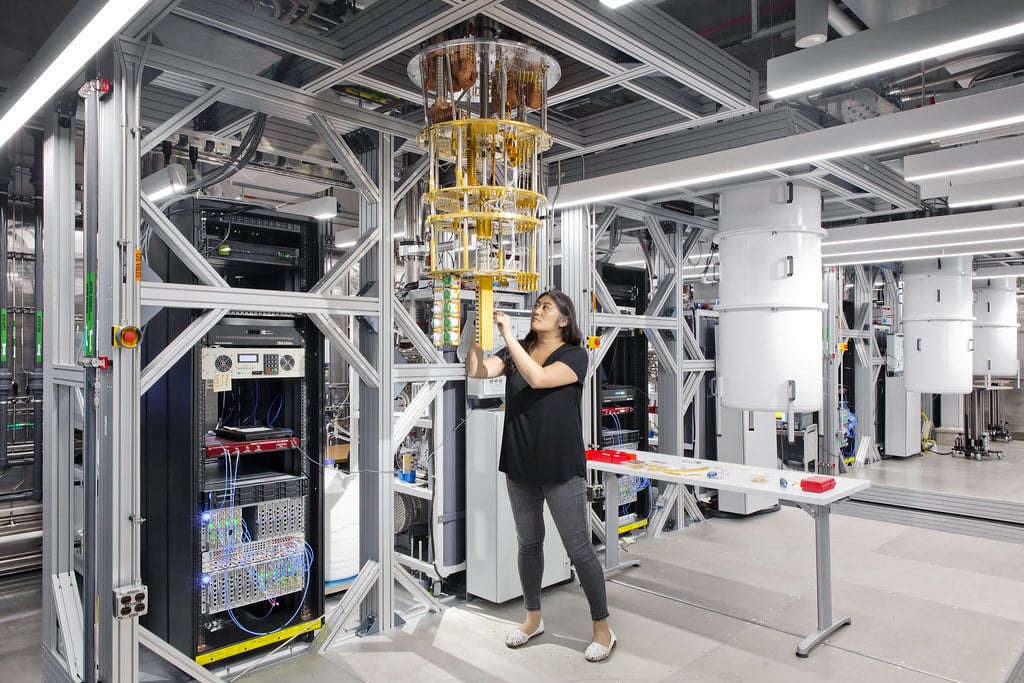
Google Quantum AI researchers have demonstrated a technique that cuts errors in a critical quantum computing resource by roughly 40 times, a result the company says removes one of the biggest obstacles to building a practical, error-corrected quantum computer.
The team detailed the work, called magic state cultivation, in a peer-reviewed paper published in the journal Science on October 15.
What the experiment showed
Google Quantum AI said it has demonstratively opened up a key bottleneck in quantum computing: we’ve shown that “magic state cultivation” works in practice on our Willow processor, reducing errors about 40x compared to without it.
The experiment used 54 physical qubits out of Willow’s 105 , according to the paper and independent reporting on the study.
On Google Quantum AI’s Willow processor, the protocol achieved a 40-fold error reduction and producing T-states with 99.99(1)% logical fidelity (error rate ≤ 0.0001) .
According to independent accounts of the experiment, researchers injected a noisy quantum state into a small region of the company’s Willow chip, ran coordinated measurements to filter out errors, and retained roughly 8% of attempts. What survived had a logical fidelity of at least 99.99%.
Why magic states are so costly
Magic states are specialized quantum states that help computers perform operations that standard error correction cannot handle on its own, but each state can be used only once.
Quantum computers are prone to errors, and a fully functional machine could end up devoting most of its resources not to performing calculations, but to ensuring those calculations are correct.
Industry estimates have suggested that up to 95 percent of a quantum computer could be spent just generating these high-fidelity magic states , according to Google Quantum AI research scientist Emma Rosenfeld.
Physicists invented magic states as quantum states prepared in advance that allow computers to perform difficult quantum operations without compromising their error correction.
The traditional approach, called distillation, creates fewer, more accurate quantum states from many imperfect ones.
Cultivation instead starts with a rough magic state, keeps checking it, throws away any attempt that shows an error, and grows the survivors into cleaner, larger states, an approach that proponents say could sharply cut the hardware overhead needed to scale up quantum machines.
Who did the work and what comes next
The experiment, published in Science, showed that a technique called magic-state cultivation works on Google’s Willow processor, according to a Google Quantum AI blog post written by Emma Rosenfeld, research scientist and Craig Gidney, quantum software engineer.
Google researchers Gidney, Noah Shutty and Cody Jones developed their cultivation approach in 2024, building on an idea from earlier research, according to the post.
The team showed how the method lets researchers grow, or cultivate, an exceptionally pure, low-error quantum state that could be adapted into a larger, useful encoding, including by moving a state from a smaller code into a larger surface code on the hardware.
Google Quantum AI’s team has demonstrated “magic state cultivation” on physical hardware for the first time.
The announcement arrives amid a broader wave of hardware competition in the field. Days later, NVIDIA said it had run a 104-qubit simulation of a fault-tolerant quantum processor on the JUPITER supercomputer in Germany, and rival cloud providers have been racing to expand paid access to quantum hardware, as seen in recent tiered quantum computing plans.
What the result does not do
Despite the improvement, researchers and independent analysts caution against overstating the near-term impact.
The result does not deliver a cryptography-breaking machine. One independent analysis of the paper noted that the reported fidelity reflects the fidelity of one prepared magic state, and the reported result keeps 8% of attempts.
Building a full-scale fault-tolerant quantum computer capable of running complex, useful algorithms will still require stitching together many such cultivated states inside larger error-correcting architectures. Google Quantum AI has said that it still needs to demonstrate magic state cultivation at a larger scale to make it realistic for practical quantum computing, and plenty of technical challenges remain.
Google’s Quantum AI team has framed the result as a foundational engineering step rather than an immediate leap to a working fault-tolerant machine.
