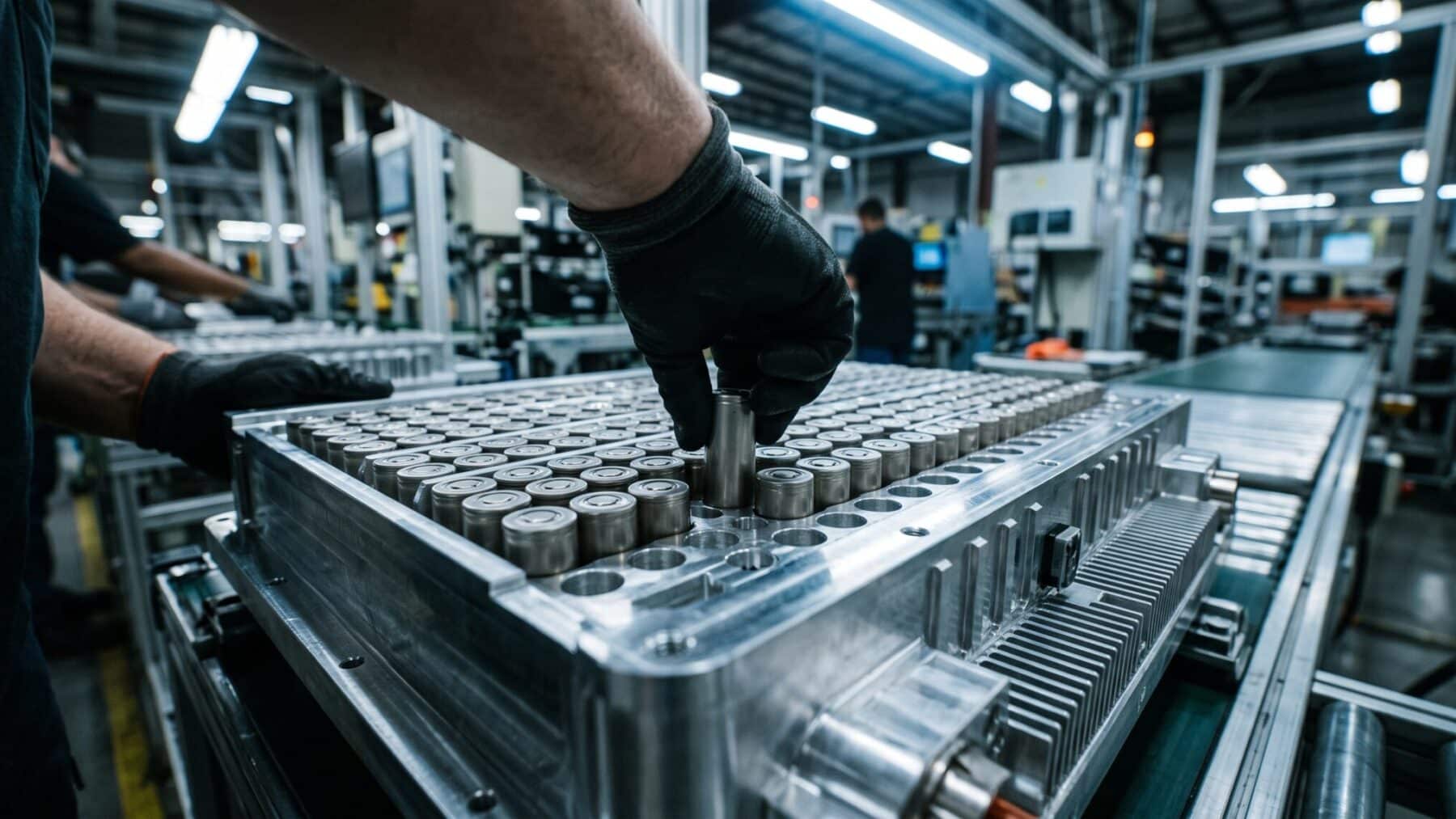
The U.S. Department of Energy’s (DOE) Office of Critical Minerals and Energy Innovation (CMEI) announced $500 million for seven selected projects to expand critical mineral and material processing, battery manufacturing, and recycling capacity in the United States on August 20, 2026, according to a DOE announcement on energy.gov.
Third round of a long-running federal program
The latest awards mark the third round of funding under DOE’s Battery Materials Processing and Battery Manufacturing and Recycling programs, which support battery materials processing, recycling, and manufacturing through demonstration projects, construction of commercial-scale facilities, and the retrofitting or retooling of existing plants. Together, DOE says the first two rounds represent nearly $5 billion in grants supporting 39 projects and roughly $16 billion in combined investment across the domestic battery supply chain.
The battery programs required recipients to cover a share of project costs, meaning the seven projects together represent well over $500 million in combined public and private investment. Eligible activities include demonstration projects, construction of commercial-scale facilities, and retrofitting or retooling of existing facilities.
What the money covers
The grants target a range of battery minerals and materials including next-generation anodes, direct lithium extraction, cobalt, electrolyte, and recycling. Three of the seven selected projects are battery recycling or reprocessing plants, placing a large share of this round of funding in the circular economy rather than in new mining. Three projects were selected at $100 million and four at $50 million.
Lilac Solutions received $100 million to build a commercial lithium extraction and refining facility on Utah’s Great Salt Lake. Formation Holdings US Inc., doing business as Jervois, received $100 million for a commercial cobalt refinery to produce battery-grade cobalt sulfate and related materials. Nth Cycle received $100 million to refine recycled battery black mass into high-purity metals and battery-grade materials. Princeton NuEnergy, Arcanum Ventures, Elevated Materials, and Coreshell Technologies each received $50 million for projects spanning cathode recycling, electrolyte chemicals, lithium-metal materials, and silicon-anode batteries.
The Energy Department said it received hundreds of applications for this third round of its Battery Materials Processing and Battery Manufacturing programs. The seven projects were selected through a competitive, multi-stage review process rather than a discretionary grant process.
National security framing drives the policy
In accordance with President Trump’s Executive Order, Unleashing American Energy, the selected projects advance the President’s agenda to strengthen America’s domestic critical minerals and materials supply chains, reduce reliance on foreign sources, bolster national security, and advance American energy dominance.
Energy Secretary Chris Wright addressed a long-standing vulnerability in a statement. “For too long, America has depended on foreign actors for critical materials essential to modern life that underpin our economy, energy security, and national security,” said U.S. Secretary of Energy Chris Wright. Assistant Secretary Audrey Robertson added that “DOE is taking decisive action to secure the critical supply chains necessary to power our nation,” and that “these projects underscore DOE’s commitment to driving innovation, reducing reliance on foreign sources, and promoting American energy dominance.”
Context: a rapidly scaling US storage market
The supply-chain push comes as the domestic storage buildout accelerates. The U.S. energy storage market installed a record 3.3 gigawatts (GW)/8.4 gigawatt-hours (GWh) of battery energy storage systems in Q1 2026, surpassing the previous Q1 record by 54%, with utility, commercial, and residential installations all hitting new highs, according to the U.S. Energy Storage Monitor report from the American Clean Power Association (ACP) and Wood Mackenzie.
The DOE’s Vermont battery clearance and the record Q1 2026 storage installations illustrate how the agency is simultaneously funding deployment and trying to shore up the upstream supply chain that makes that deployment possible.
Globally, 108 GW of new battery storage capacity was deployed in 2025, 40% more than in 2024, with installed capacity now eleven times higher than in 2021, according to the International Energy Agency.
Without a domestic processing and recycling industry to match, analysts have warned that the US risks trading an oil import dependency for a battery materials dependency. The August 20 award signals that closing that gap is now an explicit federal priority.
