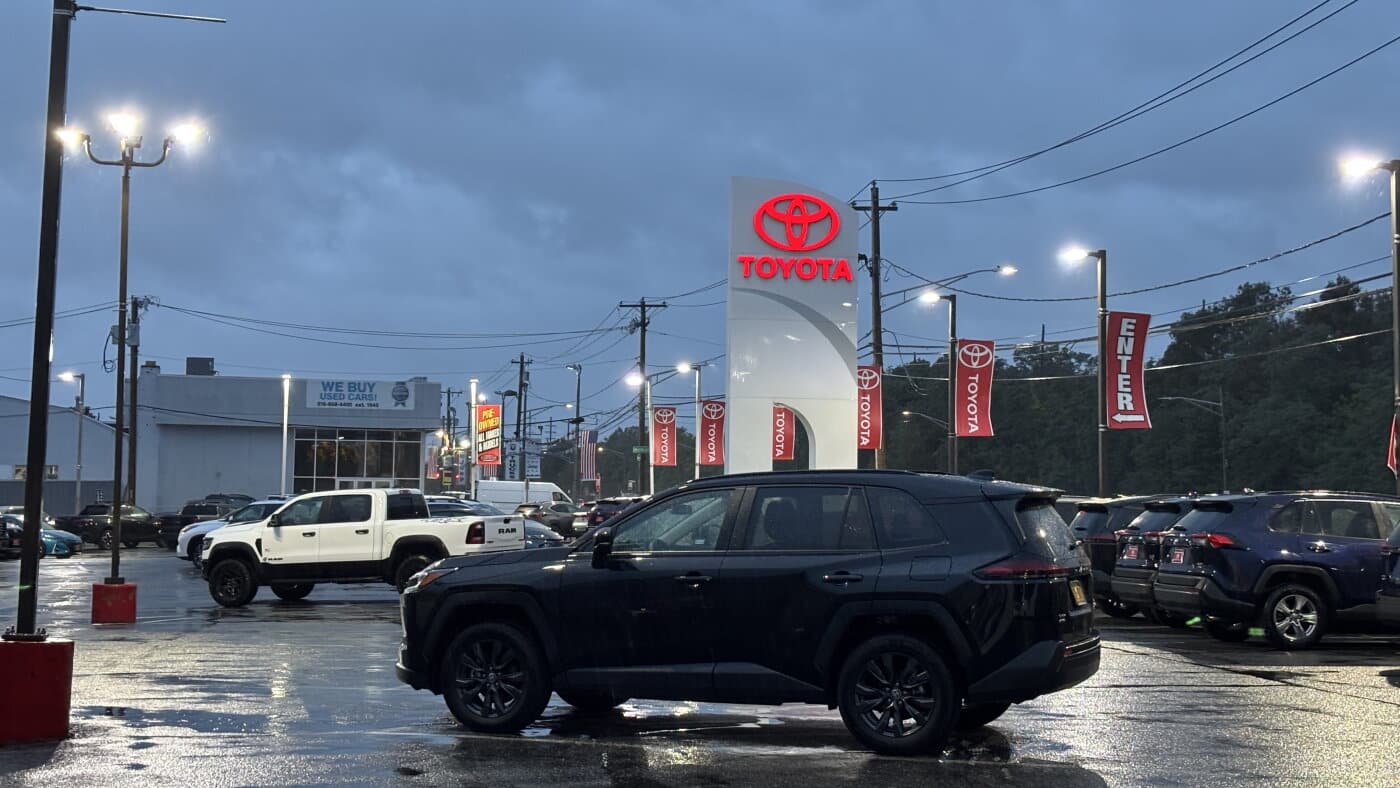
A year ago, dealership lots across the country were nearly stripped bare of electric models as buyers rushed to beat a deadline.
Salespeople remember phones ringing nonstop through the last week of September.
Then the calls stopped almost overnight.
Today those same lots look different again, with electric models parked longer and hybrids moving fastest.
So what actually happened to the money that used to make electric cars cheaper, and where did it go instead?
Why the incentive’s exit hit so hard and so fast
The mechanism behind the crash is simple arithmetic shock. For years, a federal credit worth up to $7,500 shaved thousands off the top of an EV’s price the moment a buyer signed, making an electric model cost roughly the same as a comparable gas car. One year ago, the auto industry bid farewell to a hefty federal tax credit that helped bring down the cost of electric vehicles. Congress had voted to kill it as part of 2025’s One Big Beautiful Bill Act, and car buyers rushed to take advantage of the credit before it ended on September 30, 2025.
It vanished in a single day. That is why the drop was so steep, and why dealers had almost no time to adjust pricing or incentives before buyers simply walked away.
Over 11% of car buyers bought electric vehicles in September 2025, but only 5.8% did a month later, Edmunds data shows. That seven thousand dollar gap buyers had budgeted for simply disappeared between one month and the next.
Dealers felt it directly, because financing math that worked in August stopped working in October. A car priced to compete with a Camry at $34,000 after rebate suddenly listed at $41,500, and monthly payments jumped enough to push shoppers toward other options entirely.
Inside the lots where the shift is playing out
Walk a dealer lot now and the inventory tells the story better than any chart. Electric models that once sold within days now sit through full pricing cycles before moving, while hybrid versions of the same nameplate barely reach the lot before they are gone.
That pattern lines up with what Edmunds has observed at Toyota dealerships, where, in the words of Edmunds director of insights Ivan Drury, “We consider anything under 14 days basically sold out.” The momentum for hybrids goes beyond Toyota.
Hyundai sold 33% more hybrid vehicles in August compared to the year before, making up almost 30% of its total August sales. Kia’s August hybrid sales rose 99% compared to the previous year , a surge tied to the record hybrid sales share building across the industry.
That is not happening in isolation from the EV slowdown. It is the direct mirror image of it, with buyers who once chose electric now choosing the gas-electric blend sitting one aisle over on the same lot, while tariff driven sticker prices climb on an entirely separate track all year.
What a year of data actually shows
This year, new EV sales have been more sluggish, but they’re stable. EVs have steadily accounted for somewhere between 5 and 6% of all new car sales throughout 2026, according to Edmunds , with Cox Automotive reporting similar figures. That settled number matters because it is roughly where the market stood before incentives existed at all.
The decline was sharpest right after the deadline. EV sales peaked around September, then dropped in the following two quarters once the credit expired. Compared to the year before, in late 2025, they fell 36%. They were down 27% year-over-year in the first quarter of 2026 , according to the same NPR analysis.
Analysts had braced for worse. “This trajectory is clearly nothing like what it was previously, but it has not fallen off of a cliff, which is what some people’s predictions would’ve been,” said Ivan Drury, director of insights at Edmunds. That floor, rather than a collapse, is the headline finding a full year out.
Layered on top is a separate tariff story. In the first full year, tariffs cost the automotive industry an estimated $30 billion, and the average price increase for an imported car is now $5,000 to $8,900 compared to last year.
Where the stabilized number still breaks down
The 5 to 6 percent floor is not uniform everywhere, and it hides sharper splits beneath the surface. Some brands gained EV share even as the overall pool shrank, proving the floor is a market average rather than a fixed outcome for every manufacturer.
Used electric cars are quietly becoming the pressure valve for buyers priced out of new ones. Used EV market share has edged up to around 2.8 percent of the used car market, but that share is growing fast.
More than 300,000 EVs are expected to return from lease in 2026, which is an increase of more than 200% from the 123,000 units projected for 2025. That supply wave changes the math for cost conscious shoppers who still want to go electric without the full sticker price.
None of that erases the destination fee problem stacking on top of tariffs. Domestic brands now average $2,189 in destination fees, which is a $713 premium over the $1,476 import average , a non-negotiable line item that climbs regardless of powertrain.
What the new normal means for buyers going forward
Put together, the picture is less a crash than a reset to baseline. The stabilized EV share nearly matches where the segment stood before the credit existed, suggesting the incentive mostly pulled forward demand rather than permanently expanding the buyer pool.
Even so, the people inside the data see reason for patience. The rise of the hybrid has been a kind of bright spot in a year that’s been flat for the EV industry, with “hybrids having their moment,” according to Stephanie Valdez Streaty, director of industry insights at Cox Automotive, who points to stronger growth in used EVs and hybrids even as new EV demand has leveled off.
For shoppers, the shift is simple.
The rebate driven urgency of last September is gone, replaced by a slower market where hybrids absorb much of the demand that used to go electric, and tariffs quietly add their own cost on every vehicle regardless of what powers it. That leaves a market still finding its footing, with hard numbers now public showing exactly how much of last year’s EV boom was the credit, and how much was the cars themselves.
