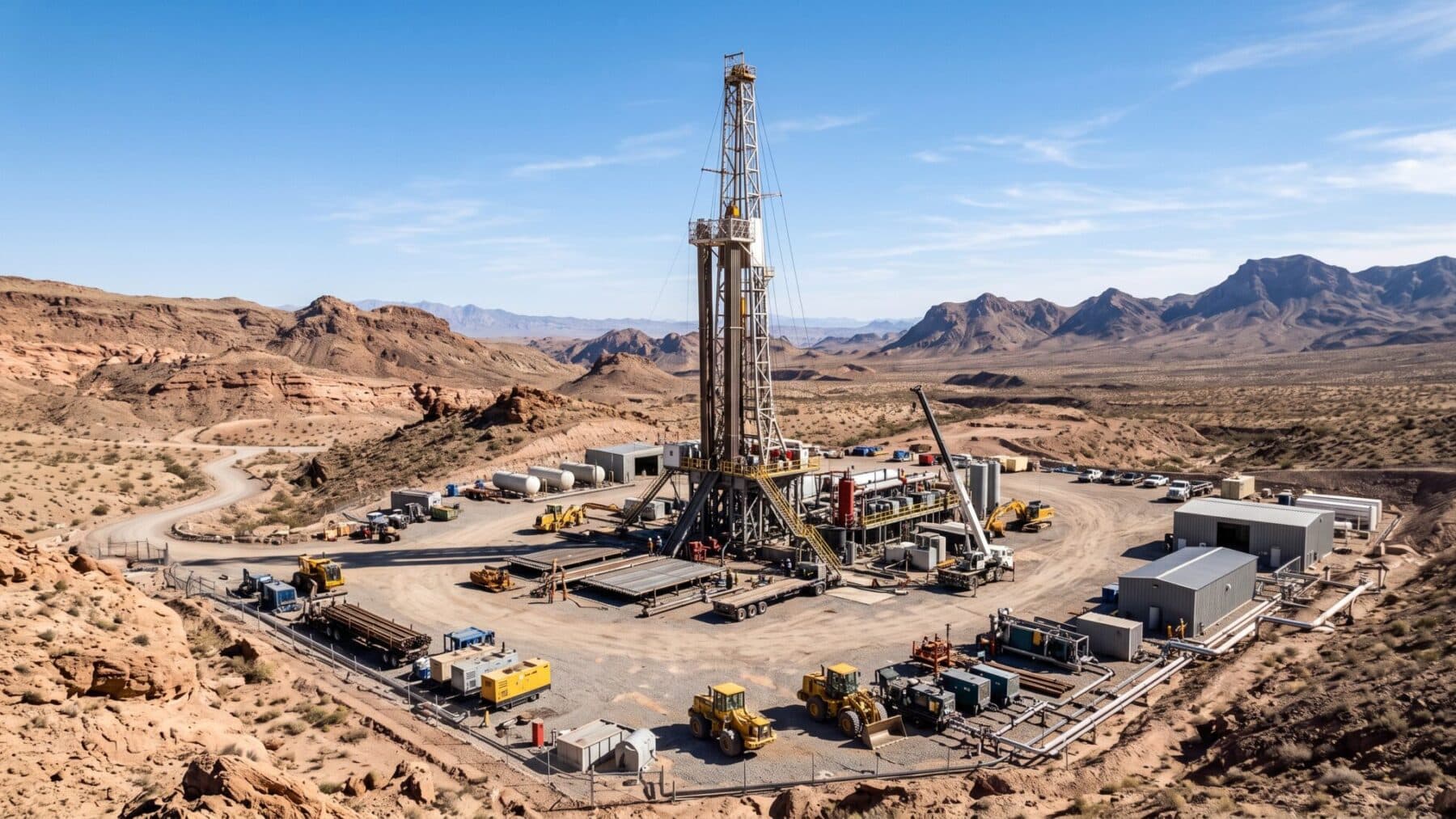
Miles below a flat stretch of Utah desert, rock sits hot enough to boil water without a single flame.
Engineers drill down, crack the rock open and run fluid through the fissures to pull heat to the surface. The pitch is compelling: firm power, around the clock, no clouds required, no wind needed, no fuel to buy.
But threading pipes through miles of ancient rock sets off something the sales sheet rarely leads with.
What happens when the sensors say stop?
Why cracking rock deep underground can rattle the ground above it
Enhanced geothermal systems, known as EGS, do not rely on naturally occurring hot-water reservoirs. Instead, they use drilling technologies borrowed from oil and gas, including horizontal drilling and hydraulic fracturing, to create hydrothermal reservoirs where none currently exist. That distinction is the whole commercial promise: build a geothermal field almost anywhere the subsurface runs hot enough.
The catch is physics. Forcing high-pressure fluid into tight, impermeable rock to crack open new pathways can shift stresses along existing faults, sometimes triggering tremors felt at the surface. Technical risks and induced seismicity have historically hindered EGS expansion, and that history now sits at the center of every new project’s operating plan.
The DOE has put a best-practice protocol in place covering all drilling, stimulation and production phases. It uses a color-coded traffic-light system: green means proceed, yellow means slow down or pause, and red means halt immediately. A red signal mid-stimulation does not just pause the work; it can strand a well before it has produced a single watt.
The world’s largest EGS project and its seismic safety net
Cape Station, in Utah’s Beaver County, is being developed by Fervo Energy as a 500-megawatt enhanced geothermal project, the world’s largest EGS development. Phase I is on track to begin delivering clean power to the grid by late 2026, with Phase II targeted for 2028. It applies directional drilling to target and create fractures in hot, impermeable rock, allowing fluid to flow where it previously could not. The first large-scale commercial EGS generator in the United States is under construction.
Fervo held a groundbreaking ceremony in September 2023 to mark the start of its exploration drilling campaign at Cape Station. In 2024 the team successfully carried out reservoir stimulation on multiple horizontal wells. Each stimulation step is the moment induced seismicity risk peaks: fluid pressure is highest, and the rock’s response is hardest to predict.
Seismic stations surround the site, the result of a partnership with the Frontier Observatory for Research in Geothermal Energy. The University of Utah publishes detailed public data on every seismic event recorded, including date, time, magnitude and depth.
Accelerometers at a nearby geothermal plant and a local high school add further ground-motion readings, supplemented by the operator’s own array of additional seismometers. Running that network is a real and ongoing operating cost, not a one-time construction expense.
What the drilling cost numbers actually show
Drilling costs can account for one-half of the total project cost for a geothermal power project. Reported estimates of the levelized cost of EGS vary widely across sites and studies, depending on geology and drilling difficulty, partly because so few plants are currently operating.
Pilot campaigns have delivered real efficiency gains. Rate of penetration at Utah’s federal research site reached roughly five times the level achieved at the same site in 2017, though standard oil and gas performance still runs considerably higher. A well that takes half as long to drill costs roughly half as much to sink, and when drilling represents half your capital, speed is the sharpest lever on profitability.
Even so, the geological lottery has not gone away. A reservoir modeled with adequate heat and permeability can turn out to be impermeable the moment the drill bit reaches it. That is not a minor cost overrun but a potential project-stopper, mirroring the hidden-cost dynamic that buyers of always-on power contracts have already encountered at every scale.
Where the traffic-light system gets complicated
The DOE-mandated clear traffic light protocol is the industry’s primary tool for keeping induced seismicity within safe limits, but it carries its own operational complication. A crew mid-stimulation must be ready to stop pumping fluid within minutes of a sensor threshold being crossed, even if stopping at that point damages the permeability they were trying to create.
The stakes for grid reliability are not trivial. Since the 2021 DOE market report, 26 new geothermal power purchase agreements have been signed, representing more than 1,000 megawatts of new capacity commitments under development. Every one of those contracts assumes the underground reservoir behaves as modeled, a bet that the traffic-light system exists precisely to hedge.
The DOE’s own draft transmission study, which flagged surging load growth as the grid’s critical pressure point, makes clear why firm generation sources matter so much right now. The project’s lead developer has said publicly that firm, dispatchable geothermal power is the product utilities cannot find anywhere else on the market, and that demand is driving the aggressive drilling timeline at Cape Station.
Where the money and the technology go from here
The DOE has committed hundreds of millions of dollars to support next-generation geothermal field-scale tests and confirmation drilling for conventional hydrothermal resources. The funding’s explicit goal is to close the gap between what models predict and what the drill bit actually finds.
The DOE’s Enhanced Geothermal Shot aims to cut EGS costs by 90% to $45 per megawatt-hour by 2035. The drilling-efficiency gains already recorded at Utah’s federal research site show the trajectory is at least plausible. A cut that deep would move EGS from a premium option into direct competition with gas peakers.
Phase I of Cape Station is on track to begin delivering power by late 2026, with Phase II targeted for 2028. Full commercial output from the world’s largest EGS project would be the industry’s clearest proof point yet, assuming the sensors stay green.
