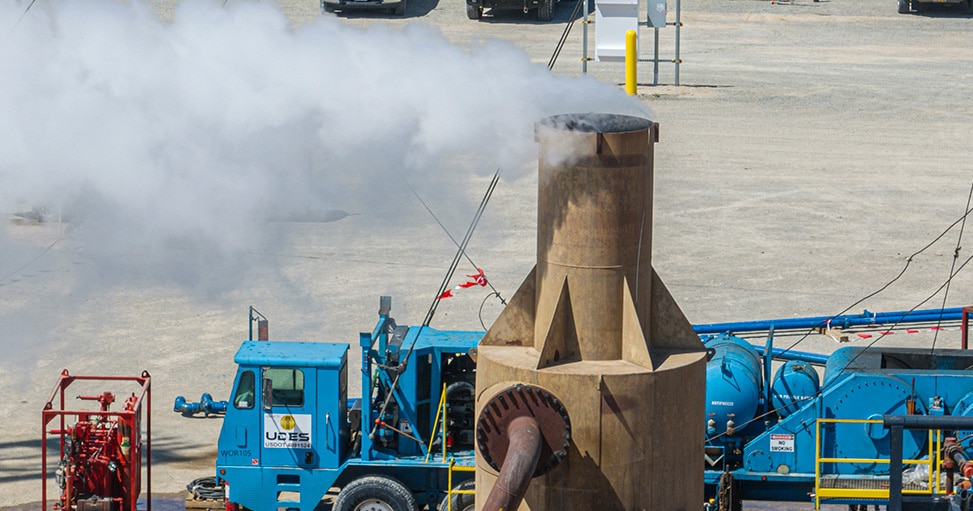
A drilling pad in the high desert hums with pumps pushing water down a well casing thousands of feet into hot rock.
Hoses snake across the gravel in loops thick as a fire truck’s intake line.
Nothing about the scene looks like a power plant yet.
No turbine spins, no transmission line hums overhead, just water disappearing into stone.
That water is the opening move in a process sold as the next source of round the clock power.
So what happens to all of it once it goes down the hole?
How stimulation actually works underground
Enhanced geothermal systems do not rely on naturally hot, permeable rock the way older geothermal fields do. Crews drill into hard rock that holds plenty of heat but almost no natural pathways for fluid to move through, so engineers have to create those pathways themselves.
That step is called stimulation, and it means pumping water underground at high enough pressure to crack open tiny fractures in rock that can sit two miles down. Those fractures become the plumbing that lets water later circulate between wells.
A federal research summary notes that EGS projects can use as much as 10 million gallons of water for stimulation, and they use water for operations throughout their lifetime. That is roughly what a few dozen backyard pools hold, pushed underground before a single watt exists.
Once the fractures exist, the system recirculates the same fluid for years, a detail sales pitches tend to frame as a one time cost rather than an ongoing one.
Where the promised efficiency runs into the rock itself
The pitch to utilities is simple: unlike wind or solar, a geothermal plant can run at nearly any hour, which is why developers call it firm, always on power. That promise anchors recent power deals signed with data center operators and grid planners hungry for predictable generation.
But the underground reservoir that makes that promise possible is not a sealed tank. It is fractured rock inside a much larger, uncontained formation, and formations like that leak.
Engineering literature puts a number on it. One widely cited analysis found that EGS has additional water requirements for simulation techniques, where a fluid which is often water is injected into the geothermal reservoir, and some of this water is lost, 1 to 10 percent, as the reservoirs are not confined , so additional water is needed to maintain system efficiency.
A well stimulated with ten million gallons could permanently lose a hundred thousand to a million gallons into the rock. Operators then keep topping off the loop for the plant’s life, the same way a cooling tower demands steady makeup water.
What the industry itself says about the tradeoff
One leading commercial EGS developer has published its own account rather than letting outside estimates stand alone. It states its wells typically run 12,000 to 15,000 feet deep and use about 8,000 barrels of water, mainly to maintain the drilling fluid that cools tools and carries cuttings out of the hole.
That figure is separate from stimulation volume, and the company argues the water left underground is not simply wasted. It says a large portion of this water stays in the subsurface, replenishing the formation.
Federal researchers add a second detail. Geothermal power cycles and cooling cycles are anticipated to generally use binary, closed-loop dry cooling, so the total amount of water consumed is expected to be relatively small compared to the amounts used in alternative power generation and cooling.
Developers can also sidestep freshwater entirely, sourcing brackish or degraded supplies instead. That choice avoids competing with farms, though it does not answer where the lost share ultimately ends up.
Why the catch still matters for projects already underway
None of this makes enhanced geothermal unworkable, and nobody serious in the industry claims otherwise. But the all in cost of a project includes a water bill that gas turbines and most solar farms do not carry, a cost that shows up well before interconnection and grid delays even begin.
That cost compounds against a backdrop where drilling already eats the lion’s share of budgets. Research on hard rock formations finds drilling often consumes half of total investment, twice what comparable oil and gas drilling needs.
So the water figure sits atop a project already capital intensive, the same dynamic that has made newly mapped geothermal basins attractive on paper but slow to finance.
Regions with limited freshwater face the sharpest version of this tradeoff, precisely the arid western basins where the best heat resources sit.
What buyers of geothermal power should actually watch for
The fix is not a mystery; it is written into federal research priorities. Government labs list water-saving drilling technologies like air drilling or biodegradable fluids, plus stimulation methods using carbon dioxide or nitrogen instead of water, as active goals.
So the percentage lost per well today is not necessarily what it will be in five years. Sealing techniques and better reservoir modeling both aim directly at shrinking that leakage rate.
Even so, any utility signing a decades long contract for geothermal power, including deals like those behind recently renegotiated geothermal contracts, is buying into underground plumbing that behaves differently than the brochure implies.
The power may show up on schedule, steady as promised. But the water that made it possible does not all come back, and that is simply the real cost of the trade, not a flaw hidden from anyone willing to read the fine print.
