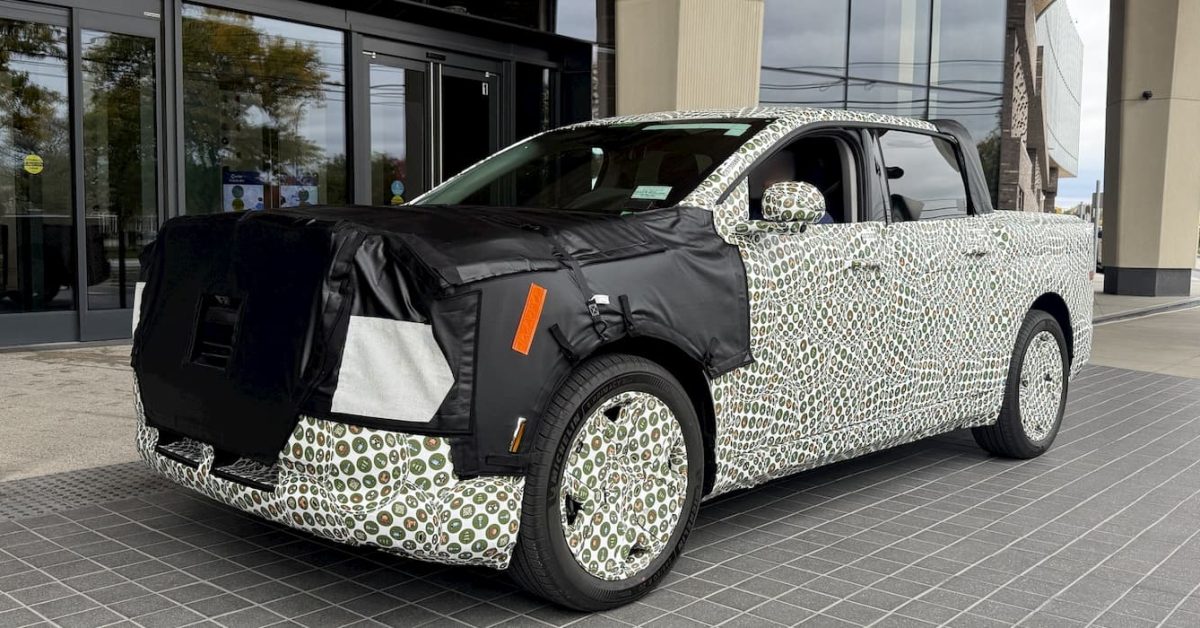
Ford Motor Company opened an online interest list this week for its upcoming Fathom electric pickup, a midsize truck the automaker says will start at $28,350 before delivery charges when it reaches showrooms in early 2027.
The move lets prospective buyers register for updates well over a year before the first unit is expected to reach a driveway.
What Ford announced
Ford opened the sign-up sheet for preorder invites on October 14, 2026, according to Electrek, which first reported the move. Ford had already confirmed the production name of its new electric pickup as Fathom and announced its starting price back in August.
Although preorders for the Fathom won’t officially open until early 2027, Ford is now inviting interested buyers to sign up for a preorder invite and become one of the first to own its all-new electric pickup , with a starting price of $28,350 for the standard-range battery, or $29,945 with a $1,595 destination fee .
As the first model based on its new Universal Electric Vehicle (UEV) platform, Ford’s first electric truck cost about twice as much, though the company says the price is the least interesting part . By using lithium iron phosphate (LFP) batteries, Ford said it will reduce costs while preserving interior space.
A response to the Lightning’s struggles
The affordable pricing target reflects lessons Ford drew from its first electric pickup.
Ford has spent the better part of two years promising a cheaper, smaller electric truck after the F-150 Lightning struggled to find buyers at its original price point, and Fathom is meant to be that answer.
Speaking at the Automotive News Congress in Detroit in late September, Ford CEO Jim Farley framed the Universal Electric Vehicle platform as the company’s response to fast-growing Chinese competitors.
Farley said the company realized at one point that a BYD EV would have roughly a 20% cost advantage over Fathom’s battery, prompting the team to modify the motors, gearboxes, and inverters, enabling smaller batteries than BYD’s without ultimately sacrificing range.
Farley acknowledged the challenge ahead, saying “It’s going to be a heck of an effort to launch this at scale, at cost, on time.”
Specifications still under wraps
Despite the pricing announcement, Ford has withheld most technical details.
One thing we do know is that the Fathom will have an NACS port after a prototype was caught at a Tesla Supercharger over the summer.
Ford has yet to announce the battery size, driving range, and other key specs , but it did reveal a few details about the upcoming EV pickup. All Ford Fathom models will be BlueCruise-capable for hands-free highway driving and will offer bidirectional charging capability , a feature set that puts the Fathom in the same technology family as this hands-free highway system covering hundreds of thousands of miles of pre-scanned roads.
Where it will be built
Production is slated for Ford’s Louisville Assembly Plant in Kentucky, the same state that has become a hub for the automaker’s electrified lineup, as seen in GCN’s reporting on a Kentucky plant’s hybrid SUV output.
Ford previously said the first Fathom prototypes are scheduled to roll off the assembly line at its 3-million-square-foot Louisville Assembly Plant in 2027, and the company is investing $5 billion between its Louisville Assembly Plant and BlueOval Battery Park in Michigan to prepare for UEV production.
The Fathom enters a market still adjusting to shifting EV incentives and inconsistent demand.
If Ford can hold its sub-$30,000 target while meeting the 2027 production timeline, the truck would represent one of the cheapest electric pickups offered by a major American automaker.
That would be a notable contrast with the premium pricing that has defined most new long-range EVs this year, a trend also visible in GCN’s coverage of new 400-plus mile EVs arriving mostly at luxury price points.
