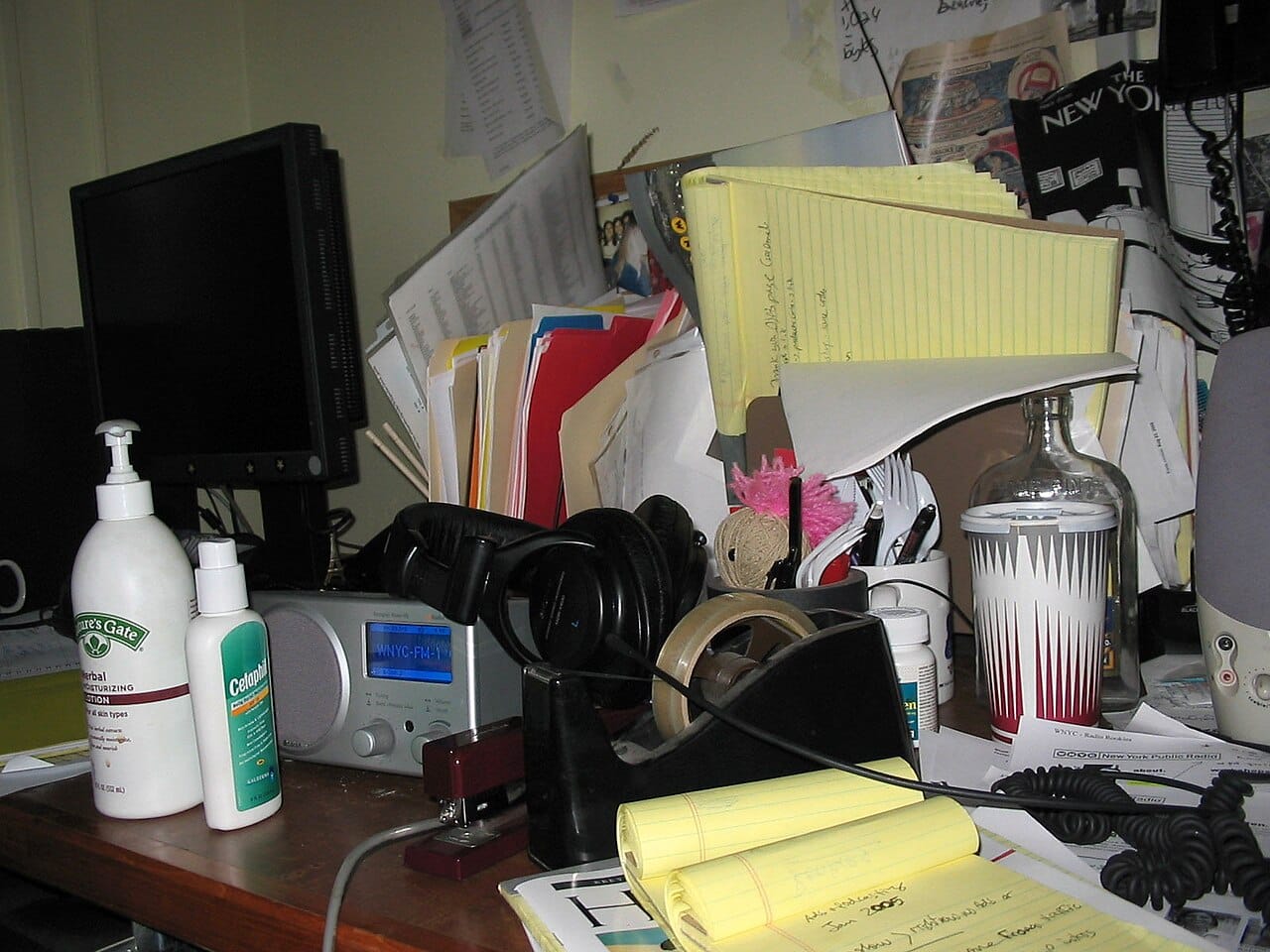
A woman walks a camera crew through her own living room, narrating what she sees out loud.
She calls one corner a mess.
She calls another pile unfinished business, and nobody in the room is grading her on tidiness.
Yet those exact words, researchers later found, lined up with something happening inside her body all day long.
So what was it about a simple home video tour that let scientists spot a person’s stress pattern just from how she talked about her own stuff?
How a few spoken words about a messy shelf end up inside the bloodstream
The mechanism is simpler than it sounds. When someone narrates their own space and reaches for words like cluttered or unfinished, they are not just describing furniture, they are revealing how much ongoing visual disorder their brain has been quietly registering, day after day.
That reaction shows up as a key stress hormone, cortisol, which in a healthy pattern spikes in the morning and tapers off by night. Researchers analyzed 60 dual-income spouses’ self-guided home tours, calculating the frequency of words describing clutter, a sense of the home as unfinished, restful words, and nature words , then matched those transcripts against saliva samples taken from the same people over the following days.
What they found was that wives with higher stressful home scores had flatter diurnal slopes of cortisol, a profile associated with adverse health outcomes, whereas women with higher restorative home scores had steeper cortisol slopes , meaning the hormone did not drop the way it should have by evening in the women whose language flagged their home as stressful.
So the mess itself was not necessarily the direct trigger. The language used to describe it tracked closely with how the nervous system had already adapted to living around it, though the study’s authors were careful to note this was a correlation, not proof of cause.
Inside the homes where the recordings happened
The setting for this was not a lab with blank walls. It was real houses belonging to real dual-income couples, the kind juggling jobs, kids and overflowing closets like anyone reading this at home right now, with a camera in hand instead of a clipboard.
Each spouse walked a researcher room by room, pointing a handheld camera at the kitchen counter, the garage, the home office corner that had become a dumping ground. That footage became the raw material researchers later coded using linguistic analysis software (Linguistic Inquiry and Word Count) , tallying words tied to clutter and unfinished projects against words tied to rest and nature.
Some spouses used flat, neutral language, mentioning a bookshelf without judgment or calling the office clutter just a project in progress. Others landed harder, describing the same kind of pile as overwhelming or a source of shame.
That split in tone turned out to be the detail worth tracking. A tidy home described harshly and a cluttered home described gently did not sort into stress outcomes the way a simple photo audit would have predicted.
What the hormone data actually showed
The researchers behind the project, Darby Saxbe and Rena Repetti, were both at UCLA when the study was conducted, published in 2010 in Personality and Social Psychology Bulletin; Saxbe has since become a psychology professor at USC. They had 60 working spouses give home video tours and then analyzed the specific words each person chose to describe their own rooms.
The link to the hormone was not subtle. Over three weekdays following the home tours, wives with higher stressful home scores had flatter diurnal slopes of cortisol, a profile associated with adverse health outcomes , and these same women reported more depressed mood as their days went on.
By contrast, the pattern reversed for calmer language. Women with higher restorative home scores had steeper cortisol slopes , the healthier pattern.
There was also a difference between men and women: husbands who described their homes as being stressful did not show nearly as strong a link to low mood as their wives did. That gap is part of why researchers lean on hormone samples and recorded language rather than assuming every household member experiences clutter the same way.
Where the pattern breaks down and why that matters
None of this means every messy desk is secretly poisoning someone’s health. The sample size was modest, just 60 spouses, and the women’s language tracked more strongly with the hormone data than the men’s did in the same study.
Because the project measured married, dual-income couples specifically, it says little about renters, single adults or households running on a completely different rhythm. That is a real limit worth sitting with rather than skipping past, much the way other everyday habit research, like the hidden cost of routine found in office attendance, only applies cleanly to the population it actually measured.
Even so, the researchers were careful about causation. The study was correlational, so it cannot show that clutter itself caused the cortisol changes, only that the language people used to narrate their homes tracked closely with how their stress hormone behaved over the following days.
So a cluttered garage does not doom anyone to a flattened cortisol curve. It is the running internal commentary about that garage, repeated silently or out loud for months, that the data linked to how the body handled stress.
A calmer way to think about your own messy shelf
None of this is a reason to panic about the junk drawer. If anything, it is a quietly useful reframe, since the goal is not a magazine-ready house but making peace with the internal narration about the space a person already lives in every day.
That lines up with other everyday habit research this desk has covered, including how a lived-in desk covered in photos and small objects can outperform a bare one on focus tasks, so long as the person chose that clutter themselves. It also echoes a broader pattern seen in other small daily habits, where the smart move is rarely a dramatic overhaul but simply working with the routine a person already has.
Which is the most useful takeaway here. Swapping overwhelmed or disaster for something plainer, like this room needs an hour this weekend, costs nothing and asks nobody to buy new bins, since the shelf stays the same and only the sentence describing it changes.
