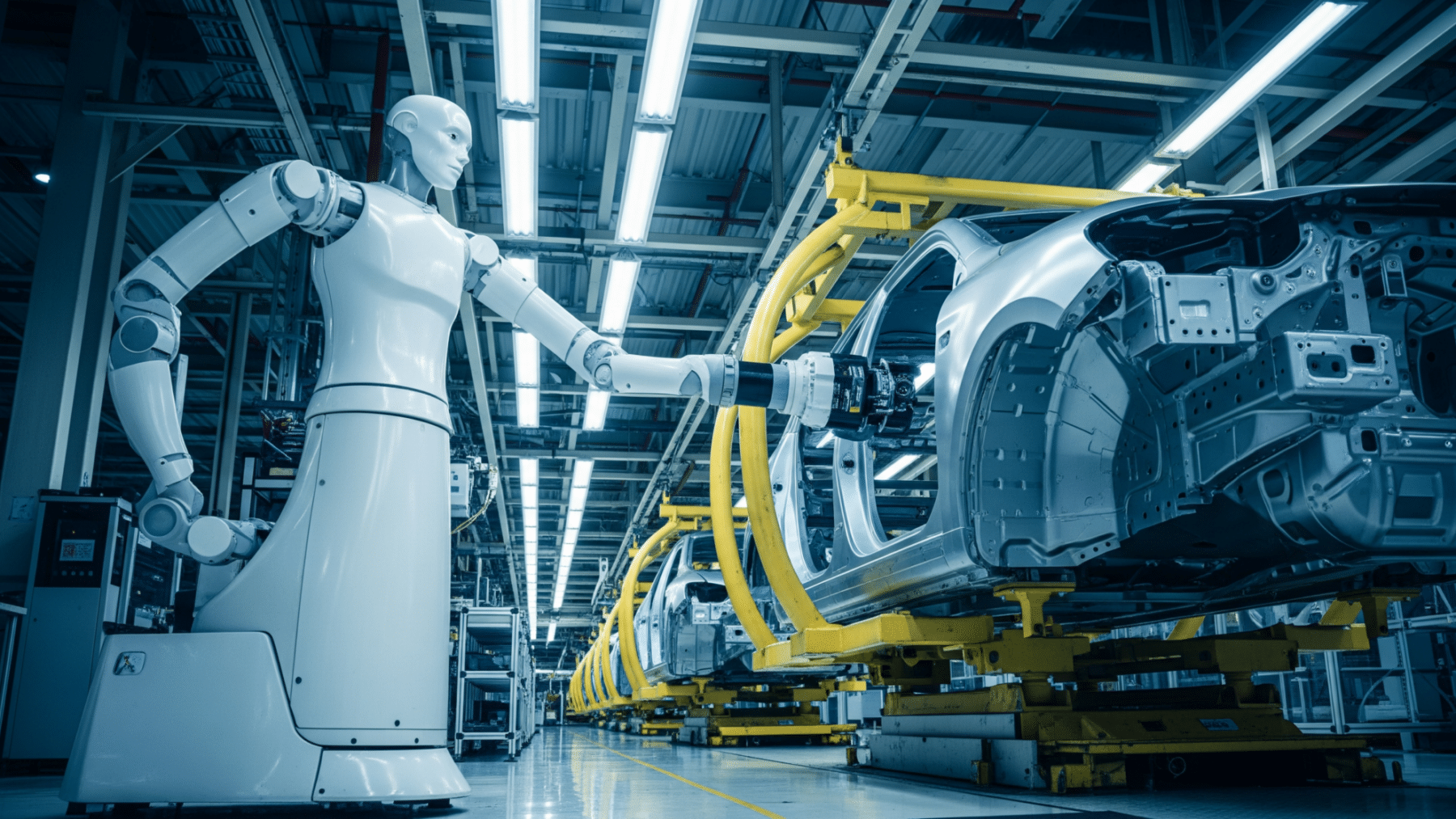
Picture the busiest car plant you have ever seen. Now add 25,000 humanoid robots and the question of who, exactly, gets to flip the switch.
That is not a science-fiction scenario.
It is the precise situation unfolding at Hyundai Motor Group right now, and the answer to that question is shaking up the entire robotics industry.
A car company just placed one of the largest robot commitments in history
Hyundai Motor Group told investors that it plans to deploy more than 25,000 Atlas humanoid robots, developed by its US robotics subsidiary Boston Dynamics, across Hyundai and Kia manufacturing plants, absorbing 83 percent of the 30,000-unit annual production capacity the group is targeting by 2028.
It is one of the largest humanoid deployment commitments on record.
The announcement, made at a JPMorgan Chase investor session in Boston, is the first time Hyundai has disclosed a specific fleet figure for internal deployment.
That is a staggering bet on machines that, until very recently, existed mostly in carefully edited YouTube videos.
What Atlas can actually do on a real factory floor
The robots will initially carry out parts sequencing tasks from 2028, with applications expanding gradually as safety and quality benefits are validated. By 2030, Hyundai said Atlas robots were expected to move into component assembly, with a longer-term plan to take on tasks involving heavy loads, repetitive motions, and complex operations across production sites.
A task learned by a single Atlas robot can also be replicated across the entire fleet.
Boston Dynamics describes this as dramatically reducing the sim-to-real gap: behaviors developed in large-scale simulation that deploy directly to physical hardware, cutting the time needed to train robots for new roles.
Hyundai Motor’s vice chair Jaehoon Chang said that the company understands concerns about job losses, but people will be needed to maintain and train the robots, and additional personnel will be required.
And Hyundai did not stop at ordering the robots. It bought the whole company.
The $325 million move that turned a robotics star into a family business
Hyundai Motor Group is acquiring SoftBank’s remaining approximately 9.9 percent stake in Boston Dynamics for roughly $325 million, making Boston Dynamics a wholly owned subsidiary of Hyundai Motor Group and its affiliates.
Boston Dynamics has stated that all 2026 production is committed to Hyundai, with plans to add additional customers in early 2027.
Hyundai also recently announced a $26 billion investment in its US operations, including plans to build a new robotics factory capable of producing 30,000 robots per year.
The scale here is genuinely without precedent. But there is a catch that nobody saw coming.
The clause that is keeping 25,000 robots off the factory floor
The announcement arrives as the Korean Metal Workers’ Union has blocked Atlas from entering any Hyundai factory floor without a formal labor-management agreement. That is the reveal buried inside the biggest robotics deal of the decade.
The Korea Times reported that the Hyundai Motor branch of the Korean Metal Workers’ Union issued a public statement on January 22, 2026, declaring that Atlas will not be permitted to enter Hyundai factories without a labor-management agreement, citing the robot’s anticipated unit cost, estimated at roughly 200 million Korean won, approximately $145,000 per unit, based on internal union calculations, as evidence that management views Atlas as a labor-cost reduction tool.
That cost figure matters. At that price, each robot carries a real argument about displaced wages.
During overseas roadshows, Kia CEO Song Ho-sung said humanoid robots are expected to begin operations at Hyundai Motor Group Metaplant America in Georgia in 2028, with deployment at Kia’s Georgia plant planned for 2029.
For readers who follow AI automation closely, the dynamics here echo the Gemini Robotics 2 humanoid rollout, where capability outpaced the industrial relationships needed to actually use it.
If Atlas performs well at Hyundai and Kia facilities, other automakers may feel pressure to speed up their own robotics plans. Still, the hard part starts on the factory floor. Atlas must work safely around people, handle unpredictable tasks, and prove it can do more than impress in videos.
Why this moment defines who wins the next decade of manufacturing
The competitive pressure in humanoid robotics is real and accelerating. Humanoid robots have become one of the most contested frontiers in technology, with Tesla pushing its Optimus toward mass production and a wave of rivals, many of them Chinese, racing to commercialize their own machines.
On July 5, 2026, Hyundai Motor Company integrated Atlas into the FIFA World Cup 2026 during the Round of 16 match at New York/New Jersey Stadium. As the Official Robotics Partner of the tournament, Hyundai Motor delivered the first-ever robotics-powered halftime activation on football’s biggest stage to a live global audience. At halftime, Atlas performed a sequence of iconic goal celebrations inspired by some of the world’s most celebrated footballers, then delivered the ceremonial match ball to the referee, marking Hyundai’s most visible public demonstration of the robot’s real-world capabilities to date.
The union negotiations, the $26 billion factory investment, the full Boston Dynamics buyout: together they amount to a bet that the company which controls its own robot supply chain will define what cars cost to build for the next generation.
Whether 25,000 Atlas units arrive on schedule depends less on the robots than on the humans who decide to let them in.
