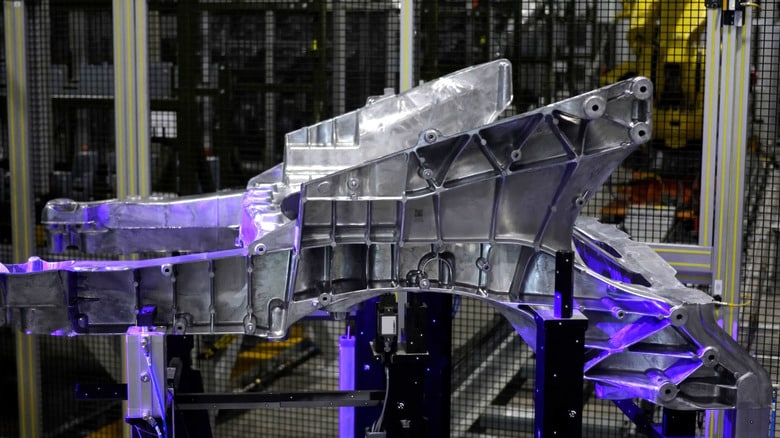
A half built truck frame rolls down a quiet assembly line in Kentucky, its battery pack already bolted beneath bare metal.
No paint yet, no badge, no name plate catching the light.
Engineers crowd around it with laptops instead of wrenches.
Somewhere in Shenzhen, a rival automaker is building something similar for a fraction of the cost.
That gap decides whether a famous price tag survives contact with reality.
Why the sticker price is suddenly so fragile
The math behind an affordable electric truck starts with the battery, since it is the single most expensive part of the vehicle. Ford’s own internal assessment found that a benchmarked BYD EV would have roughly a 20% cost advantage over the battery in Ford’s new truck.
So rather than accept that gap, Ford changed how it built the motors, gearboxes and inverters that sit around the battery, letting it use a smaller battery than BYD while still matching its range. CEO Jim Farley has described this trade-off directly.
Shrink everything else enough, and a smaller, cheaper battery can still deliver the same driving range. That is the whole trade. Ford has reportedly pushed its design discipline down to the millimeter in pursuit of that goal.
Inside the truck Ford is betting its EV future on
The truck now has a name, Fathom, and a number attached to it that Ford has repeated since summer. The Fathom name and its starting price were announced on August 6, 2026.
The Fathom will have a starting price of US$28,350, plus destination and delivery charges of $1,595, for a total of $29,945, just under the symbolic $30,000 line Ford set for itself when the platform was first unveiled.
Unlike rivals selling a bare shell, Ford wants more. The automaker intends to include modern conveniences like infotainment and driver assist hardware, a harder balance to strike at this price, not unlike what one Detroit automaker tried in a single liquid cooled chip meant to simplify vehicle wiring.
The truck will be built at the Louisville Assembly Plant in Kentucky, the same region where other automakers have reworked factory floors, as seen in a Kentucky prototype line using far fewer parts to speed assembly.
What the automaker’s own CEO has said, on the record
None of this would carry much weight without the person running the company saying it out loud. Speaking at the 2026 Automotive News Congress, Farley said the launch would demand serious discipline from his team.
Ford CEO Jim Farley admitted, “It’s going to be a heck of an effort to launch this at scale, at cost, on time.” That line matters because of what it does not say.
Farley has not confirmed a delay or set a timeline. Order books are set to open in early 2027, with customer deliveries later that year, and reporters pressed him weeks later for one anyway.
By early November, Farley offered a window rather than a promise. Farley has since told analysts that the Fathom will reach the market near the end of 2027, with the caveat that it “will require a high-level execution by our team to deliver it on time.” Order books are still set to open in early 2027 with customer deliveries later that year.
The stakes are real money. Ford has previously disclosed a $19.5 billion hit as it scaled back parts of its EV strategy, costs that predate this truck entirely.
A cheaper rival is already shipping ahead of Ford
While Ford works through its cost math, Slate Auto, the EV startup backed by billionaire Jeff Bezos, has finally revealed the starting price of its electric truck: $24,950, with preorders open and an earlier calendar. The Slate Truck undercuts Fathom by thousands of dollars before any fees are added.
That comparison is not abstract. The Slate Truck starts at $24,950 before destination, and the company is building trucks at its Warsaw, Indiana factory, a former printing plant that represents a roughly $400 million investment, with deliveries expected ahead of Ford’s Kentucky line turning on.
Philosophy, more than price, separates the two trucks. Slate Auto managed its bargain price by making the vehicle radically simple, with hand-crank windows, no radio, and a smartphone mount instead of a built-in navigation screen rather than engineering around them.
Even gasoline competitors are circling the same price band, a reminder that Ford is racing some of the cheapest trucks on the road, period.
What a late or pricier Fathom would mean for buyers
None of the companies involved have an incentive to rush a flawed product to market, which is why delays in this corner of the industry tend to be common rather than scandalous. Both the Ram electric pickup and Ford’s own earlier full-size electric truck plans have slipped multiple times for similar reasons.
Even so, a delay on the Fathom would land differently. Ford has spent over a year building public anticipation around one specific number and one specific promise of affordability.
That is the trade a shopper is really watching. A truck that slips a few months but keeps its price intact is a minor inconvenience. A truck that keeps its date but drifts upward in cost erodes the entire reason buyers cared.
For now, the interest list is open, the factory in Kentucky is being retooled, and the cheaper competition is building first. Whether Fathom lands on budget, on time, or neither, will likely decide how seriously the industry treats a $30,000 electric truck as a real category rather than a headline number.
