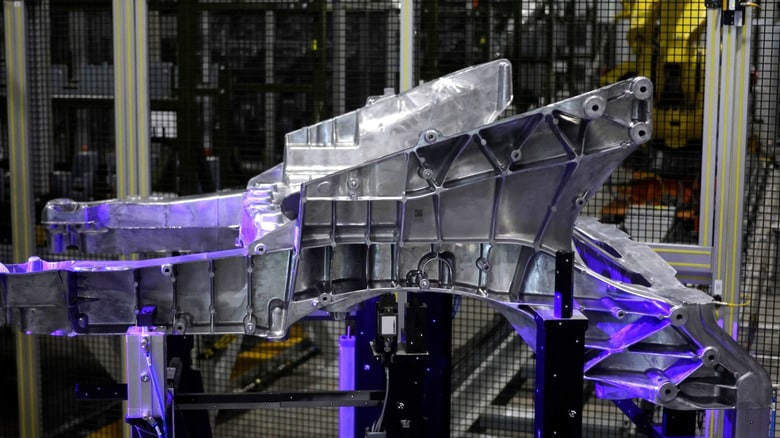
A rack of raw aluminum parts rolls through a Kentucky assembly bay, each piece the size of a dinner table and still warm from the mold.
Nearby, a furnace glows at a temperature hot enough to melt a car door.
A technician checks a scanner, then waves the next piece forward.
None of it looks like a typical body shop, and that is the point.
How two castings replace a truck’s whole skeleton
For decades, a pickup’s front and rear structure came together from dozens of stamped steel panels, each one pressed, trimmed and then welded to its neighbors by robots working in sequence. That sequence is exactly what a new casting process throws out. The Fathom has two unicastings, one for the front part of the truck and another for the rear, and this radical parts simplification reduces 146 structural parts to just two.
The mechanism starts with raw metal. Ford melts aluminum ingots at about 1,300°F (700°C) and injects the metal into either a front or rear structure mold. Each truck gets two of them, front and rear, replacing a tangle of individual welded parts that used to take far longer to assemble.
Inside the plants doing the work
The split between where parts are made and where trucks get built is deliberate. The castings are made at Ford’s Shelbyville Technical Center and shipped to Louisville Assembly Plant for process testing and prototype builds. Louisville is the Kentucky factory Ford is retooling for the Fathom and other vehicles on its Universal EV Platform.
Shelbyville functions as a casting laboratory, not a traditional production line. So Ford is now refining its own process, including reducing casting cycle times and engineering the components to support modular repairs.
Even so, the truck itself is no secret. Ford’s upcoming Fathom is a midsize truck the automaker says will start at $28,350 before delivery charges when it reaches showrooms in early 2027. More than 5,000 large castings have already been built as Ford fine-tunes the process. Readers can see how the sign-up list opened for that same pickup earlier this year.
The hard numbers behind the milestone
The 5,000 figure is not a projection. It comes from Vladimir Bogachuk, Ford’s chief engineer of advanced vehicle structure architecture, in a post on Ford’s From the Road blog , which lays out the casting production details directly from the company’s own engineering team.
Engineers examine the structures through industrial X-rays, dimensional scans and laboratory tests, and Ford’s unicastings have been specifically engineered for modular repairability , addressing concerns that damage to large cast components can complicate repairs. Entire batches are not released to Louisville until every test is passed, a detail confirmed in the original blog post describing the process.
Where the approach runs into real limits
Ford is not inventing the idea here. It’s the clearest sign yet that Ford is all-in on the manufacturing approach Tesla popularized with its Giga Press six years ago. Ford’s 146-to-2 figure looks great on paper, but it’s a front-and-rear layout, basically the same architecture Tesla launched with on the Model Y.
That means this is catching up, not leapfrogging, just with a vehicle built to cost less. Readers can see how far EV pricing has shifted since sticker prices moved after a federal tax credit disappeared.
There is a real tradeoff too. Repair cost concerns are the standard objection to large castings, and it is the one question this approach leaves open. Tesla’s own approach to large scale castings, which uses several structural modules built in parallel rather than a single underbody piece, shows how differently automakers are still solving this same problem.
What the next year of testing is meant to settle
None of this guarantees a smooth launch. The 5,000 castings built so far are prototypes and process trials, not finished customer trucks rolling off a line at volume.
Even so, early validation is moving fast. Ford’s Kumar Galhotra told investors that 90 percent of the validation testing has been completed, and that the company has built its first production vehicles at the Louisville Assembly Plant, noting Ford has already produced 5,000 unicastings, massive single aluminum castings that replace hundreds of stamped and welded pieces.
What comes next is harder. Ford says it’s also working on cutting cycle time and on designing the castings for modular repair access. Separately, the broader payoff Ford is chasing comes from how the plant goes together, not the castings alone, since the unicastings are one piece of a bigger overhaul at Louisville, where Ford is splitting the line into three branches that meet at the end.
For a truck whose entire pitch rests on an aggressive price, that patience looks like strategy, not delay. Shaving parts and welds only pays off if the castings come fast and cheap enough to keep that sticker number real once deliveries begin next year.
