Every app you use has a design system behind it, a shared library of buttons, menus, text styles and layout rules that keeps the whole product looking like itself.
Most users never think about them. Most developers treat them as a stack of polished components to copy from and move on.
That assumption is about to feel very outdated.
Something that lived entirely inside one of the world’s largest tech companies for eight years just landed in the open, and the hidden layer inside it is already rewriting what developers expect a design system to do.
The tool most developers never knew existed inside one tech giant
On June 28, 2026, Meta launched Astryx, an open-source React design system currently in public beta.
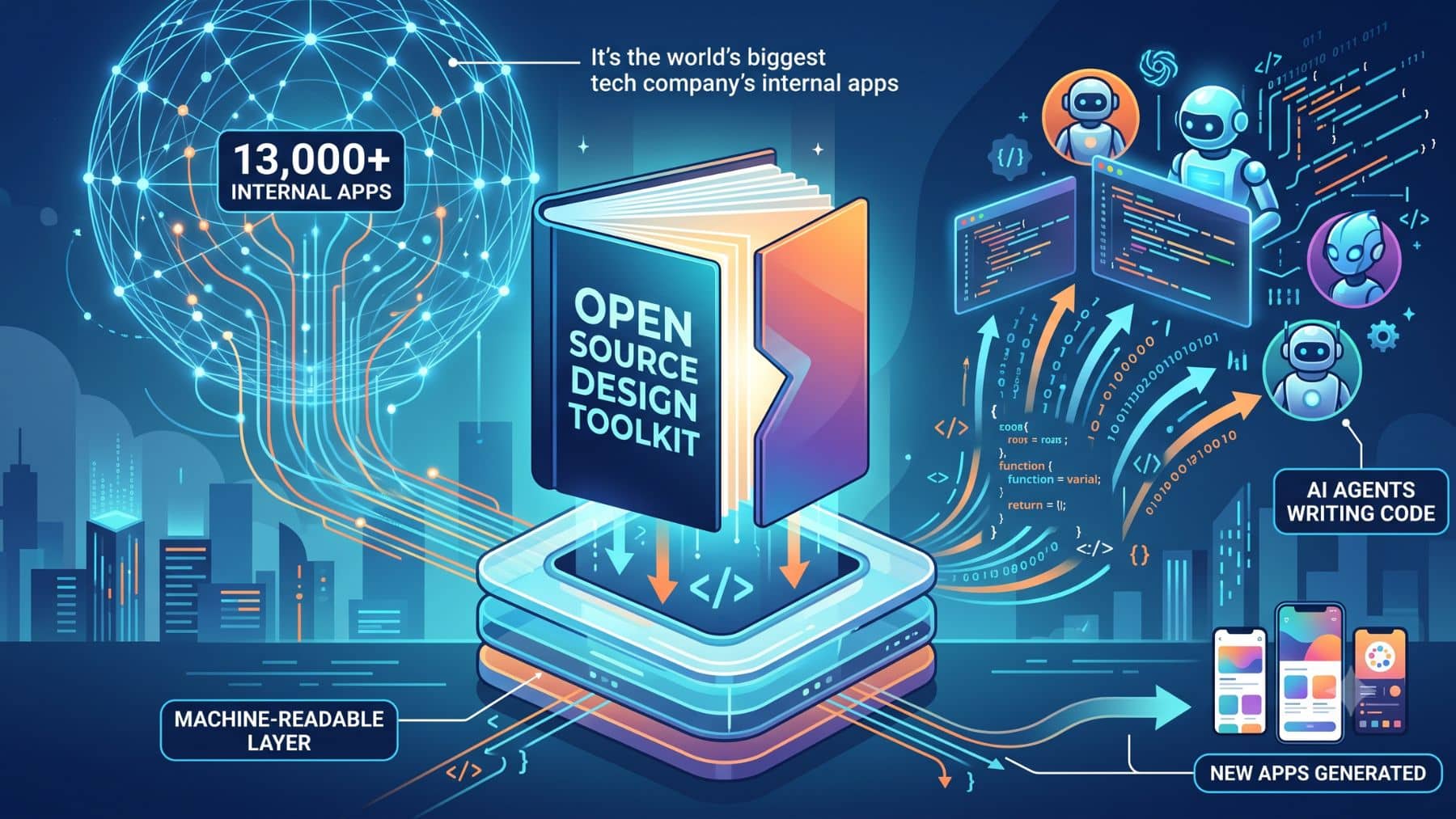
Until that moment, it had been developed entirely within Meta’s internal infrastructure, growing to power approximately 13,000 internal applications, dashboards, and monitoring tools.
That list includes some of the most heavily trafficked products on earth, among them Facebook, Instagram, and Threads.
For developers, MIT license means free to use, modify and ship in commercial products, no strings attached.
What sits underneath: a CSS engine that compiles before the page ever loads
The foundation of Astryx is not standard CSS.
It runs on StyleX, Meta’s own compile-time styling engine, and the way that works is what gives Astryx its performance edge.
StyleX compiles styles at build time into atomic CSS, which eliminates unnecessary runtime dependencies and makes components predictable.
In plain terms: the visual rules are baked into the build, not injected live.
On top of that sits a theming cascade built entirely from CSS variables, with ten fully swappable themes, including gothic, y2k and brutalist, that change every token in the system without touching a single component.
The official repository documents more than 90 React components, while Meta’s docs site counts over 150.
Why developers keep hitting a wall with AI coding assistants
Here is the problem every developer working with an AI coding agent eventually runs into.
The agent, whether it is Claude Code, Cursor or GitHub Copilot, cannot actually see a design system the way a developer can.
It has to guess from documentation, scrape README files and hallucinate component names it has never confirmed.
Most UI libraries are distributed as an npm package with documentation: a developer reads the README, selects a component, and writes code.
Astryx breaks this pattern.
The result is wasted cycles, broken layouts and the kind of back-and-forth that turns a twenty-minute task into a two-hour headache.
The reason this keeps happening comes down to one thing that every design system has been missing, something the backend world figured out a decade ago.
The machine-readable layer that changes what AI agents can build
What makes Astryx worth attention is not the component count.
It is a JSON manifest that gives AI coding agents an authoritative, machine-readable contract for every CLI command, the same kind of structured specification that the backend world has had in OpenAPI for a decade, now applied to a frontend design system for the first time.
That manifest is exposed through two channels simultaneously.
The CLI allows interaction with the system from the terminal, installing components, updating tokens, and generating code templates.
An MCP server opens the same capabilities to AI agents: Claude, GPT, or any other tool supporting the protocol receives access to the API and system documentation in machine-readable form.
Astryx includes specific architectural features designed to interface natively with automated AI coding agents, including a built-in MCP server, an open-standard protocol that provides AI models with a structured API to programmatically discover components, query layout templates, and map configurations without text-scraping codebases.
The protocol powering that server is not proprietary. In December 2025, Anthropic donated MCP to the Agentic AI Foundation, a directed fund under the Linux Foundation co-founded by Anthropic, Block and OpenAI, with support from Google, Microsoft, AWS, Cloudflare and Bloomberg. The protocol has since been adopted by OpenAI’s ChatGPT and Google’s Gemini as a shared standard. Meta’s Astryx release is among the first major open-source design systems to implement it natively at the component level.
This is a system that speaks two languages: one for humans, one for machines.
What this means for the next generation of developer tools
The practical consequence is significant.
An MCP server opens the same capabilities to AI agents, meaning engineers and agents work with the same commands, receive identical components, and follow the same design logic.
An AI coding agent using Astryx no longer has to guess what a component is called, what props it accepts or how its spacing tokens work.
It queries the MCP server directly, the same way a developer would type a CLI command.
The system is built using React and StyleX with roughly 75% TypeScript coverage, giving the codebase a strong type-safety foundation that agents and humans alike can rely on.
The broader trajectory matters too. The open-source agent tool movement is accelerating fast, and Astryx points to where it is heading: not just models that write code, but models that understand the entire design-to-deployment chain in structured, queryable terms.
And for developers curious about how fast the open tooling landscape is shifting, the same standardization push that produced the MCP protocol is already influencing how startups build on AI platforms across the industry.
Astryx is still in public beta. The foundations are production-grade, the MCP and CLI surface is genuinely novel, and the public ecosystem is starting from zero. That last part is an invitation, the kind that tends to get answered quickly when the underlying code has already survived eight years at one of the world’s busiest software companies.
