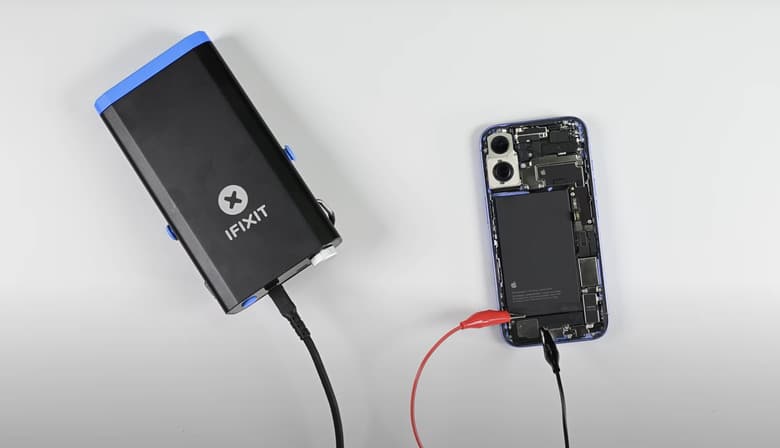
A phone sits face down on a repair bench, its back glass already peeled away to show a swollen silver cell underneath.
The technician does not reach for a new phone.
He reaches for a price list taped to the wall.
Somewhere on that list is a number that just went up again.
And a few feet away, at a trade in counter, that same battery is about to cost someone else money in the opposite direction.
Why one battery number now controls two separate bills
The mechanism is simple once you see it. Apple and most carriers use a single health percentage, measured against the battery’s original capacity, to decide what happens next.
Drop below that line and two different processes trigger at once, a repair charge going up and a resale value going down, both tied to the identical number sitting quietly in your settings menu.
Apple’s own support materials spell out the threshold directly. AppleCare+ covers a free battery replacement only when your battery holds less than 80 percent of its original capacity. Normal wear above 80 percent is not covered, and the standard one-year warranty follows the same rule. Above that line, nothing is wrong enough to qualify, no matter how the phone actually feels in daily use.
That same mark is not just an Apple habit. Most buyback platforms have specific battery health thresholds that affect pricing tiers. A phone quoted at one rate may drop to a lower tier if battery health falls below 80%. Many buyback and trade in operators grade a device a tier lower the moment health slips below that line. The chemistry of a cell quietly decides two prices most owners never connect.
A fee that just climbed to its highest point yet
Picture the newest Pro model, barely a month old, already showing the first signs of normal chemical wear a year or two down the road. That is the phone this fee now targets, and the number attached to it has never been higher for an iPhone battery swap.
Apple has raised the U.S. out-of-warranty battery service fee for the iPhone 18 Pro and iPhone 18 Pro Max to $129. The new figure appears in Apple’s iPhone repair price table, up $10 from the $119 fee for the iPhone 16 Pro, iPhone 16 Pro Max, iPhone 17 Pro, and iPhone 17 Pro Max. That is a real jump, not a rounding change.
The premium Pro tier now carries a premium repair bill to match. AppleCare+ customers are not charged for battery service when the battery’s maximum capacity has fallen below 80 percent, and the rest of the lineup holds its old shape: $119 for the iPhone 17 Pro, 17 Pro Max, iPhone Air, 16 Pro and 16 Pro Max, $99 for the iPhone 17, the iPhone 16 and 16 Plus and the iPhone 14 and 15 families, $89 for the iPhone X through iPhone 13, and $69 for the iPhone SE and the iPhone 8 or older. Only the newest Pro models broke the old ceiling.
Where this gets measured, and what the numbers actually show
None of this is guesswork. Apple’s own iPhone repair and service page lists the current fee structure directly, and independent pricing trackers that monitor the same published table confirm the figures, describing the new fee as the first time Apple has charged more than $119 for a battery, after the fee held at $119 through the 16 Pro and 17 Pro generations.
Looking back further, one tracker notes the battery fee on Apple’s top-tier phones has climbed from iPhone 15 Pro: $99, iPhone 16 Pro: $119, iPhone 17 Pro: $119 to $129 on the iPhone 18 Pro, a rise of roughly 30 percent over four generations of the Pro line. Independent repair shops, by contrast, often charge less for comparable work, though prices vary by shop and region.
On the resale side, buyback guidance describes similar mechanics. Many third-party programs treat low battery health as a real cost. Many buyers treat battery health below 80 percent as a deduction, since the device may soon need a replacement battery. Depending on the platform, that can mean a flat deduction, a lower condition grade, or in some cases a steeper cut on older models. The two numbers move in opposite directions for related reasons: a weaker battery costs more to fix and buyers price that cost into what they will pay for it.
Where the rule bends, and where it genuinely does not apply
This is not a trap with no exits. AppleCare+ remains a real backstop, and anyone carrying it pays nothing once the 80 percent line is crossed, regardless of how the out of warranty fee has moved.
But coverage lapses. Plans get skipped at purchase, and plenty of phones in daily use are well past the window where AppleCare+ still applies.
For those owners, the full posted price applies the moment a battery needs attention. Trade in programs differ too, and neither Apple nor Samsung publishes an exact figure tying a specific battery health percentage to a specific dollar deduction, so shoppers are often left estimating from past payouts rather than a published rulebook.
Shoppers eyeing this year’s flagship, covered in our look at the new in house chip, should know it arrives bundled with this higher repair ceiling too.
What it means for anyone holding a phone past its first year
None of this changes what a phone does on day one. It changes what that same phone costs to keep running, or to pass along, somewhere around year two or three, exactly when battery chemistry naturally starts to slip.
That timing lines up with how long people now keep devices. The average age of devices being traded in continued to rise through last year, with iPhones averaging 3.80 years and Android devices averaging 3.96 years for the full year, according to trade-in trends data. Trade in data covered in our report on phones averaging nearly four years shows ownership now stretches well past the point where this threshold starts to matter financially.
Batteries are not a scam. They wear out everywhere, in every brand.
What is worth knowing is that one quiet percentage in a settings menu now reaches into two separate wallets, the repair counter and the trade in line, at the same stage of a phone’s life. Checking that number before either moment arrives costs nothing and tends to pay for itself.
