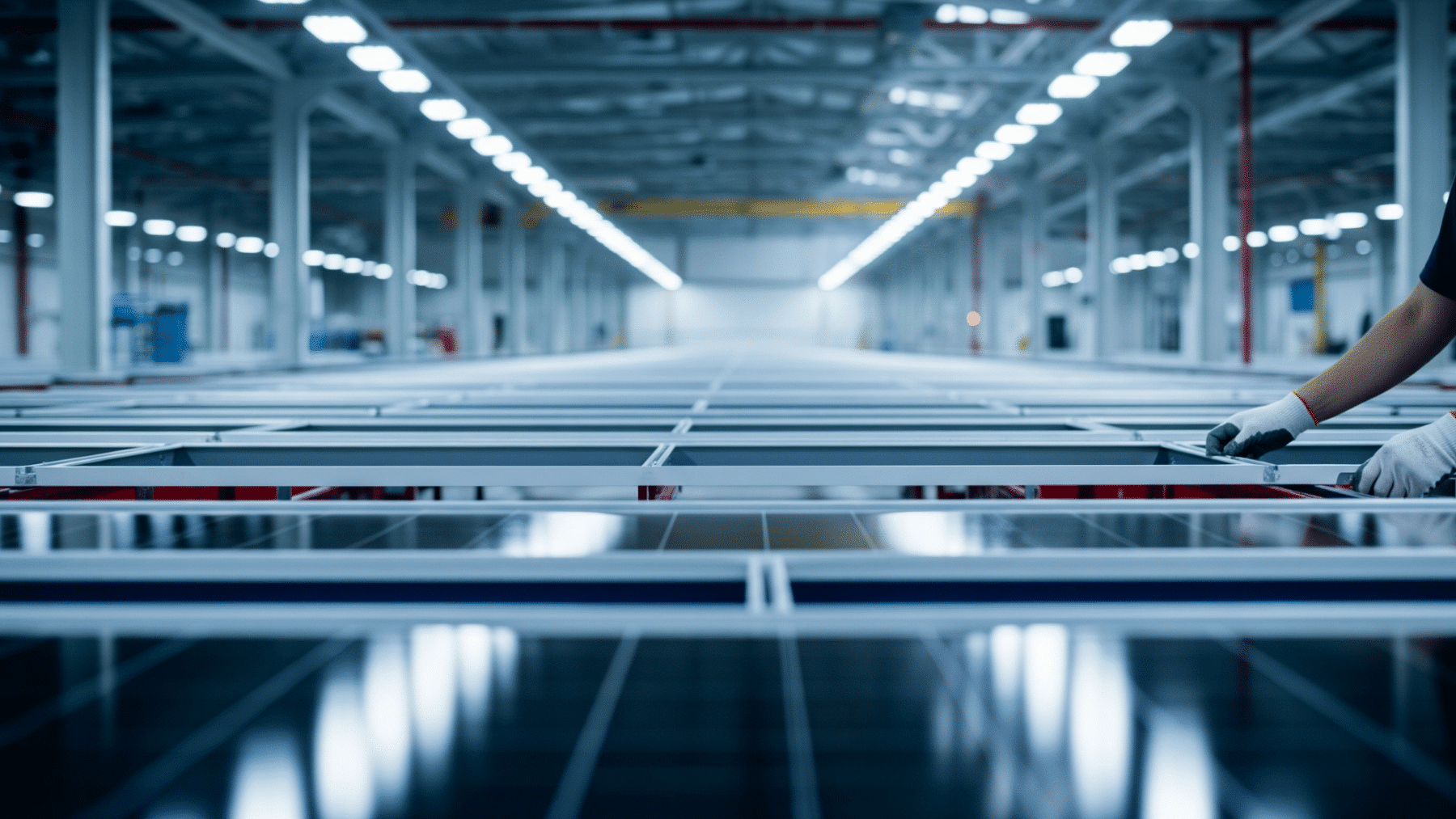
A sheet of glass slides onto a conveyor belt, and nobody on the line can see what happens to it next until it reopens.
Inside a press, the temperature climbs past 280 degrees.
Thirty minutes pass before the machine releases its grip.
What comes out is a sealed slab that will sit on a rooftop or a solar farm for a quarter century.
No one can crack that seal open again without destroying it.
How a laminator turns loose parts into a sealed, unfixable object
The process starts simple. A glass sheet moves into place and a technician lays a transparent film layer called an encapsulant across its surface, then rows of photovoltaic cells get strung together and wired with metal strips before a second film layer closes over the top like a lid.
That stack then enters the laminator, where heat and pressure fuse everything into what workers on at least one line call the solar panel sandwich. Once the panel enters a laminator operating at roughly 280 degrees, the cells are permanently sealed between layers of glass and encapsulant.
Timing is everything here. Lamination takes about 30 minutes; curing consumes another three hours.
Because once that press closes, there is no easy repair afterward. Quality checks occur throughout the process because after lamination, mistakes become permanent. A panel that looks flawless from the outside can carry a hidden defect from day one that no one may ever see coming.
Why a quarter century rides on a single pass through the press
This is not an abstract concern for an industry racing to add capacity. The country now has a vast amount of panel assembly running, yet most of what gets fused inside that press still starts life somewhere else. A silicon ingot can travel oceans before it ever reaches an American laminator as a finished cell.
At one of the largest single factories doing this work, in Pataskala, Ohio, the scale is hard to miss. The machines move continuously among eight production lines inside a 1.1-million-square-foot facility that Illuminate calls the largest single-site solar-module manufacturing operation in North America.
Illuminate USA has built a cumulative 10 gigawatts (GW) of solar modules at its Pataskala facility, representing nearly 18.5 million solar panels since output began.
Yet the plant’s own leadership points past the robots to something less visible: the consistency of every input feeding that press, keeping each encapsulant batch, cell shipment and glass sheet behaving the same way, run after run.
What federal and industry data show about the gap behind the glass
The lamination press itself is rarely the weak link. The real risk sits upstream, in the raw materials sealed inside it, and trade groups tracking the industry have put real numbers on that gap. The Solar Energy Industries Association’s latest quarterly report found that domestic solar module manufacturing capacity reached 60.1 gigawatts by the third quarter of this year.
Encapsulant and backsheet film, the two layers fused around every cell, remain among the thinnest links in that domestic supply chain, since, as that same report notes, growth in upstream manufacturing capacity remains slow or non-existent even as module assembly has expanded rapidly.
That shortfall matters because a bad batch rarely announces itself at the factory door. A single substandard batch of encapsulant or backsheet can lead to premature yellowing and power loss across thousands of panels, and those failures tend to surface years later, on a roof or a solar farm, long after the warranty paperwork was filed and nobody is still watching the line that made them.
Where the lamination bottleneck still bites hardest
Even with a near flawless press, a module assembled in the United States is rarely built entirely from American parts. Most components still come from overseas, and while domestic suppliers are beginning to certify products, a fully US sourced panel remains difficult at current volumes.
So the lamination step inherits risk from every supplier ahead of it.
A cell made abroad, glass from a newer domestic furnace, or film from a smaller producer all converge at that single press, and the machine cannot tell good inputs from bad ones. That inherited risk echoes a pattern seen elsewhere in American energy infrastructure, where a hidden gap only surfaces once regulators start asking questions, much like the shortfall found in a Colorado gas utility case.
Some flaws, especially contamination trapped between layers, simply do not show symptoms until years of heat cycling wear the seal down from the inside.
What it means for a panel’s next twenty five years
None of this makes lamination a weak technology. The process is well understood, fast, and increasingly automated across American factories racing to meet demand for utility scale installations and rooftop systems alike.
What it does mean is that the 30 minute press, not the final inspection line, is the real finish for a panel’s quality. Everything upstream, from a domestic glass furnace to a film line in Ohio, has to behave identically every time.
That is why Pataskala keeps returning to the same words: repeatability, stability, sameness.
It is less exciting than a record output number. But it is the real guarantee behind every panel’s quarter century warranty, one sealed, unfixable panel at a time.
