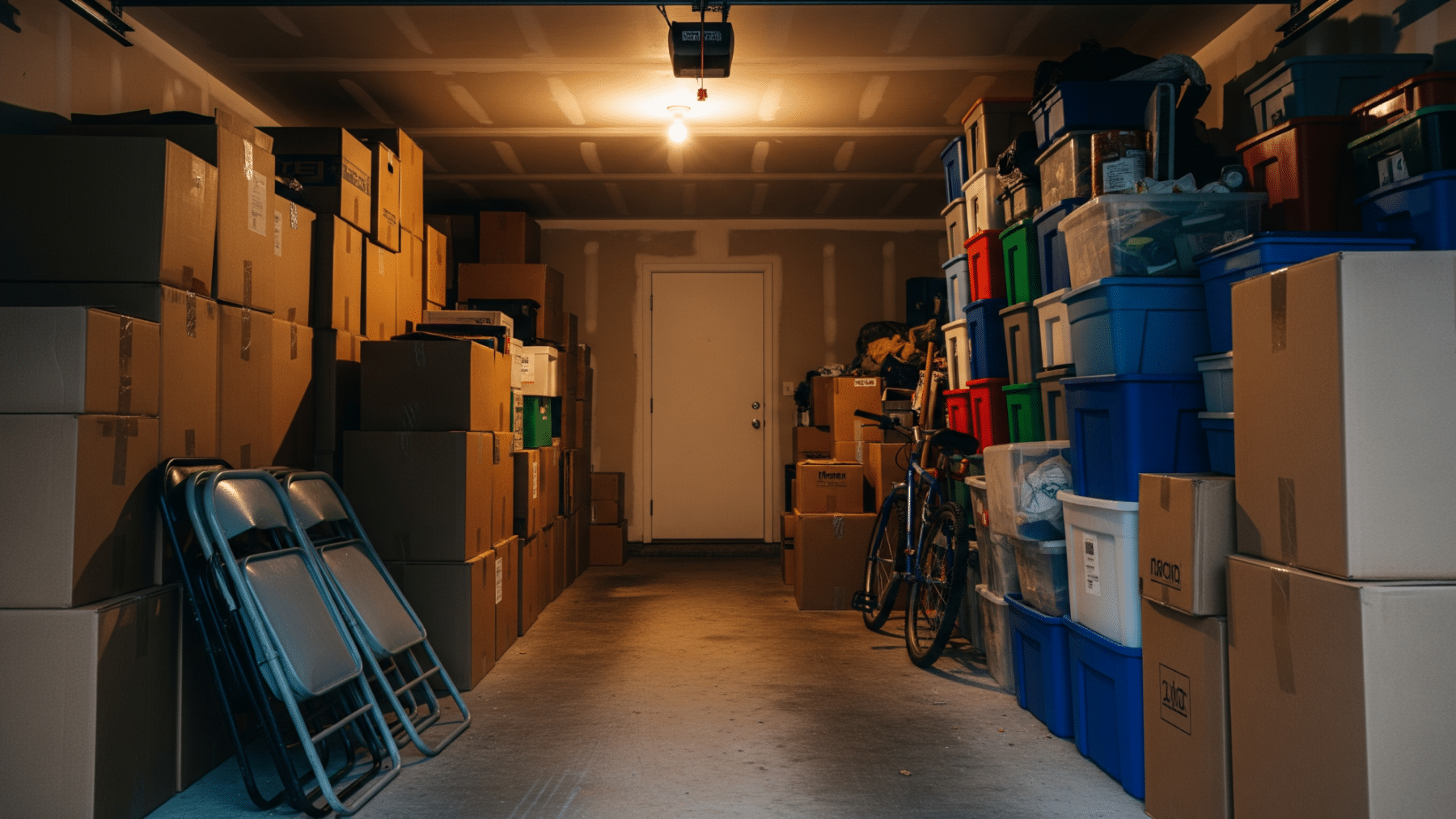
Think about the room at the end of the hall, the garage you can barely walk through, the bedroom that became a storage unit somewhere between the second move and the third holiday season.
Most people file that space under “deal with later.”
Researchers just ran the numbers on what later is costing, and the figure is not what anyone expected.
The room you stopped thinking about is still on the meter
Americans are paying more than they realize to store the things they rarely use, often inside their own homes.
That is not a lifestyle observation. It is a measurable dollar figure tied to one of the most familiar features of American domestic life.
The square footage swallowed by boxes, bags, and bins is not free.
Every foot of it has a price attached, and until recently, almost no one had done the math on what that price actually is.
What researchers found when they finally did the calculation is the kind of number that makes people look up from the page.
How the problem grows without anyone noticing
It tends to start small. A closet fills up after a move. A garage gradually becomes a warehouse. A spare room goes from guest space to overflow.
Thirty-one percent of respondents report their garages are at least half-filled with clutter, while 9% cannot park in their garages at all.
That last figure is striking. Nearly one in ten households surveyed owns a garage that a car cannot enter.
Southern households sacrifice the most space, with 23% dedicating 300 to 500 square feet, while simultaneously being the most likely to rent additional self-storage units.
Renting outside storage on top of using home space as storage is essentially paying twice to keep the same possessions.
The square footage is not the only thing disappearing
There is another layer beyond the physical space, and it involves time.
According to the National Association of Professional Organizers (NAPO), the average person spends a staggering one year of their life searching for misplaced items, a figure widely cited across the professional organizing industry.
That lost time has a financial shadow too. Widely cited data suggests the average person spends around $1,000 per year replacing items they cannot find, money spent on duplicates of things they already own.
The psychology of the accumulation is just as well documented. Nearly three-quarters of Americans, 74%, report experiencing stress or anxiety when confronted with cluttered areas, with 23% describing that stress as significant or extreme.
And 32% avoid inviting guests to their homes due to concerns about clutter, while 26% say it has negatively impacted relationships.
For households already stretched thin, as nearly half of Americans still report being, the behavioral and financial drag compounds steadily.
The $113,500 number hiding inside ordinary clutter
Here is what the researchers actually calculated, and where the real weight of the problem lands.
Based on a survey of 1,000 Americans, the report reveals that 21% dedicate over 500 square feet, roughly the size of a small apartment, purely to storage, effectively paying $113,500 in real estate value to house their belongings, based on current median home prices of $227 per square foot.
That translates to $113,500 in real estate value effectively paid to house belongings.
That figure comes from Storable and SpareFoot’s April 2025 report, a first-of-its-kind study translating home storage habits directly into lost property value.
Over half of respondents, 54%, sacrifice between 100 and 500 square feet to house possessions they rarely use.
And the numbers are even sharper in expensive cities. In high-cost areas like Boston, where square footage runs $905, even 50 square feet of clutter translates to $45,000 in real estate value.
The $113,500 figure applies to the top fifth of households measured in the study. For the broader majority giving up a full room’s worth of space, the value surrendered still runs into the tens of thousands.
For households tracking every dollar, this sits in the same category as other major overlooked home costs. It also changes how household spending decisions look when space, not just money, is part of the equation.
What the calculation actually opens up
Reframing clutter as a real estate decision, not a housekeeping one, is the shift the research is pushing.
Americans spend more than $44 billion annually on self-storage, a steep price for things they often do not use, with many households effectively paying rent for clutter.
The flip side of that math is equally concrete. Reclaiming even 100 square feet at median national prices is worth roughly $22,700 in living space returned to its intended use.
That could be a home office, a room rented to a tenant, or simply a garage that fits the car it was built for.
The study does not advocate for a particular solution. It simply puts a price tag on inaction, and that price tag, it turns out, has been sitting there the whole time.
