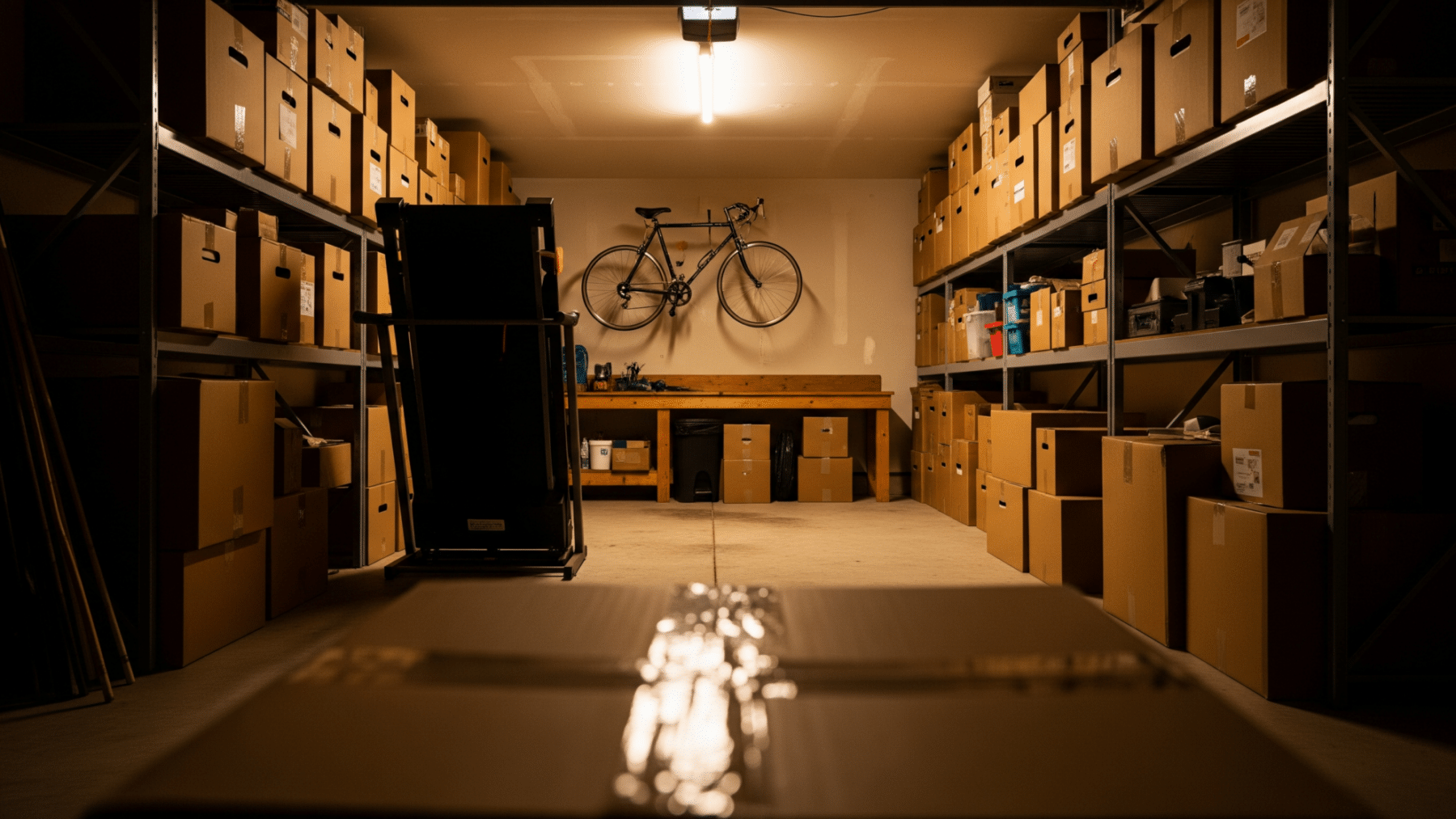
Walk through the average American home and you will find it fairly quickly: a room that used to be a guest bedroom, now sealed by a mountain of bins. A garage that hasn’t held a car in years. A hall closet that requires a shoulder check just to latch shut.
Nobody planned it this way.
The stuff simply accumulated quietly, year after year, until whole rooms quietly changed jobs.
And now, researchers have put a precise dollar value on exactly what that slow creep is costing the households it has swallowed.
Most people think of clutter as a tidying problem, not a money problem
That framing is almost certainly wrong.
Americans are paying more than they realize to store the things they rarely use, often inside their own homes, and a first-of-its-kind report from Storable and SpareFoot surveyed 1,000 Americans to uncover the true cost, both financially and psychologically.
The instinct is to think of clutter as a comfort issue, a stress issue, maybe a chore for a long weekend.
Researchers found it is a real estate issue.
And the math, once you do it room by room, starts to feel uncomfortable in a very specific way.
The rooms that quietly stopped being rooms
Over half of Americans, 54 percent, sacrifice between 100 and 500 square feet of their home to possessions they rarely use.
That range stretches from a large hall closet all the way up to something closer to a small one-bedroom apartment’s worth of floor space.
The report found that garages are among the worst offenders: for a significant share of respondents, the space is at least half-filled with clutter, and a notable fraction cannot park a car in it at all.
Think about that second group for a moment.
A portion of American households owns a garage that no longer functions as a garage.
It functions as a very expensive, climate-uncontrolled storage unit they already paid a mortgage for.
The self-storage industry exists almost entirely because of this habit
When the home runs out of room, the instinct is to rent more room somewhere else.
Americans spend more than $40 billion a year on self-storage, a figure that has made the United States, by some counts, home to more storage facilities than McDonald’s, Starbucks, and Subway locations combined.
That is before accounting for the duplicate purchases, the tape measure bought because the original one vanished behind the holiday boxes, the set of hand tools replaced because nobody could find where the first set ended up.
The average home, by widely cited estimates, contains a staggering number of individual items, most of them never touched.
For families already feeling the squeeze, and nearly half of Americans remain financially stretched even as paycheck-to-paycheck rates have improved, every square foot quietly devoted to old furniture and forgotten exercise equipment carries a cost that most households have never calculated.
The number researchers actually put on it: $113,500
The report reveals that 21 percent of Americans dedicate over 500 square feet, roughly the size of a small apartment, purely to storage, effectively paying $113,500 in real estate value to house their belongings, based on current median home prices of $227 per square foot.
That is not rent. That is not a storage bill. That is the chunk of home equity those households have permanently assigned to boxes they no longer open.
The figure is calculated against the national median, so it scales sharply in high-cost cities. In premium markets like Boston, where prices per square foot in some neighborhoods can run well above $700, even 50 square feet of clutter can translate to tens of thousands of dollars in surrendered real estate value.
The mid-tier finding is striking on its own terms too. A household dedicating 300 square feet to storage is effectively paying $68,000 in real estate value to house their belongings, enough, in most parts of the country, to cover several years of rent on a studio apartment.
The full Storable and SpareFoot report was released in April 2025.
The cleaner the space, the more valuable the home becomes to actually live in
The same study found that nearly three-quarters of Americans, 74 percent, report experiencing stress or anxiety when confronted with cluttered areas, with 23 percent describing that stress as significant or extreme.
Thirty-two percent avoid inviting guests to their homes due to concerns about clutter, and 26 percent say it has negatively affected their relationships.
The dollars and the daily friction turn out to be the same problem wearing different clothes.
Homeowners have increasingly rebuilt outdoor areas for actual daily use, 83 percent of renovated outdoor spaces now include a lounge area, a sign that Americans are actively reclaiming square footage for living, not just owning.
The indoor calculation is next. When the spare room gets its purpose back, the home does too, and at $227 a square foot, every box cleared is a small act of reclaiming something that was already paid for.
The clutter was never free. It just never sent a bill.
