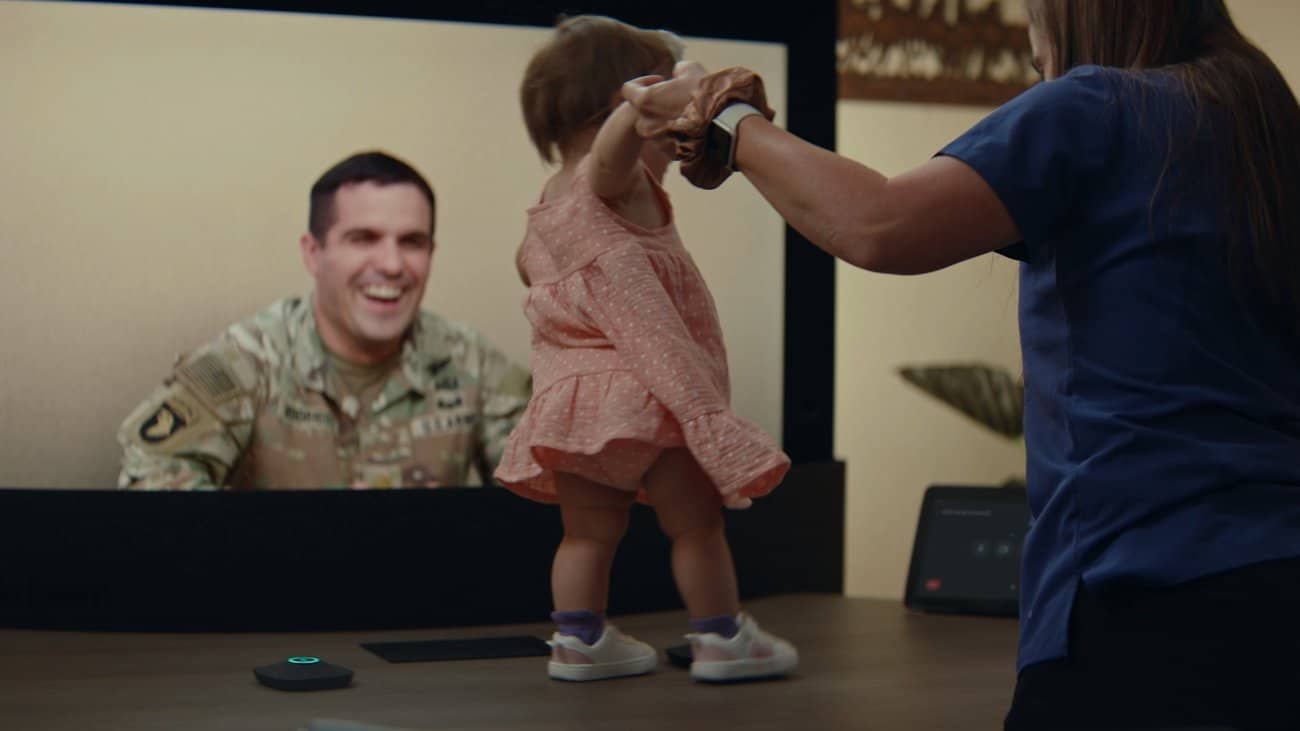
Google is deploying its Beam 3D video communication system to 20 United Service Organizations locations worldwide, a hardware and cloud rendering expansion aimed at letting deployed troops see family members in lifelike three dimensions rather than on a flat screen.
The company detailed the rollout in a blog post published this week alongside a new docuseries.
What the system does
Google Beam uses AI to create lifelike 3D video calls that make it feel like you’re sitting right across from someone.
The commercial hardware behind it, built with HP under the name HP Dimension, features a 65-inch screen and six cameras inserted directly into the frame , feeding an AI model that builds a full 3D image of the person on the other end in real time.
The system also uses a screen that sends slightly different graphics to each eye, making the visitor appear life-size and realistic, with head tracking and spatial audio that places voices precisely where they belong in the room.
That processing pipeline, which fuses six camera feeds into a real-time volumetric render without requiring a headset, depends on dedicated compute built into the booth rather than a standard webcam setup, distinguishing it from ordinary video conferencing software running in a browser.
From a two site pilot to global rollout
The USO deployment builds on a smaller test. Google Beam began a pilot program connecting families between Trzebień, Poland, and Fort Bliss, Texas earlier this year.
The expansion will reach Grafenwöehr, Germany, and Fort Hood, Texas, in addition to those two existing locations for the time being.
Google has not identified which countries or installations, beyond Poland, Germany, and the two Texas bases, make up the full 20-site count , and Google has not provided a timetable for completing the rollout , leaving open when service members at all 20 sites will have access to a working booth.
Real families, documented on camera
Google paired the hardware announcement with a short docuseries directed by veteran filmmaker Kyle Hausmann-Stokes. The series follows four soldiers from the 2nd Battalion, 37th Armored Regiment during their deployment in Poland , showing how they used Beam to reconnect with loved ones back home.
Sergeant Amoy Brown is a Bradley Gunner deployed in Poland, and Tiyanna Orane, his wife, is an aviation logistics specialist in Fort Bliss , and an eight-hour time difference makes celebrating major milestones like Tiyanna’s military promotion feel distant; Google Beam helped create an intimate, lifelike reunion where Amoy and Tiyanna could celebrate her achievement, and Amoy could interact with their young son, Azeal.
Another featured family showed how the format can capture ordinary milestones. Major Michael Rodriguez, an armor battalion operations officer with 12 years of service, is deployed while his wife, Jessica, works as a pediatric physical therapist and cares for their four young children. The series shows Rodriguez watching their one-year-old daughter, Kathryn, practice taking her first steps through Beam.
Google frames those moments as the practical case for the technology, arguing that standard video calls make it harder to pick up on nonverbal cues during long separations.
Part of a broader Beam push
The USO program is the latest step in Google Beam’s commercial expansion beyond research labs. Originally developed as Project Starline, Google Beam uses artificial intelligence and specialized display technology to give remote conversations a sense of physical presence.
Since launching commercially through HP, Google Beam has been adopted by enterprise customers including Bain & Company, Salesforce, Deloitte and NEC. The military rollout marks the first time the system has been aimed specifically at a non-corporate, emotionally driven use case rather than business meetings.
The move also lands as major cloud providers continue investing heavily in the physical infrastructure that makes real-time AI processing possible at scale, a theme GCN has covered in reporting on linked data centers and on monitoring GPU fleets.
For now, Google and the USO have not said whether the booths will expand beyond the initial 20 sites or what the long-term cost of maintaining the hardware network will be.
