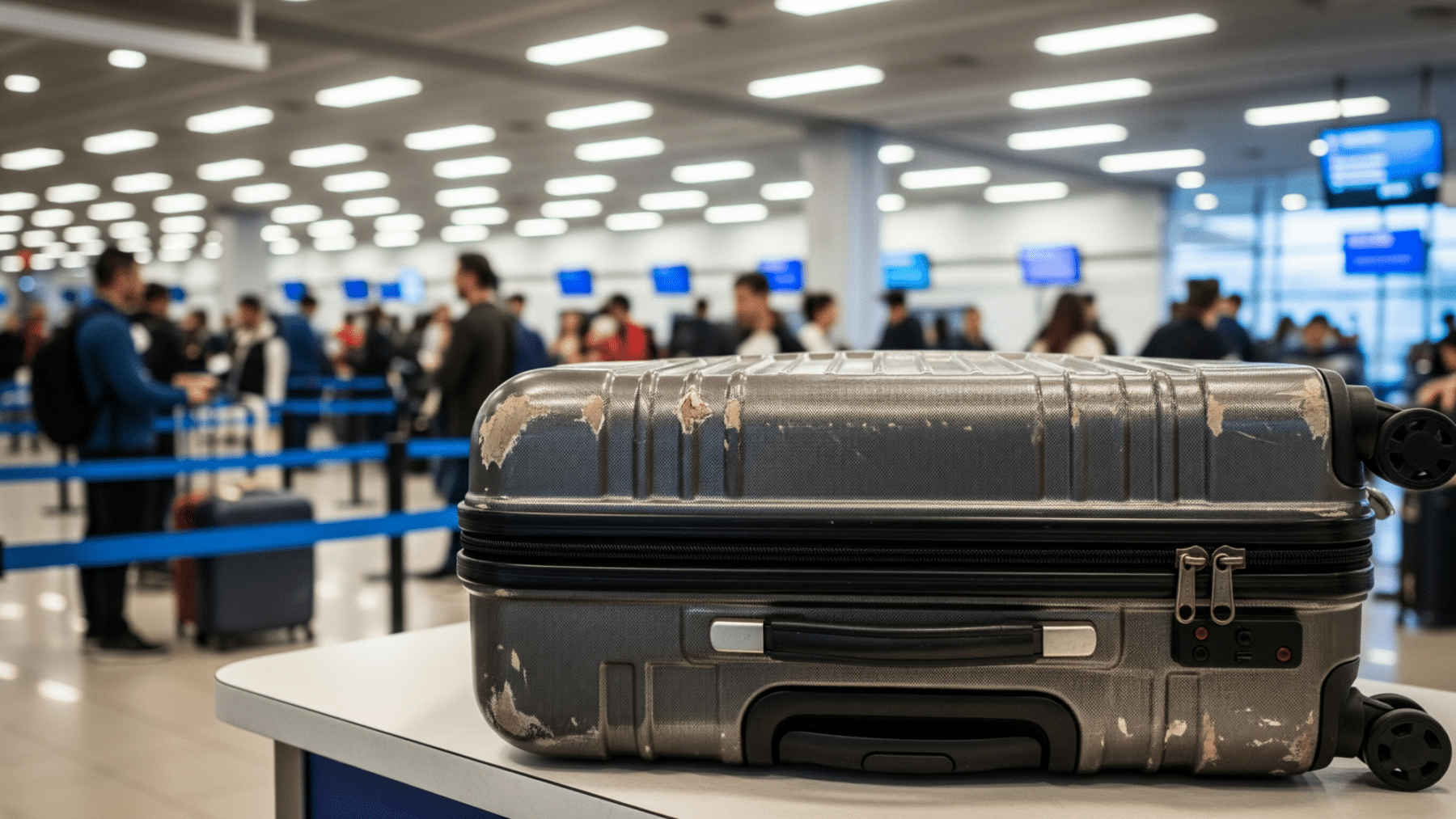
For a long time, one airline stood apart from every other carrier in America. Its entire pitch to travelers was simple: show up, check your bags, and pay nothing extra. No fine print. No loyalty card required. No threshold to hit.
That promise lasted more than half a century.
Then it ended, and almost nobody saw the second hit coming.
Why millions of travelers chose this airline for decades
For decades, Southwest Airlines offered two free checked bags to all of its customers.
That policy was a cornerstone of its customer-friendly image and a key differentiator in a competitive market.
Budget travelers built their whole booking strategy around it.
Families traveling with kids planned vacations knowing the bags were covered.
Road warriors rerouted connecting flights to use it. It was, for millions of Americans, simply part of the deal.
Major carriers were typically charging $30 to $35 for the first checked bag and $40 to $45 for the second on domestic flights.
For a family of four taking a two-week vacation, baggage fees alone at other airlines could add $240 to $280 to trip costs.
Choosing the one holdout was not just loyalty. It was rational math.
The moment the last holdout finally folded
Southwest Airlines officially ended its iconic “Bags Fly Free” policy, implementing a $35 fee for the first checked bag and $45 for the second starting May 28, 2025.
This historic policy change marked the end of a 54-year tradition that distinguished Southwest from all other major U.S. carriers and represented one of the airline’s most recognizable customer benefits.
It was a stark reversal for the only major American carrier that had still been offering two free checked bags to all passengers.
Southwest CEO Bob Jordan called the decision a “tremendous opportunity” for the airline to boost its profitability, while the carrier also pointed to mounting competitive pressure as a factor.
Financial analysts anticipated the change could generate significant additional revenue for the airline in the fiscal year.
Southwest’s new baggage fee structure officially took effect on May 28, 2025, applying to all flights booked on or after that date. Travelers who had booked before that date were protected, for now.
Everyone else was paying.
What happened at the gate almost immediately after
The behavioral reaction was instant and entirely predictable.
Immediately after ending free bags, the airline ran into a problem of its own making.
With travelers being forced to shell out at least $35 per checked bag, they instead began bringing a carry-on.
Overhead bins filled faster. Boarding times stretched.
Gate agents were caught managing a surge in carry-on volume that the aircraft layout had not been redesigned to absorb.
The airline had itself anticipated a shift in passenger behavior as travelers tried to avoid checked bag costs by bringing more carry-on luggage, and acknowledged this could increase boarding times and onboard congestion.
Meanwhile, with vacation plans already at a six-year low and travelers watching every dollar, the optics of a beloved perk disappearing were difficult to spin.
The fee that went up again before most people noticed
Here is the part the original headlines did not prepare anyone for.
On May 28, 2025, Southwest ended the “Bags Fly Free” policy that had made it the last major U.S. carrier to offer free checked bags on every fare, introducing fees for the first time in its history: $35 for the first bag and $45 for the second. That alone was a shock to loyal flyers.
Then, less than a year later, Southwest announced it was increasing its fees on first and second checked bags by $10, effective on all reservations ticketed or voluntarily changed on or after April 9, 2026.
The cost for the first checked bag rose from $35 to $45, and the cost for the second rose from $45 to $55.
That is a $10 increase per bag, per direction, in under twelve months.
Fees are per bag, per direction, meaning a round trip with one checked bag costs $90 total. On a family of four each checking one bag on a round trip, total bag fees now reach $360, money that cost nothing before May 2025.
Delta, United, and JetBlue all announced similar increases in 2026, citing rising jet fuel costs.
The FTC’s fee transparency rule, while welcome news for travelers already stretched thin by costs, does not ban fees, does not cap them, and does not tell airlines what they can or cannot charge. It is a transparency rule, not a price regulation.
And the fees are now prominently displayed, as required. They just keep going up.
What loyal flyers are doing differently now
The carry-on pivot has real limits.
Airlines tightened size standards even as bags multiplied in overhead bins.
The 22×14×9 inch carry-on size limit has become the widely published standard across major U.S. airlines, with American, Delta, United, Alaska, and JetBlue all citing those or very similar maximum dimensions for overhead bin access on most domestic routes.
Travelers with A-List Preferred status or those purchasing Southwest’s most expensive fares still enjoy free checked bags, while A-List members receive one free checked bag, and customers holding a co-branded Southwest credit card also benefit from one free checked bag.
Southwest was the last major U.S. airline to start charging for bags in May 2025, and now, less than twelve months later, has already raised those fees. A family of four flying this carrier round-trip and each checking one bag is now looking at $360 in bag fees per round trip, costs that simply did not exist before May 2025.
The era of truly free checked bags from a major U.S. airline is, for now, gone. What travelers have left is the right to see exactly what they owe before they click confirm.
