
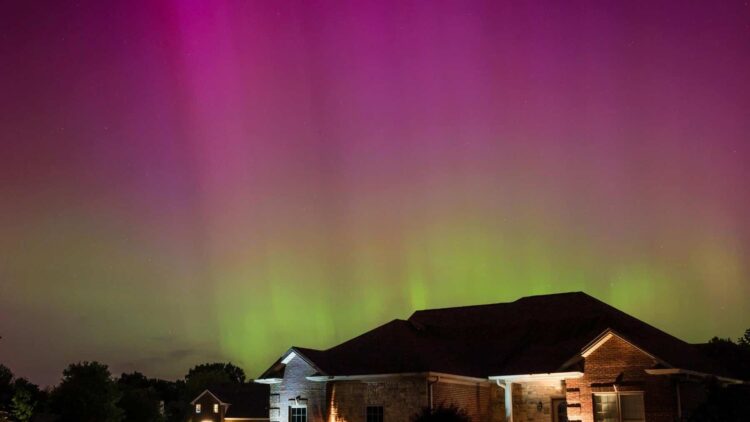
February is not just the month of love this year. A recent geomagnetic storm could cause the skies to be painted with the Northern Lights as soon as this upcoming weekend. Several states across the United States could get a breathtaking glimpse of the Aurora Borealis, so keep an eye on the sky from Friday.
Who will get to witness this miracle of nature?
The National Oceanic and Atmospheric Administration Space Weather Prediction Center predicts the arrival of energy from the storm, which can show up in our skies in brilliant shades of purple, green, blue and pink, may be visible in the northern latitudes of the U.S. and parts of the Midwest.
The NOAA anticipates that the northern lights will be strongest on Friday or Saturday night. States with the best chances of viewing these gorgeous purple, green and blue hues include Alaska, Washington, Idaho, Minnesota, Montana and North Dakota. Although less likely, viewers in South Dakota, Michigan, Wisconsin, New Hampshire, Vermont and Maine may also see the aurora.
The solar storm’s fiercest phase is expected to come in the early hours of Saturday. Sunday evening and continuing into Monday, the aurora borealis should begin to fade, according to NOAA’s forecast.
In extremely rare instances of aural events, the stunning display can be seen across the United States and Europe. The University of Alaska even reported one particularly extreme case where the northern lights were visible in New Mexico in 1958.
What is the Aurora Borealis and how does it occur?
Energy and charged particles are sent to Earth by the sun and this phenomenon is known as solar wind. This solar wind can sometimes become a storm. This occurs when the sun’s outer atmosphere occasionally “burps” out huge bursts of energy called coronal mass ejections. They then produce solar storms, also known as geomagnetic storms, according to NOAA.
Thanks to the Earth’s magnetic field, we are shielded from these storms for the most part. However, particles can travel down the magnetic field lines along the north and south poles and into Earth’s atmosphere.
When the particles interact with the gases in our atmosphere, they can produce light. Each color that is produced is related to the element that the particles react with. We get blue and purple from nitrogen, green and red from oxygen. It is this chemical reaction that produces the colors that make for the absolutely stunning night sky we know as the northern lights or Aurora Borealis.
On Jan 20, the sun experienced a coronal mass ejection, which is what causes the auroras, according to NASA. The space agency said the ejection was an M5.5-class flare – a medium-strength solar flare – and is headed toward Earth. A G2-level geomagnetic storm, classified as a “moderate” storm, was predicted by NOAA.
What are the optimal viewing conditions?
The National Oceanic and Atmospheric Administration Space Weather Prediction Center recommends that people who are looking to view this natural phenomenon should get as far away from light pollution as possible. Just as light pollution makes it seems like there are no stars left in the night sky, light pollution will likely have a similar effect on the beautiful ripples of blue, green, red, and purple that will be spreading through the sky.
Astronomers at NASA said in October 2024 that our star had just started this part of its current cycle and that it will likely experience increased storm activity for some years to come. As a result, the solar maximum, the apex of the sun’s 11-year activity cycle, is when all types of solar weather, which includes more coronal mass ejections and geomagnetic storms, will occur most frequently.