
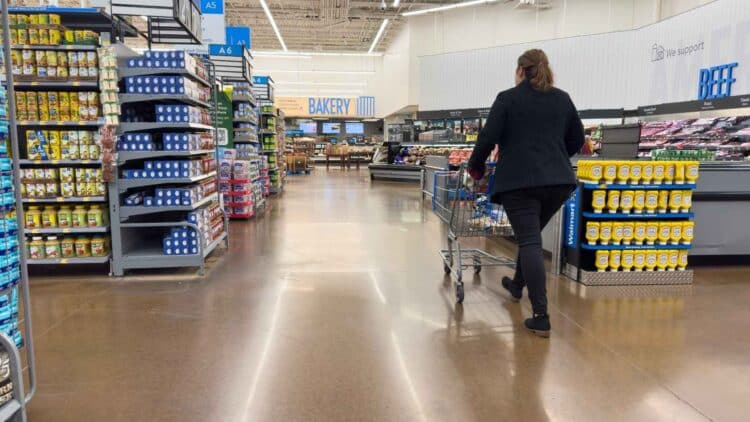
Supermarket giant Walmart appears to be treading in some precarious waters as it tries to keep up with growing inflation rates and an increasingly waning sense of confidence from customers.
As it stands, the retail landscape is something of a catch 22 for both consumers and businesses alike. On one hand, consumers are being compelled to tighten their budgets as prices continue to rise. On the other, retailers are hiking prices as a result of slow sales and external pressure due to skyrocketing tariffs and a potentially escalating trade war.
Walmart stocks are plummeting
Retailers large and small having been struggling as of late, however, Walmart in particular has been facing a surprising amount of controversy since the year began — and some of it has no relation to pricing and economic factors.
Walmart CEO Doug McMillon recently noted that he had been noticing “stressed” behavior from customers as tightened budgets weighed down on them. Last Tuesday, it was revealed that the supermarket chain lost $22 billion worth of valuation and customer confidence has stooped to a 12 year low.
Financial constraints are not the only reason customers have been turning away from this supermarket, however. The retailer’s decision to axe all DEI policies severely impacted its reputation and led to large scale boycotts, worsening the overall situation for the company.
By market close last Tuesday, company shares dropped by approximately 3% and as a result, the market cap is now standing at around $680 billion. Bad news for the retailer continued after e-commerce giant Amazon beat out Walmart in terms of quarterly earnings for the first time since the inception of both retailers, according to last month’s reports.
The state of the economy is partially to blame for these losses as tariff negotiations and growing inflation rates have been a cause of great concern to consumers. Conference Board reports show that consumer confidence has fallen for the last four consecutive months. The index dropped to 65.2 which is “well below the threshold of 80 that usually signals a recession ahead.”
In a statement, Stephanie Guichard, senior economist at the Conference Board, shared, “Consumers’ optimism about future income — which had held up quite strongly in the past few months — largely vanished, suggesting worries about the economy and labor market have started to spread into consumers’ assessments of their personal situations.”
In this regard, McMillon also shared at a February 27 talk that, “You can see that the money runs out before the month is gone, you can see that people are buying smaller pack sizes at the end of the month.”
Customer confidence vs. the bottom line
Consumer behavior experts are warning that a change in confidence will not likely be seen any time soon and this could taken as a warning sign that “economic recovery may be stalling.”
“While the pain of inflation is hurting many Americans right now, the effect of inflation on your cost of living just compounds over time,” Kelly LaVigne, vice president of consumer insights at insurance company Allianz Life, explained to Fortune. “That means inflation will continue to erode your purchasing power, unless you have a long-term strategy to address it.”
According to a survey conducted by Allianz Life, “71% of consumers expect inflation to worsen over the next 12 months, which is up from 60% at the end of 2024.” Additionally, “75% of surveyed consumers worry new tariffs will increase their living expenses.”
Despite this, McMillon does not seem to be especially concerned about the impact of Trump’s high tariffs on the price of goods.
“Tariffs are something we’ve managed for many years, and we’ll just continue to manage that,” McMillon confirmed in the latest earnings call.
On the same call, however, Walmart chief financial officer John David Rainey noted that there were “still uncertainties related to consumer behavior and global economic and geopolitical conditions.”
As shaky as things seem at the moment, the retailer did still manage to post growth last quarter. However, profit and revenue growth is projected to slow for the fiscal year and as a result, Walmart’s share price took a 6% dip.
“We don’t want to get out over our skis here,” Rainey reiterated. “There’s a lot of the year to play out. Again, we feel good about our ability to navigate the environment, whether it’s tariffs or other macro uncertainty.”