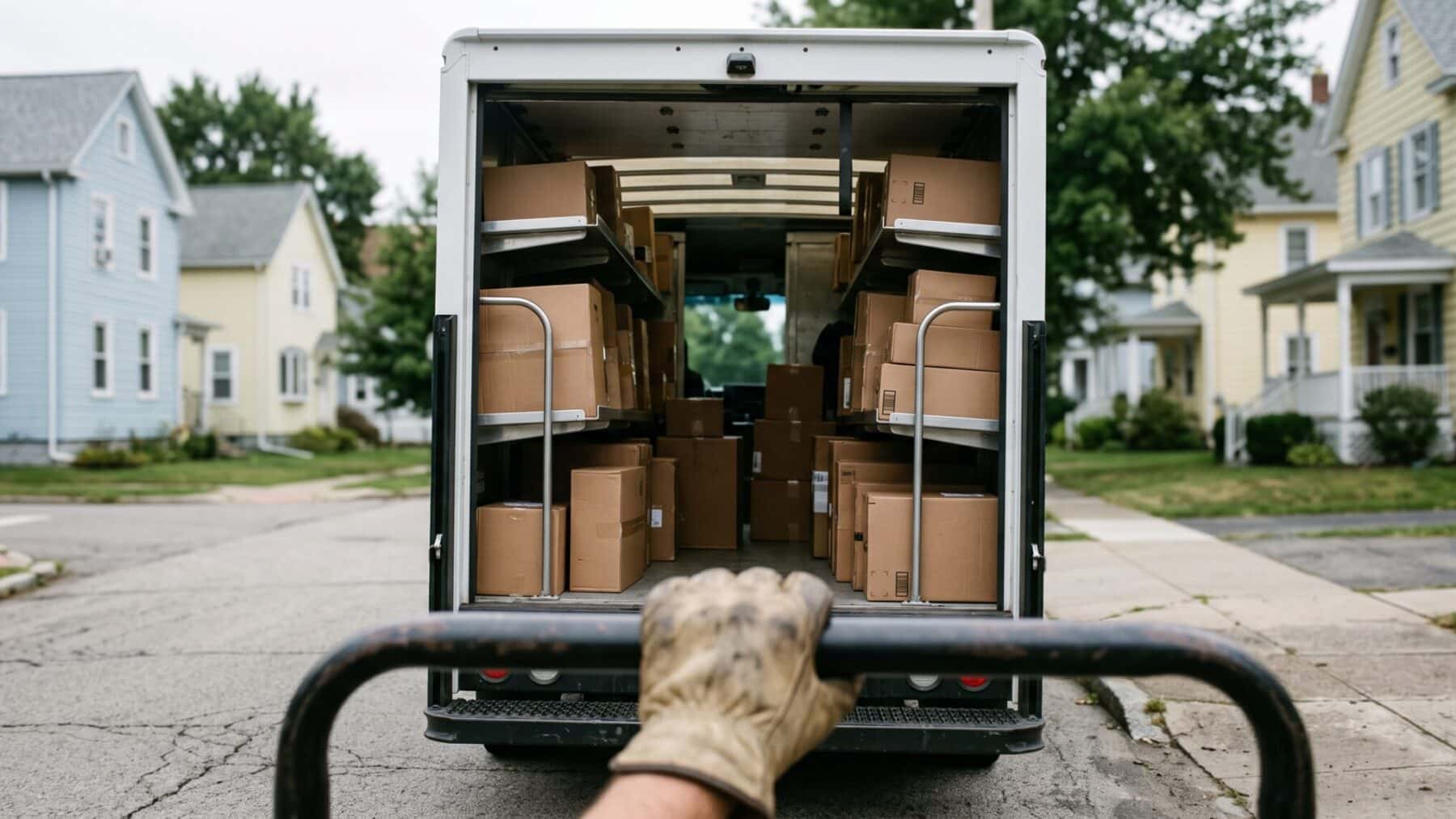
Picture the brown van that stops outside your house most afternoons.
The driver hops out in under four seconds. The back door is already open. A shelf holds the right box at shoulder height. None of that is accidental. Every move inside that cab was modeled, timed and locked into hardware before the first van left the factory. So what, exactly, is doing the work?
How the van turns a parked moment into a choreographed sprint
The trigger is deceptively simple. When the driver shifts into park, a signal fires to the powered bulkhead door separating the cab from the cargo bay, swinging it open automatically before a foot hits the pavement. No button, no reaching across a console.
The seat is equally deliberate. Tilting to stand up lowers the driver’s hip just enough to clear the steering wheel, and that same pivot places the hand directly beside a purpose-built holder for the delivery scanner. One movement, and the driver is upright with the device already in hand.
Then the cameras take over. A 360-degree exterior view feeds a digital display, and automatic bulkhead doors and 360-degree cameras are standard across both variants. Highway lane-keep assist and adaptive cruise control handle freeway legs between dense neighborhoods. Inside the bay, integrated shelving puts every parcel within arm’s reach.
Seconds saved per stop, across hundreds of deliveries a day, is how the unit economics justify the price tag.
What 30,000 vans on US streets actually looks like
Amazon now has over 30,000 custom-built Rivian Electric Delivery Vans (EDV) delivering packages across thousands of cities in the US. That is a 50 percent jump from the end of 2024, when Amazon had over 20,000 Rivian EDVs in its fleet.
Under the skin, the Delivery 500 and Delivery 700 variants each feature a 100 kWh lithium iron phosphate battery pack, and both models are powered by a front-wheel-drive single-motor powertrain delivering 320 horsepower. Rivian rates the Delivery 500 at 161 miles and the Delivery 700 at 160 miles on a full charge. The 500 carries a maximum payload of 2,663 pounds, while the 700 is rated at 2,258 pounds. That range figure was deliberately matched to dense urban routes where a depot is never more than a half-day away.
Behind the scenes, Amazon has installed over 17,000 EV chargers at 120 of its delivery centers to keep the fleet topped up overnight, making it the largest private EV charging operator in the US. Every van returns to a live socket each night, bypassing the public charging network entirely.
The platform behind the van and where the numbers come from
The EDVs use the RCV platform, which is derived from the R1 platform underpinning Rivian’s R1T pickup and R1S SUV, sharing the same basic electrical and network architecture, electronic control units and battery-pack design. That shared foundation let engineers adapt a proven commercial body to existing drive-system hardware without designing a new powertrain from scratch, which kept unit costs in check.
The commercial van is available in two variants: the Delivery 500 and Delivery 700. The 500 is more compact than the 700, with the names reflecting approximate cargo volume in cubic feet. Overall body length is 248 inches on the 500 and 278 inches on the 700.
After the exclusivity agreement ended in 2023, any fleet operator can now order the Commercial Van, with the Delivery 500 starting at $79,900 and the larger 700 at $83,900. Both prices sit well above a comparable diesel van. Fleet managers tracking total ownership costs say the savings stack up most quickly on predictable urban routes, where fuel and maintenance gaps close the price difference over a typical vehicle life.
Where the 160-mile ceiling becomes a real constraint
Front-wheel drive and modest range have limited the van’s deployment in rural regions, longer routes, and harsher winter climates. Those conditions still belong to diesel.
Rivian is developing a larger battery pack targeting roughly a 30 percent range increase and a new all-wheel-drive configuration, which could push the ceiling to approximately 209 miles. An all-wheel-drive version is also in the pipeline alongside that bigger pack. That combination would let a single van cover a suburban-to-rural route and return without a midday charge stop, which is the last real bottleneck for fleets trying to retire their remaining diesel holdouts.
Meanwhile, serious rivals are arriving. Amazon’s European EV fleet added nearly 5,000 Mercedes-Benz vans deployed across Austria, France, Germany, Italy, and the United Kingdom, diversifying its supplier base beyond Rivian. Other major automakers have announced electric van programs targeting US production later this decade. The segment that one company effectively invented now faces competition from every direction, a dynamic visible in the broader US automaker profit picture.
What the next chapter looks like for the fleet that rewrote last-mile delivery
Amazon is committed to adding 100,000 Rivian electric vans to its delivery fleet by 2030. The 30,000-van milestone is real, but the gap to that target is still wide. At last year’s growth rate the math is reachable, though it requires the AWD and long-range variants to unlock routes the current van cannot serve.
The deeper lesson may be the design philosophy itself. These vans were built around the delivery process, not around a range figure or a sticker price. Rivian’s commercial vans were specifically designed around the delivery process to minimize the total cost per package delivered, through features such as an automatic bulkhead door that opens as the driver reaches each stop. Engineering time savings into the physical cabin, then letting electricity handle the fuel bill, is the formula the rest of the industry is now studying closely.
For the millions of households that already see one of these vans most afternoons, the upgrades will be invisible. The door will open before the driver stands, and the shelf will hold the right box. But the van doing it will soon travel farther, grip better in a January sleet storm, and reach the winding country roads that diesel still owns today.
