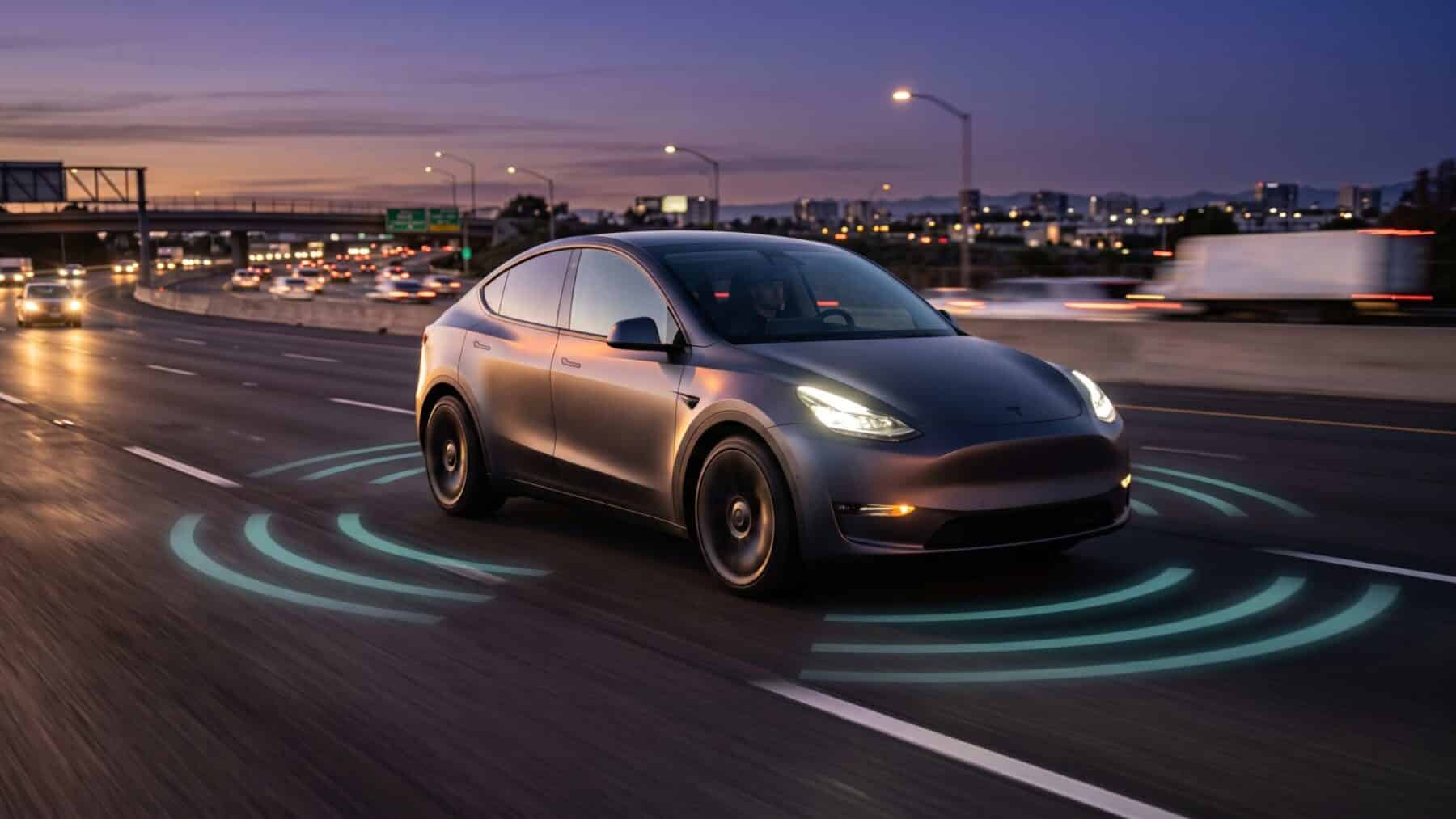
The U.S. Department of Transportation’s National Highway Traffic Safety Administration announced that the 2026 Tesla Model Y is the first vehicle model to pass the agency’s new benchmark for vehicles with advanced driver assistance systems. The designation, published May 7 on NHTSA’s official newsroom, marks the first result under recently added pass/fail evaluations that federal regulators integrated into the long-running New Car Assessment Program.
What the new tests measure
The new benchmark rating applies to 2026 Tesla Model Y vehicles assembled on or after November 12, 2025. The updated NCAP program incorporated new advanced driver assistance technologies and added pass/fail evaluations to better protect those both inside and outside the vehicle.
Those four new tests are pedestrian automatic emergency braking, lane keeping assistance, blind spot warning, and blind spot intervention.
The Model Y also passed the agency’s four original ADAS criteria: forward collision warning, crash imminent braking, dynamic brake support, and lane departure warning. Unlike traditional crash-test ratings that assign stars or scores, the updated ADAS evaluations use a pass-or-fail system.
The tests are part of NHTSA’s New Car Assessment Program (NCAP), which runs the government’s five-star safety rating program. The 2026 Model Y holds a five-star safety rating based on crashworthiness evaluations; the new ADAS evaluations are pass/fail checkmarks and do not affect a vehicle’s overall five-star NCAP rating, which remains based on crashworthiness.
NHTSA frames it as an industry benchmark
NHTSA Administrator Jonathan Morrison said: “Today’s announcement marks a significant step forward in our efforts to provide consumers with the most comprehensive safety ratings ever. By successfully passing these new tests, the 2026 Tesla Model Y demonstrates the lifesaving potential of driver assistance technologies and sets a high bar for the industry. We hope to see many more manufacturers develop vehicles that can meet these requirements.”
These pass/fail tests, which have recently been added to NHTSA’s New Car Assessment Program, are intended to ensure consumers have the information they need to assess the safety benefits of new technologies. By including ADAS in these new tests, the agency is also encouraging automakers to prioritize innovations that keep families safe on the roads.
On December 3, 2024, NHTSA published a final decision notice that adds four new ADAS technologies to the NCAP, enhances performance evaluation of existing ADAS technologies currently in NCAP, and finalizes a 10-year roadmap for updating NCAP through multiple phases for the period 2024 through 2033. The notice responds in part to the provisions in section 24213 of the Infrastructure, Investment, and Jobs Act. The safety update was included as part of the Bipartisan Infrastructure Law. The NCAP is a voluntary consumer information program administered by NHTSA that provides comparative safety information for new vehicles.
NHTSA originally finalized these NCAP updates in late 2024 for model year 2026 vehicles. In September 2025, the Trump administration delayed full implementation by one year to model year 2027, after the Alliance for Automotive Innovation, the industry’s main lobbying group, asked for more time. That delay means the Model Y being “first” to pass doesn’t mean it’s the only vehicle with these capabilities, it means it’s the first one NHTSA has formally tested under the new framework.
Parallel scrutiny over Full Self-Driving
Tesla reached the milestone while NHTSA continues separate investigations into the automaker’s Full Self-Driving system over concerns tied to visibility conditions and driver-warning safeguards. The agency escalated its probe into Tesla’s Full Self-Driving system from a Preliminary Evaluation to a more serious Engineering Analysis stage, a step that typically precedes a recall. The investigation now covers an estimated 3.2 million Tesla vehicles spanning Model S, Model X, Model 3, Model Y, and Cybertruck vehicles equipped with FSD technology. Regulators are specifically examining whether Tesla’s camera-based Tesla Vision system can properly detect reduced-visibility conditions such as sun glare, fog, dust, and other environmental obstructions, and whether the system adequately warns drivers when visibility limitations affect the vehicle’s ability to operate safely.
NHTSA continues emphasizing that Tesla’s Full Self-Driving system remains a driver-supervised assistance feature rather than a fully autonomous driving system. The two regulatory tracks reflect a broader tension in how the agency evaluates automakers that sell both baseline ADAS features and more advanced, subscription-based driver-assist software on the same platform.
What comes next for NCAP testing
The expanded testing reflects growing regulatory focus on advanced driver-assistance systems as traffic fatalities and pedestrian deaths remain a concern nationwide. Industry analysts say the changes signal a broader shift toward evaluating crash-prevention capabilities alongside traditional crashworthiness performance.
NHTSA will begin conducting its own assessments of certain ADAS features using contracted test labs for model year 2027 vehicles. Whether other automakers accelerate their own NCAP submissions before the 2027 deadline will determine how quickly consumers can compare ADAS performance across brands on a single federal scale. The semiconductor supply partnerships now linking chip makers directly to Tier 1 automotive suppliers suggest the hardware pipeline for these sensor-heavy systems is being reinforced ahead of that deadline.
