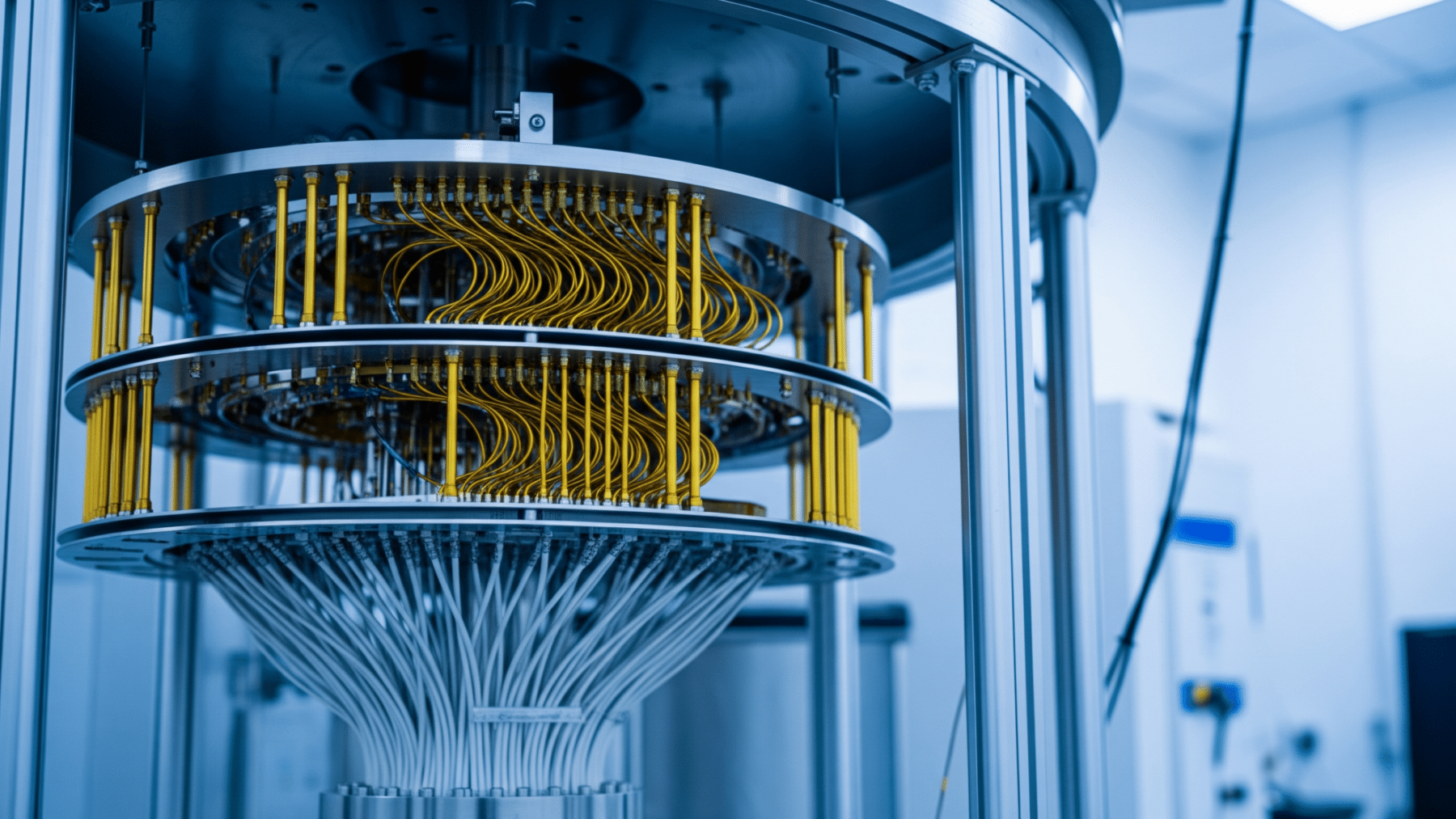
There is a machine sitting in a handful of laboratories right now that most Americans have never seen in person, will likely never touch, and have probably scrolled past a dozen headlines about without stopping.
It hangs inside a metal cylinder. It has to be kept colder than outer space to work.
And analysts just put a number on what it could eventually be worth that is genuinely hard to sit with.
The machine that barely anyone uses but everyone is watching
There are now more than 40 commercially available quantum processing units globally, and more than 300 organizations are already collaborating with quantum technology vendors.
That is a lot of corporate attention for hardware that, by most measures, is still in its early stages.
Today’s machines remain noisy, small in logical-qubit terms, and too fragile for broad, repeatable economic advantage across mainstream enterprise workloads.
So why are boardrooms paying attention? Because the people who track this industry for a living just revised their forecast, sharply upward.
What it actually costs to play in this space right now
Over 300 companies worldwide, including Airbus, JPMorgan Chase, and Boehringer Ingelheim, are now actively working with quantum technology vendors to address commercial challenges.
That is not a research club. That is a market forming.
One third of companies surveyed allocated more than $10 million to quantum computing in 2025, with 7% spending more than $50 million.
Most of that money went toward developing specific use cases and building internal teams, rather than acquiring hardware outright.
Roughly 60% of 2025’s total investment concentrated in the top ten deals, and private investment dominated, accounting for 97% of funding compared to 67% in 2024.
The money is consolidating fast, which is usually what happens just before a technology tips.
The engineering problem that the whole industry is racing to solve
The central obstacle is not power or size. It is errors in calculation, tiny disturbances from heat, vibration and electromagnetic noise that scramble results before they can be used.
In 2026, error correction is not a technical footnote. It is the central engineering challenge that determines whether quantum computing transitions from laboratory achievement to an industrial tool.
IQM Quantum Computers announced a significant achievement in quantum error correction using directional tile codes, a new family of error-correcting codes co-authored with collaborators at Freie Universität Berlin, the University of Edinburgh, and Johannes Gutenberg-Universität Mainz.
That kind of multi-continent research push is what solving a hard problem looks like.
The site has already covered how Quantinuum demonstrated the first universal topological gate set using non-Abelian anyons, another signal of just how fast the error-correction race is moving.
Current published roadmaps target useful fault-tolerant operation in the 2029 to 2033 timeframe. IBM’s Starling system targets 200 logical qubits with 100 million operations in 2029, and its Blue Jay system targets 2,000 logical qubits with 1 billion operations by 2033.
The $2.7 trillion number that McKinsey just put on all of this
Here is the figure that made analysts pause when the report landed this spring.
Quantum computing could create up to $2.7 trillion of economic value worldwide by 2035 as it enhances current industry use cases and unlocks new ones, according to McKinsey’s 2026 Quantum Technology Monitor.
The 2026 monitor significantly revised previous projections upward, with the range now running from $1.3 trillion to $2.7 trillion by 2035.
Quantum computing companies generated more than $1 billion in revenue worldwide in 2025, and that figure could grow to as much as $4.4 billion by 2028.
The value is expected to span industries from chemicals and financial services to travel and logistics, sectors that touch almost every American’s daily life and wallet.
That is a sum approaching the entire current gross domestic product of a major European economy, flowing from machines that most people still cannot picture.
Why the window is opening now, not later
The quantum computing market remains nascent, but companies that move now to build capabilities and test real use cases could define the industry’s future and be well positioned to access the up to $2.7 trillion in economic value that could emerge in the next decade.
Investment in quantum technology start-ups reached $12.6 billion in 2025, 6.3 times higher than in 2024, according to McKinsey’s 2026 Quantum Technology Monitor, with revenues on track to more than quadruple by 2028.
The same dynamic is showing up across emerging tech: as covered here on the AI assistant market, the biggest shifts in technology tend to look unremarkable right up until the moment they do not.
For most Americans, quantum computing is still an abstraction, something that lives in a press release or a science segment. But the money is moving, the engineering is advancing, and the number that analysts just put on the outcome is no longer something the business world is willing to ignore.
