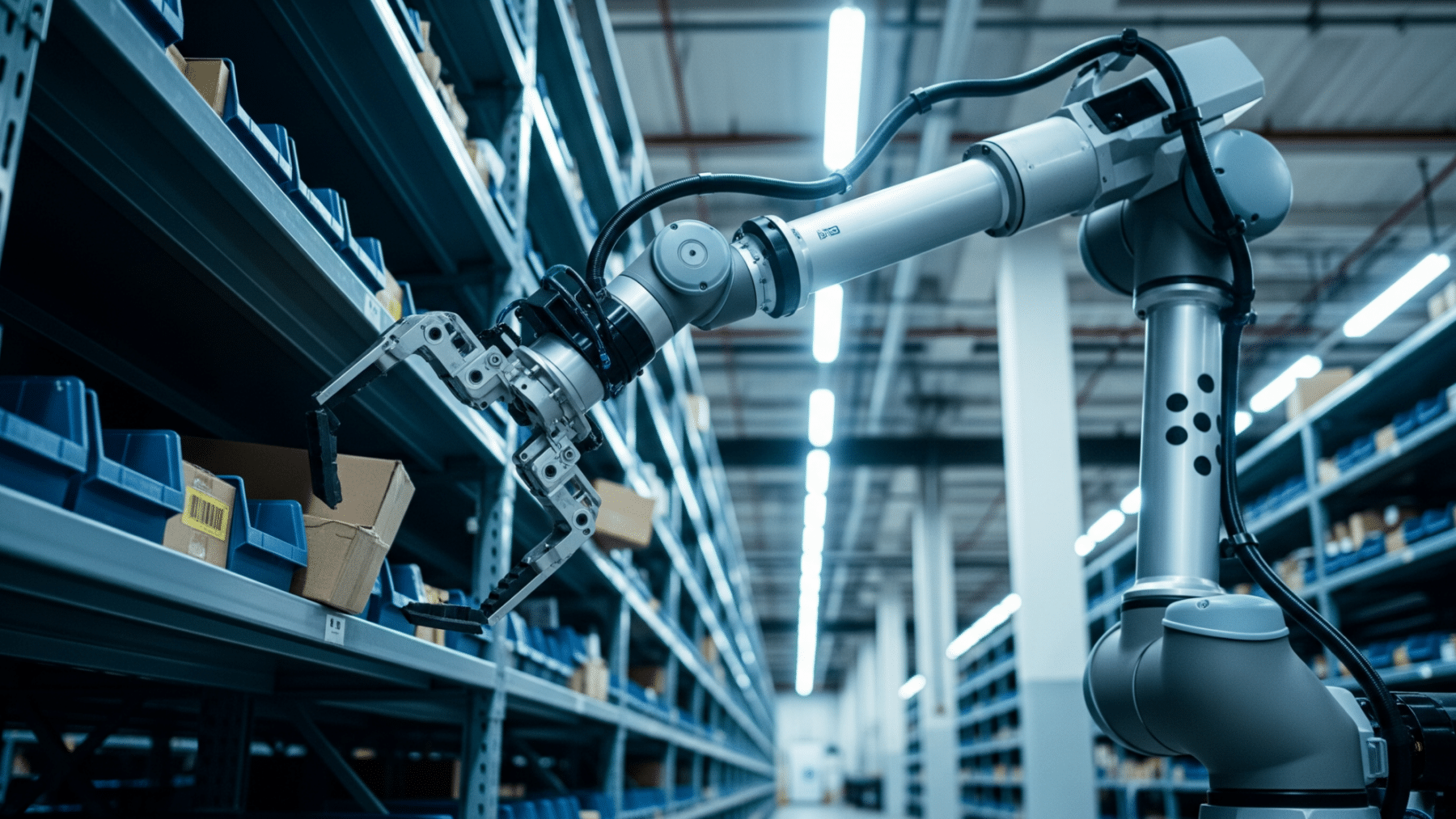
Every time a package lands on your doorstep the next day, someone, or something, spent the night before pulling it from a cluttered shelf.
For years, that “someone” had to be human. Robots could drive, sort and stack. But the moment an arm needed to reach into a crowded bin and feel its way around fragile objects, the machine lost.
That constraint has quietly shaped the economics of every fulfillment center in America. And a specific number announced in 2025 marks the moment it began to change.
The fleet milestone that rewrote what a warehouse looks like
As of July 2025, Amazon had deployed its one-millionth robot across its global fulfillment network, with that milestone robot delivered to a fulfillment center in Japan.
That number did not arrive overnight. It started when Amazon acquired Kiva Systems in 2012 and began building purpose-built machines to speed up warehouse work.
After 13 years of deploying robots into its warehouses, Amazon reached that new milestone. Global robot installations reached 542,000 new units in 2024, more than double the number installed ten years earlier, according to the International Federation of Robotics. The worldwide active stock of industrial robots reached 4,664,000 units in 2024, a 9 percent increase from the previous year.
Amazon alone now accounts for roughly one-fifth of that global total. The milestone strengthens the company’s position as the world’s largest manufacturer and operator of mobile robotics.
Why a million robots still left a stubborn gap on the shelf
Warehouse robotics had traditionally been limited by machines that can see but cannot feel their environment.
That fundamental constraint restricted robots to basic transportation tasks or simple pick-and-place operations in highly controlled settings.
The hard part was always the pick itself. Bins are cluttered. Items shift. A suction cup aimed at a shampoo bottle might grab a lip balm instead.
Amazon’s director of applied science, Aaron Parness, described the typical robot as “numb and dumb,” noting that in the past, “when industrial robots have unexpected contact, they either emergency stop or smash through that contact”, often unable to sense whether they have hit anything at all. The physical AI race had been converging on exactly this challenge across the whole robotics industry.
A new kind of arm arrives at the Spokane facility
Amazon unveiled Vulcan, its first robotic system equipped with tactile and force-sensing capabilities, at the “Delivering the Future” event in Dortmund, Germany on May 7, 2025.
Unlike previous vision-only systems, Vulcan can detect physical contact and measure the force it applies in real time, letting it pick up, move, and stow a wide variety of items without crushing, dropping, or otherwise mangling them.
The system uses arms supplied by Universal Robots, the Denmark-based robotics firm that Teradyne acquired in 2015.
Vulcan is operational at fulfillment centers in Spokane and Hamburg, where it handles picking and stowing across both sites. The robot arm made its debut in Amazon’s fulfillment center in Spokane, Washington, while a robot in Hamburg, Germany was testing Vulcan’s ability to pick out specific items from inventory.
The processing numbers were striking.
Vulcan’s dexterity allows it to handle approximately 75 percent of item types found in fulfillment centers at speeds on par with human workers.
The real shift: touch sensing closes the manipulation gap that kept humans irreplaceable
The reveal hidden inside Amazon’s robot milestone is not the headcount. It is what the new machines can actually do that older ones could not.
Amazon has framed Vulcan as a complement to human workers, not a replacement. The company says the system is designed to relieve employees of physically demanding tasks like repeated stretching, bending, and heavy lifting.
Vulcan overcomes earlier constraints with its end-of-arm tooling, resembling a ruler fused to a hair straightener, augmented by force feedback sensors that gauge and regulate applied force to prevent damaging goods.
Amazon’s director of applied science, Aaron Parness, told Amazon’s own newsroom that Vulcan “represents a fundamental leap forward in robotics,” built on key advances in robotics, engineering, and physical AI as Amazon’s first robot with a sense of touch.
A next-generation Proteus robot, unveiled at Amazon’s “Delivering the Future” event in London on June 4, 2026, layers on conversational language commands, letting workers direct the autonomous mobile robot using plain-language instructions. Employees can direct it in the same way they’d communicate with a colleague, with no technical commands and no programming interface, and the robot takes care of the rest, including determining priority, route and timing.
The compute enabling all of this is moving fast too. The hardware pushing physical AI into real-time inference has grown powerful enough to run force-feedback loops and vision systems simultaneously on a single warehouse floor.
What the next stage of the million-robot fleet means for everyone who orders online
Amazon plans to add Vulcan to more U.S. and German facilities, with further rollouts set for 2026 before a broader global expansion.
Amazon also said its STARK robotic tote-handling system, piloted in Barcelona, would expand to 15 European sites by 2027, all inside a European investment of more than €10 billion to modernize its fulfillment network.
Amazon said over 700,000 employees have been upskilled through training programs that prepare its workforce for the future , including its Career Choice program, a figure the company points to when asked whether robots displace people.
The company says its automation strategy is creating new, higher-skilled roles in robotics support and maintenance. While some studies identify potential job losses due to automation, others suggest a more nuanced impact, with the implementation of robots like Vulcan leading to the creation of new positions to assist the technology as needed. Parness has said that instead of replacing people, Vulcan will generate new jobs maintaining, operating and building the robots, and that he does not believe in 100 percent automation.
The real consequence for the average American shopper is simpler: a robot that can feel a fragile object without breaking it is a robot that can handle almost everything on your next order, and get it to your door faster than any human shift could manage alone.
