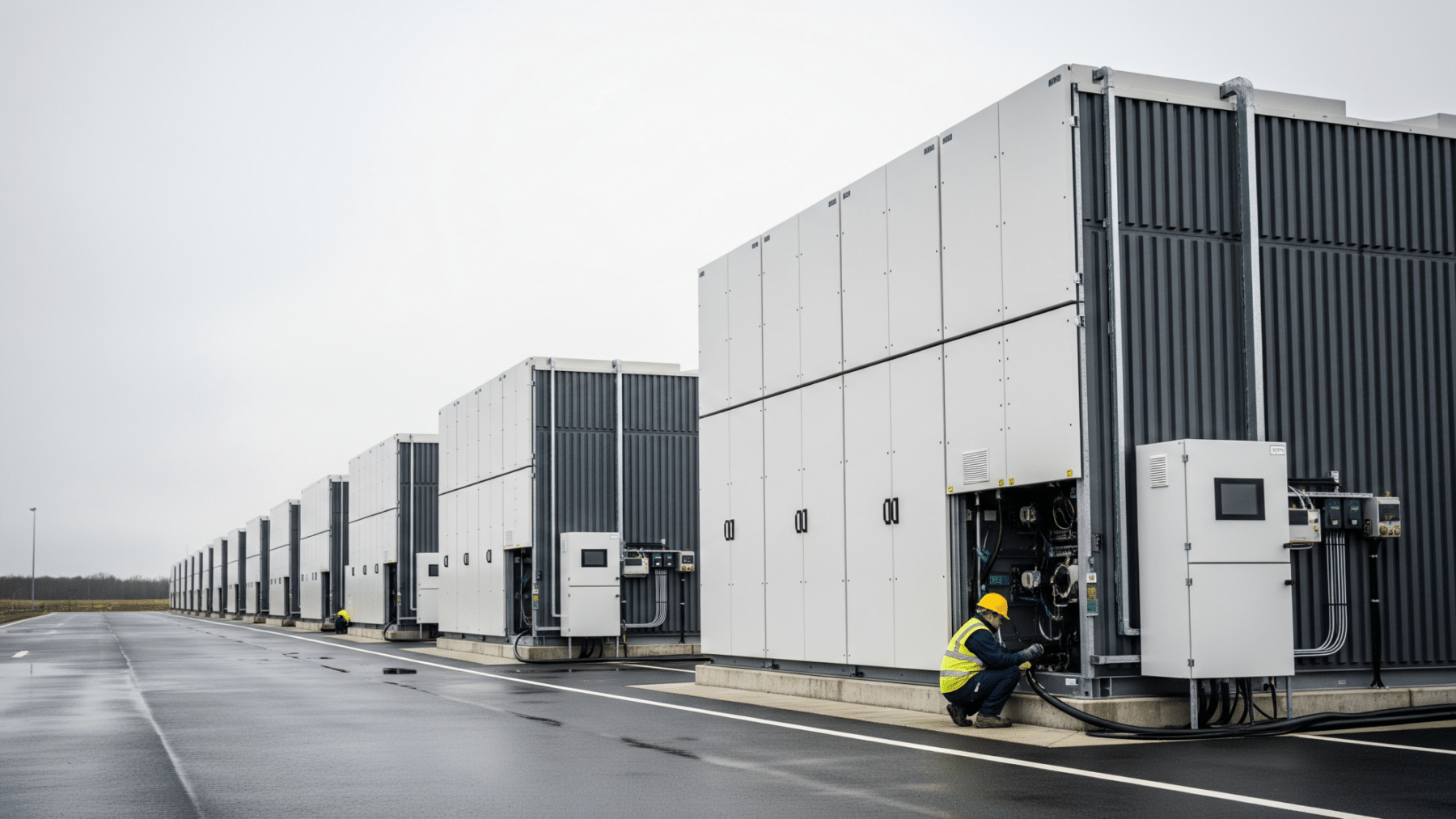
Something unusual happened to America’s power grid in the first three months of 2026, and most people outside the electricity business never noticed it.
The numbers that turned up in the quarterly reports were quietly historic, and they pointed to a buildout reshaping what the U.S. grid looks like at a speed the industry itself didn’t fully anticipate.
The scale of what moved in those three months is the kind of figure that rewrites forecasts rather than confirming them.
The plan that seemed almost too ambitious when it was written down
At the start of 2026, the U.S. Energy Information Administration published its outlook for the year ahead.
Developers plan to add 24 GW of utility-scale battery storage to the grid in 2026, up from a record 15 GW added in 2025, according to the Energy Information Administration’s February 2026 analysis.
That is a staggering jump for a single year, and industry analysts noted it with some skepticism.
Planned additions are not the same as completed ones.
Permitting delays, supply-chain bottlenecks and financing gaps have tripped up ambitious pipelines before.
So the real question was whether the opening months of the year would back up the headline figure.
A first quarter that nobody in the industry had ever seen before
The answer came quickly.
The U.S. energy storage market installed a record 3.3 gigawatts of battery energy storage systems in Q1 2026, surpassing the previous first-quarter record by 54%, with utility, commercial and residential installations all hitting new highs, according to the U.S. Energy Storage Monitor report from the American Clean Power Association and Wood Mackenzie.
Every segment of the market moved at once.
That kind of broad-based surge is unusual, though analysts noted that Q1 growth was largely driven by project delays carried over from 2025, as developers raced to meet tax-incentive eligibility deadlines in the second half of last year.
Normally one segment drives a quarterly spike while others lag, making the overall gain look narrower than the headline implies.
This time the acceleration was uniform across all three segments, a signal that the pipeline built up across 2025 was real and deep enough to clear every corner of the market at once.
Analysts tracking the pipeline described it as a structural shift, not a seasonal anomaly.
How the country got here, and why the pace keeps accelerating
The 2026 pipeline did not materialize from nowhere. The ground had been shifting for years.
The U.S. energy storage industry installed a record-shattering 57.6 gigawatt-hours of new capacity in 2025, the largest single year of new battery capacity additions on record.
Energy storage installations grew 30% from the previous record set in 2024, and are four times what the industry installed just three years ago.
Behind that curve is a cost story that grid planners keep citing in rate filings, interconnection queues, and resource adequacy studies.
In Q4 2025, new activity was spread across 13 different states, demonstrating market diversification outside of California and Texas, which have historically dominated utility-scale battery energy storage deployment.
That geographic spread matters enormously for grid resilience.
A buildout concentrated in two states is a regional infrastructure story. One running through 13 states starts to look like a national rewiring.
Utilities weighing whether to lock customers into long-term rate structures are watching all of this closely. In states like Arizona, where grid hardware costs have already jumped as much as 64 percent, the math on storage is shifting faster than regulators expected.
The cost collapse that made a 24-gigawatt year possible
Here is the fact that reframes everything above.
Battery storage is the fastest-growing power technology today.
In 2025, 108 GW of new battery storage capacity was deployed worldwide, 40% more than in 2024, and installed capacity is now eleven times higher than in 2021.
The IEA’s Global Energy Review 2026 puts the reason plainly: battery costs declined by more than 90% between 2010 and 2025, driven by innovation, competition and economies of scale.
A technology that once required a premium project budget now pencils out as the cheapest way to add flexible capacity to a grid in dozens of markets simultaneously.
Lithium-iron phosphate batteries now account for around 90% of deployments. While less energy-dense than rival chemistries commonly used in EVs, LFP batteries are typically cheaper and better suited to more frequent cycling.
Just five years ago, the market share of LFP batteries in deployments was well below 50%. That chemistry shift is part of why the cost curve kept falling even after analysts expected it to flatten.
Projections indicate the United States will install half a terawatt-hour of storage from 2026 through 2031, a 250% increase over the prior five-year period.
What a record first quarter means for the bills Americans pay next year
A record Q1 does not guarantee the full 24 GW lands by December, but it does mean the pipeline is real and moving.
Expansion of virtual power plant programs in states like Massachusetts, Texas, Arizona, and Illinois are driving residential storage deployment, which helps states cut costs, manage peak demand, and strengthen grid resilience.
For ordinary ratepayers, the connection to monthly bills is direct.
Batteries that discharge during peak hours reduce the price spikes that show up in demand charges and capacity costs, the same line items that drive rate cases like the one Colorado regulators are currently reviewing, where a record-breaking figure is sitting before a state commission right now.
Texas is set to overtake California in 2026 as the largest storage market in the country.
The grid that most Americans grew up with was built around large central power plants that run around the clock.
The one being built right now runs on a different logic: store cheap power, release it when the grid needs it most, and do it in every state that has figured out the math.
The Q1 2026 record suggests that math is now working almost everywhere at once.
