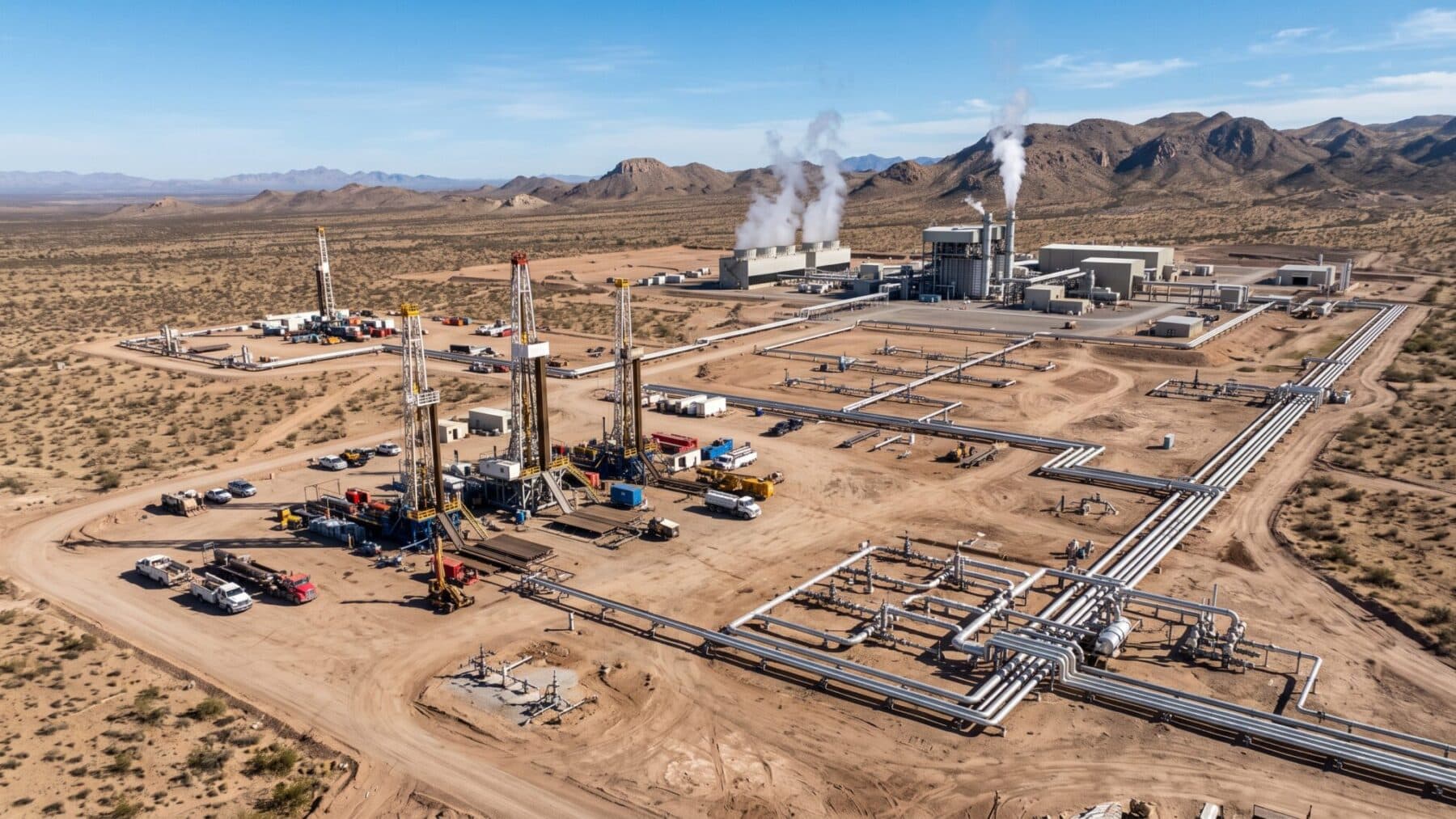
A cluster of steel wellheads sits in a Utah high-desert basin.
Pipes disappear straight down through kilometers of fractured rock. The promise is firm, clean power around the clock, every season, on demand. Yet buried inside the federal data that utilities sign contracts against is a single line that changes the math. Why does the summer figure land so far below the nameplate?
How enhanced geothermal systems lose ground exactly when the grid needs them most
Unlike conventional geothermal, which taps an underground reservoir of hot water in permeable rock, enhanced geothermal systems access heat by fracturing deep basement rock and using injected fluid to transfer that heat to a turbine. The system pushes cold water down one well, forces it through engineered cracks in superheated rock, then retrieves hot brine from a second well to generate electricity.
A thermal constraint is built into the geology. When a plant runs at full tilt during summer peak season, it pulls heat from the fractured rock faster than the surrounding formation can replenish it. Rock temperature around the fractures drops, the brine comes back slightly cooler, and the turbine produces less electricity per kilogram of fluid.
Seasonal efficiency loss, scale formation on piping surfaces, and station service loads each compound at peak summer load. The resulting gap between rated nameplate output and net summer capacity is the number utilities most need before signing a long-term contract.
The specific numbers the federal data confirms at the country’s first commercial site
The first large-scale commercial enhanced geothermal power generator in the United States is Fervo Energy’s Cape Generating Station in Beaver County, Utah. According to EIA generator survey data, it is scheduled to come online in June 2026.
The planned maximum capacity is 53 megawatts nameplate, with 28 megawatts of net summer capacity, the maximum output the equipment can supply to system load during peak summer demand. Two additional enhanced geothermal generators of the same size at the same location are expected to begin operation in January 2027. That gap is not a malfunction; it is the honest engineering reality of how these systems respond to sustained thermal demand, baked into the federal filing from the start.
That 47 percent difference between nameplate and net summer capacity is the number grid planners use when deciding how much backup capacity they must keep running alongside an enhanced geothermal contract. It is also the number that rarely appears in a headline about the technology’s promise.
What the cost data from national laboratory research shows
The summer capacity gap is only one part of the economic picture. National laboratory analysis projects that enhanced geothermal systems, whose levelized cost of energy now sits around $140 per megawatt-hour, could reach $100 per megawatt-hour by 2035. That trajectory is encouraging, but the starting point matters for utilities writing contracts today.
Capital costs remain elevated compared with conventional geothermal: the DOE’s own Enhanced Geothermal Shot program identifies drilling and well completion alone as accounting for 50 percent or more of total capital costs for a geothermal power project. That premium reflects drilling complexity, not a technology failure, but it is a cost a buyer pays upfront before the first electron reaches the grid.
Enhanced geothermal borrows horizontal drilling and hydraulic fracturing techniques from the oil and gas industry to create hydrothermal reservoirs where none naturally exist. Those methods make the technology buildable almost anywhere in the country. They also make the subsurface harder to predict than a natural steam field, adding uncertainty to both cost and long-term output.
As the DOE’s Office of Geothermal has emphasized, reducing subsurface uncertainty is the central engineering challenge the industry must solve before capacity commitments can be made with greater confidence.
Where the gap creates real complications for grid operators
A utility that signs a 20-year power purchase agreement based on 53 megawatts of nameplate must plan its reserve margin using the 28-megawatt net summer figure. That 25-megawatt difference must be covered by something else on the grid during peak seasonal hours, and that backstop capacity carries a real cost.
The challenge scales quickly. As of 2024, US geothermal nameplate capacity reached 3,969 megawatts, and multiple power purchase agreements for geothermal energy have been signed since 2021, more than in the previous five years combined. Each is written against a nameplate number, and the same planning gap that surprises buyers of backup generators shows up at grid scale when summer curtailment arrives.
Peak-demand planning is already stretched across the West as data centers and electrification keep adding load. A contract that promises 53 megawatts but has a net summer rating of 28 megawatts is correctly disclosed, but it demands careful reading that not every procurement team applies before signing.
What is being done and what the honest outlook looks like
The Department of Energy announced a funding opportunity of $171.5 million to support next-generation geothermal field-scale tests for electricity generation and exploration drilling. A core goal is reducing the uncertainty in subsurface performance across seasons and years.
DOE analysis points to potential for up to 300 gigawatts of geothermal power on the US grid by 2050. Reaching that number requires closing the nameplate-to-deliverable gap, not hiding it. The EIA’s transparent filing of a 53-megawatt nameplate alongside a 28-megawatt net summer figure is exactly the kind of honest disclosure that makes informed grid planning possible.
Better thermal modeling, longer pilot data sets, and the AI-guided drilling techniques now reviving older plants are all narrowing the margin between promise and performance. Enhanced geothermal is real, it is expanding, and the underlying resource is vast. The summer capacity figure is not a reason to walk away from contracts; it is the number that belongs in the first paragraph of every one of them.
