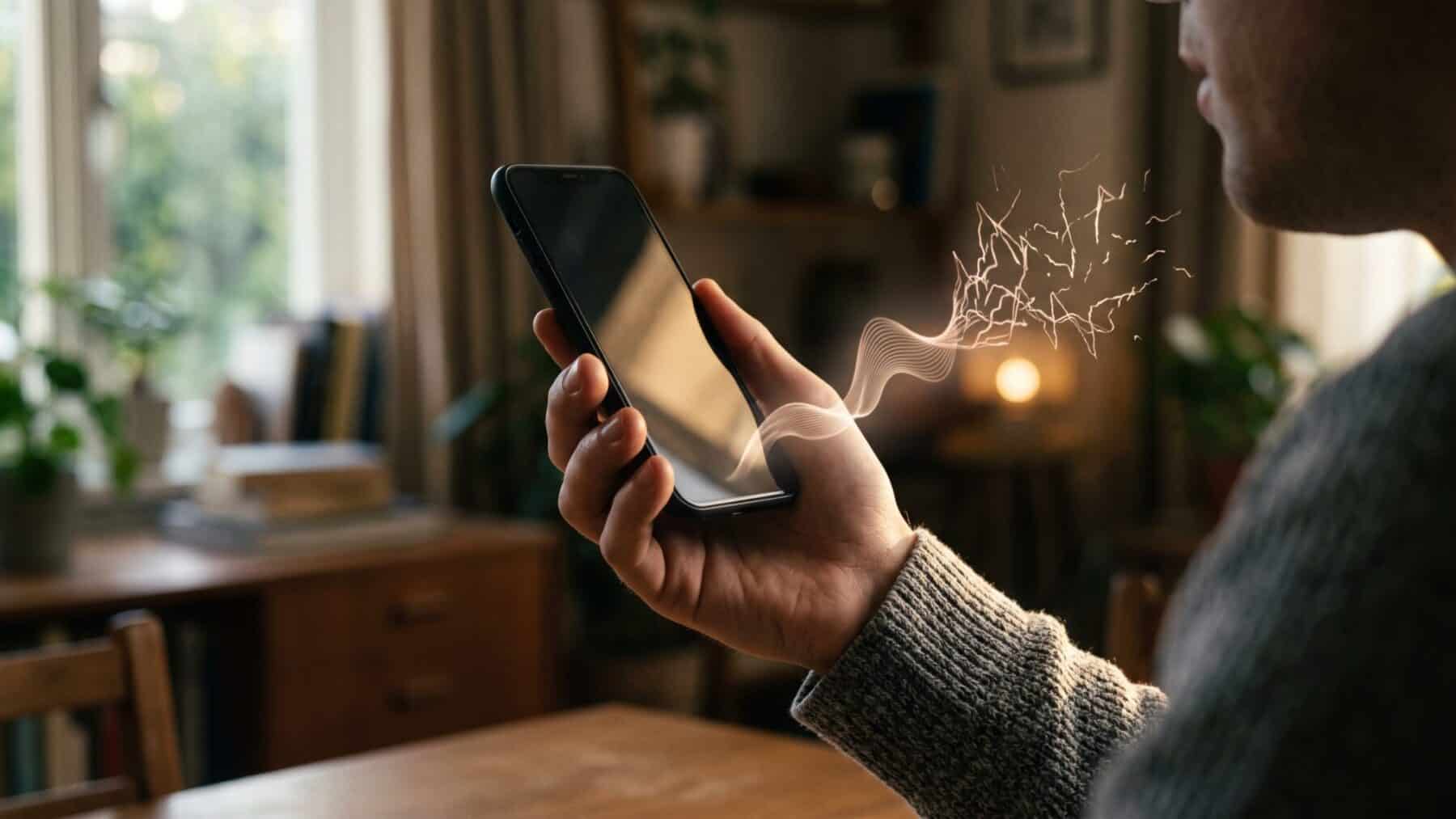
Pull out your phone and tap record.
Speak clearly, slowly, confidently, and watch the words appear on screen. Now say it again in a Scottish brogue, a Nigerian cadence, a South Texas drawl, or the Spanish-inflected English of a Miami kitchen. The words on screen begin to drift. And the app that promised near-perfect results has no warning label for any of that.
Why the model hears some voices and mishears others
Every speech recognition system learns from examples. Feed it enough audio of one kind of speaker and it grows confident with that voice. Expose it to fewer examples of another accent and it stumbles on the phonetic gaps it was never trained to close. The result is not a bug in the usual sense.
It is a structural consequence of where the training data came from. The model is simply a mirror of the voices used to build it, and those voices skew heavily toward standard American and British English. Speakers who do not fit that profile pay the price every time they press record.
Voice recognition can reach 95 to 99 percent in controlled environments on clean, scripted audio. Real-world settings, with noise, accents, and variability, often pull accuracy closer to 88 to 92 percent for typical speakers, and considerably lower for accented ones. That gap between the lab and daily life is precisely where millions of users get lost.
What the apps look like when a real accent meets the microphone
Picture a university student from Lagos video-calling a classmate in Edinburgh, both using the same transcription tool to take notes. The app’s marketing page shows a clean waveform and a clean transcript. The actual output, for both of them, is a different story.
AI transcription accuracy can reach up to 99 percent in ideal conditions, but accuracy on accented and noisy audio typically ranges from about 70 to 90 percent, well below the 95 percent or higher seen on clean studio recordings. For anyone placing real trust in an automated transcript of a job interview, a legal deposition, or a lecture, a significant error rate is not a minor inconvenience.
The gap is not uniform. Accented speech exhibits significantly higher word error rates of 30 to 50 percent, in contrast to native speakers’ 2 to 8 percent. One user gets a low single-digit error rate; a colleague with a different accent can see rates past 30 percent. That is effectively a different product.
The apps rarely advertise the range. The headline percentage a vendor prints is a lab number measured in conditions that are not your desk, your accent, your microphone, or your noisy kitchen. Maximum is not what you get on a noisy Tuesday afternoon in a second language.
What researchers measured when they ran the numbers
Independent researchers have documented the shortfall across multiple peer-reviewed studies, and the findings point in the same direction regardless of which tool is tested. One published study investigated the accessibility of widely used ASR systems across a diverse range of accents, evaluating three prominent open-source models, Whisper, Wav2Vec2, and Vosk, using traditional metrics such as word error rate, and emphasizing the need for more inclusive technology.
That research and others have drawn on the Speech Accent Archive, a resource established to uniformly exhibit a large set of speech accents from a variety of language backgrounds, in which native and non-native speakers of English all read the same English paragraph and are carefully recorded. That controlled design makes the error-rate differences impossible to explain away as recording quality.
Studies evaluating ASR on regional and national accent variation have documented substantial word error rates for underrepresented varieties. In the UK, ASR performance varies by region, with Southern British English speakers receiving the lowest error rates, while those from Northern England and Northern Ireland experience significantly higher error rates, a pattern researchers attribute to underrepresentation of those dialects in ASR training data.
Separately, researchers evaluating OpenAI’s Whisper model found superior performance in North American English compared to British and Australian accents , a gap consistent with training data weighted toward American English speech. Errors were also linked to speech type, with worse performance on spontaneous speech than on prepared reading.
Where the gap grows wider and the stakes grow higher
The problem compounds in exactly the settings where accurate transcription matters most. Live captions in a courtroom, automated notes in a doctor’s office, hiring software that scores a recorded interview: these are not casual use cases, and they are increasingly powered by the same engines that struggle with accented voices.
This concern about second-language communication barriers shows up in education too, where transcription tools are now common in university lecture halls and language learning apps. A non-native speaker using an AI note-taker is often the student who most needs an accurate record and who is least likely to get one.
Benchmark numbers quoted in vendor marketing are almost always measured on read corpora. Real conversational speech is full of false starts, regional idioms, and rhythm patterns that a model trained on audiobook narration, clean, articulate, with consistent pacing, no crosstalk, and no background noise, has barely encountered. In practice, background noise, multiple speakers, accents, and poor connections can double or triple error rates from what vendors promise. Most users have no way to know in advance where their own voice falls on the accuracy curve.
What changes when developers close the gap and what is still open
The shortfall is not permanent. Recent assessments of leading ASR systems show that performance varies sharply by model: vendor claims of near-perfect performance should be treated cautiously, as independent benchmarks place most systems in the mid-teens to low-twenties word error rate under real-world conditions. Even the stronger models, however, perform best on prepared speech rather than real conversation.
For everyday users, the practical step right now is treating any automated transcript of high-stakes audio as a draft, not a final record. A hybrid approach combining AI output with human editing remains the most dependable method for legal, medical, or accessibility content.
The broader picture matters here too. Research on how Americans connect across difference consistently shows that shared comprehension is the foundation of trust. When the tool supposed to bridge a gap quietly widens it instead, the cost is social as well as practical.
Speakers closest to the training data’s center of gravity lose almost nothing. Accented speech exhibits word error rates of 30 to 50 percent, compared with 2 to 8 percent for typical native speakers. Closing that distance requires diverse training sets, transparent accuracy reporting by accent group, and a marketing culture willing to show the real number, not just the best one.
