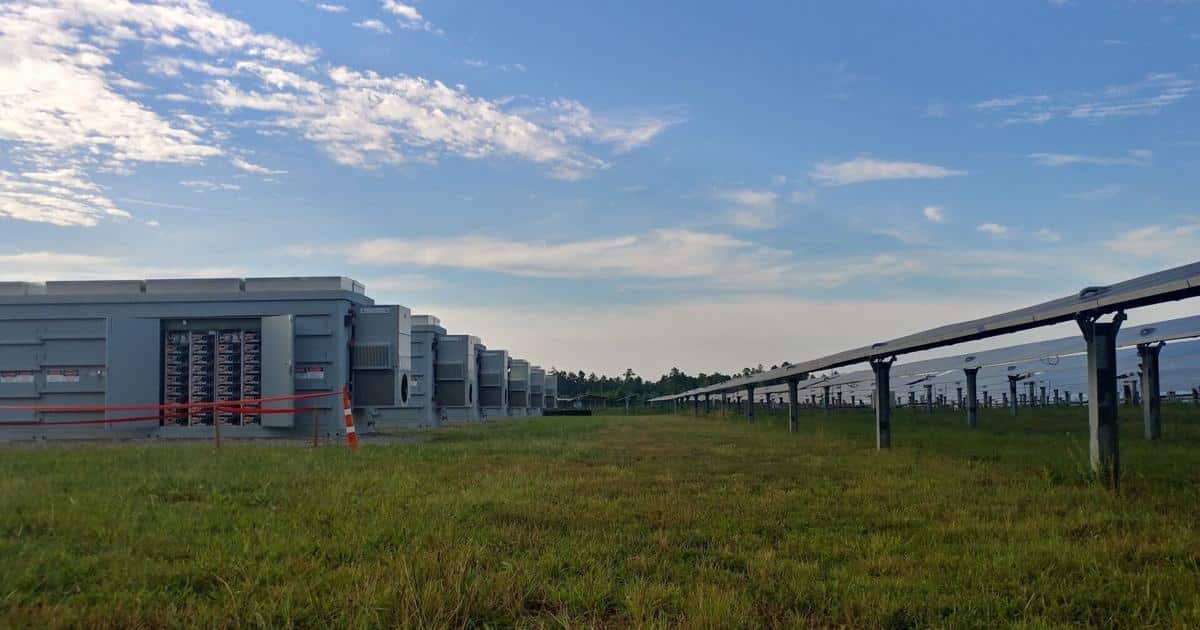
Dominion Energy has proposed adding 3.5 gigawatts of battery energy storage across its Virginia service territory over the next two decades.
The proposal appears in the 2026 Integrated Resource Plan update the utility filed with the Virginia State Corporation Commission on October 15.
At 3.5 GW, this represents one of the largest utility-announced storage pipelines in the United States, signaling that major vertically integrated utilities now treat battery storage as a core resource category on par with gas and nuclear, rather than a supplemental technology. PJM is the regional transmission organization spanning 13 states and the District of Columbia.
Data centers drive the forecast
Dominion Energy Virginia, citing data centers, projects largest growth in power demand since World War II. Dominion’s plan calls for 3.5 GW of battery energy storage in the PJM interconnection region over the next 20 years, driven by data center load growth and electrification-driven demand increases.
Virginia utilities have repeatedly revised demand forecasts upward in recent years as hyperscale computing campuses have clustered around Loudoun and Prince William counties.
In Virginia, an IRP is not a commitment to build any particular resource, but represents the utility’s general plan for meeting anticipated demand over the next 15 years.
Plan falls short of state storage mandate
Virginia’s expanded storage mandate requires Dominion to add 16,000 MW of short-duration BESS and 3,480 MW of long-duration energy storage (LDES) by 2045. Dominion’s 3.5 GW storage proposal falls short of that statutory target.
The Southern Environmental Law Center has criticized the broader plan. Dominion’s “preferred” plan to serve that demand would involve building nearly 9 gigawatts (GW) of new gas plants, more than its entire current gas fleet (about 8.5 GW), and would roughly double its carbon dioxide emissions by 2046 (from about 22 million tons/year to 47 million tons/year). Dominion also plans to build just 3 gigawatts of battery storage, despite a law passed this year that requires Dominion to build nearly five times that amount of storage by 2045. Overall, Dominion plans to build more than 21 gigawatts of new solar energy, 3.5 gigawatts of battery storage, 9 gigawatts of natural gas, 3.3 gigawatts of wind, and 2 gigawatts of small modular reactors over the next 20 years.
A Dominion spokesperson defended the plan’s overall composition. “Our preferred plan calls for more than 39 gigawatts of new power generation assets over the next 20 years, more than three-fourths of which is carbon-free solar, offshore wind, energy storage and advanced nuclear technology, and a decreasing reliance on more costly purchases from the PJM market,” Dominion spokesperson Jeremy Slayton said.
Battery storage fits a broader national trend
Dominion’s proposal lands as utilities nationwide lean more heavily on batteries to manage fast growing and increasingly volatile demand.
US utility-scale battery storage capacity reached nearly 52 gigawatts (GW) by the end of June 2026, the Energy Information Administration reported , and if that pipeline is completed as planned, operational US battery storage capacity would climb past 105 GW by the end of 2028. Utility-scale battery storage capacity in the United States grew at an average annual rate of 70 percent over the last three years, according to the EIA.
Batteries have become attractive to grid planners because they can be built faster than new gas or nuclear plants and can be sited to directly relieve stressed parts of the transmission network.
For data center heavy regions like Dominion’s territory, storage also offers a way to shift power delivery to match the steady, round the clock draw that large server farms place on the grid.
That pattern differs sharply from the sharper morning and evening spikes utilities have historically planned around, a dynamic also visible in how EV charging load growth has been slowing in 2026 even as other new demand sources accelerate.
PJM capacity market under strain
The Dominion plan also reflects pressure building inside PJM’s wholesale capacity market, which has cleared at higher prices in recent auctions as reserve margins tighten. The filing says the 2028/2029 PJM capacity auction left committed capacity more than 6,800 MW below the reliability requirement.
PJM has pushed grid operators and developers to speed up interconnection reviews. Battery storage projects are increasingly paired with solar to share a single interconnection application rather than waiting in separate queues, a pattern also reflected nationally where four-hour battery storage now undercuts gas peaker plants on cost in many regions.
Whether Dominion’s 3.5 gigawatt target survives regulatory review is not yet settled.
The Virginia State Corporation Commission will evaluate the Integrated Resource Plan over the coming months, weighing the storage additions against alternative generation options, ratepayer cost impacts and the pace of expected data center growth.
Utilities frequently revise these long-range plans in subsequent annual filings as demand forecasts and construction costs shift.
What happens next
If approved, the storage additions would roll out in phases through the mid-2040s, with the earliest projects likely tied to sites where Dominion already owns land or has existing transmission interconnection rights.
The company has not yet named specific battery sites or vendors tied to the 3.5 gigawatt target.
Regulators, data center operators and residential ratepayer advocates are expected to weigh in during the review process, since the cost of new storage and generation capacity is typically recovered through electricity rates charged to all customers in Dominion’s territory.
