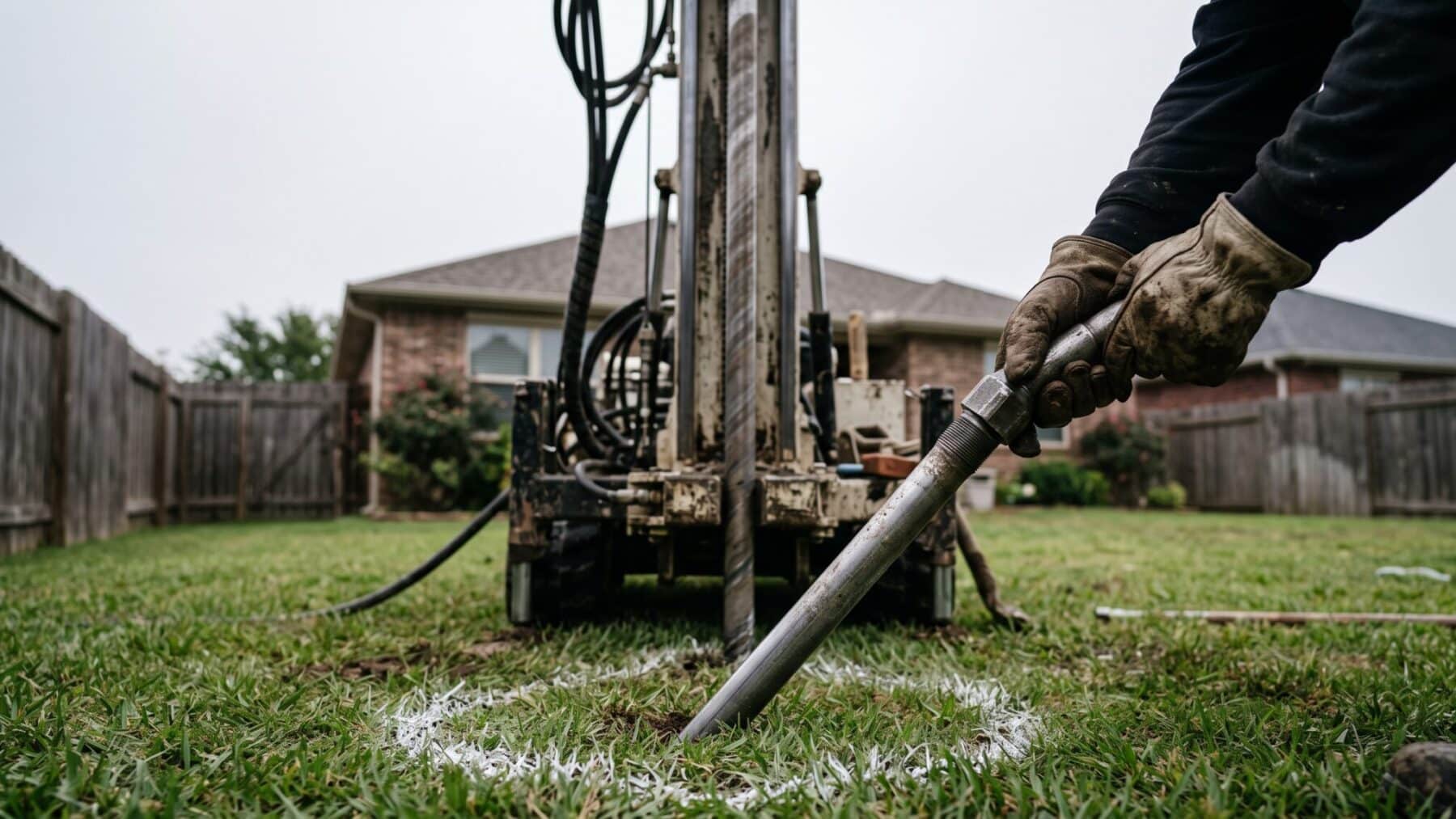
The rig shows up before dawn, a 20-foot steel mast bolted to a flatbed truck.
It parks over a chalked circle in the backyard, and two to four days of drilling follow.
The bill for that single step can rival the price of a new car.
Each borehole descends roughly 150 to 400 feet, and a typical house needs enough holes to total 300 to 500 feet of pipe per ton of heating capacity, with most homes requiring three to five tons.
What the drill bit hits on the way down determines whether a promising investment stays promising, or quietly doubles in price. So what exactly makes the ground both the engine and the problem?
Why the ground is both the engine and the expense
A geothermal heat pump does not generate heat the way a furnace does. Instead, it moves heat that already exists a few dozen feet below the frost line, where the earth holds a near-constant temperature of 50 to 60 degrees Fahrenheit year-round across most of the continental United States. That stable temperature is the engine, and it costs nothing to run.
But reaching that layer reliably requires a loop of high-density polyethylene pipe buried deep enough to exchange heat efficiently through all four seasons. For most suburban lots, that means drilling straight down rather than trenching horizontally. A vertical borehole is typically four to eight inches in diameter, but it must go deep, and depth is where the cost lives.
The drill rig charges by the foot. For vertical boreholes, contractors quote roughly $20 to $35 per foot in average soil conditions. Hit limestone, granite, or any consolidated bedrock and that figure can climb well above $35 before the crew finishes the first hole. A three-ton system needing 1,200 or more feet of total borehole depth can cost anywhere from $12,000 to over $36,000 for drilling alone.
What a real installation looks like on the ground
The mechanical side of the system, the heat pump cabinet, the circulation pump, the flow center, and the connection to existing ductwork, typically runs $8,000 to $15,000 for a whole-home installation. Add permits, grouting the boreholes, pressure-testing the loop, and the labor to tie everything together, and a midrange project in favorable geology lands between $20,000 and $30,000.
Favorable geology is not guaranteed. Contractors consistently note that total installed costs for vertical closed-loop systems range from roughly $20,000 on the low end to over $48,000 when rock is involved, with the national average around $25,000 to $30,000 for a 2,000-square-foot home. The Department of Energy’s own consumer guidance acknowledges that ground loop installation is the largest single line item in most residential geothermal projects.
That breakdown matters because marketing materials almost never lead with it. The ground-loop subcontract, which a general HVAC contractor typically hands off to a well driller, is often a number the homeowner does not see clearly until the full proposal arrives.
The evidence behind the 7-year payback claim
The payback figures circulating online, ranging from five years to fifteen, are grounded in real efficiency data. Geothermal heat pumps deliver three to five units of heat energy for every one unit of electrical energy they consume, a ratio the industry calls the coefficient of performance. A standard air-source heat pump operates closer to two to three in cold weather.
The US Department of Energy states that geothermal systems can reduce energy use by 25 to 50 percent compared to conventional heating and cooling. In a home spending $3,000 a year on heating and cooling, a 40 percent reduction saves $1,200 annually. Against a $25,000 installed cost, that pencils out to roughly a 21-year payback before incentives.
The 7-year figure was most plausible when stacking the former federal residential clean energy tax credit against a higher-than-average utility bill and favorable drilling conditions. Regional geology, not equipment efficiency, is often the deciding factor in whether the economics actually close.
Where the payback math gets complicated
The 30 percent federal residential clean energy tax credit, which covered geothermal heat pump installations placed in service through December 31, 2025, meaningfully changed the arithmetic while it was available. On a $30,000 project it shaved $9,000 off the net cost, compressing payback periods by several years. That credit has since expired under the One Big Beautiful Bill Act signed on July 4, 2025, though some states layer their own incentives on top: New York raised its residential geothermal credit to $10,000 for systems placed in service on or after July 1, 2025, and several Mid-Atlantic states continue to offer rebates or low-interest loans specifically for ground-source heat pumps.
Even so, incentives do not eliminate geology risk. A homeowner in rural New England who strikes ledge at 80 feet can watch a projected $22,000 project balloon past $40,000 as the driller requests change orders for each additional foot of hard rock. Horizontal trenched loops avoid deep drilling entirely but require several hundred feet of trench per ton of capacity, ruling them out for most suburban lots.
There is also the house itself. A leaky, under-insulated home blunts the efficiency gains that make geothermal paybacks work. Energy auditors consistently recommend air-sealing and insulation upgrades before sizing any heat pump, because oversizing the ground loop to compensate for a drafty envelope adds thousands to the drilling bill without improving comfort. This dynamic sits inside a broader shift toward managed electrification, where demand flexibility tools are becoming central to how utilities plan for homes adding high-efficiency electric equipment.
What the numbers mean for homeowners considering the switch
For a homeowner with high heating bills and a suitable lot, a geothermal heat pump remains one of the most cost-effective long-term investments in home energy. The indoor heat pump cabinet typically carries a 20- to 25-year lifespan, and the buried ground loop is warranted for 50 years or more in most installations, far outlasting a gas furnace or a conventional air conditioner.
The honest framing is that this is not a product you buy so much as a construction project you commission. Getting two or three drilling quotes before signing any contract, and asking each contractor to specify their per-foot rate for both soil and rock, is the single step most likely to prevent sticker shock mid-project.
Broader grid trends may also shift the calculus. As utilities work through rate cases and pressure on residential electric rates builds across multiple states, the value of a heating system that cuts electricity consumption by 40 percent compounds over time. The upfront drilling bill, though, remains the most important number to pin down before any contract is signed.
