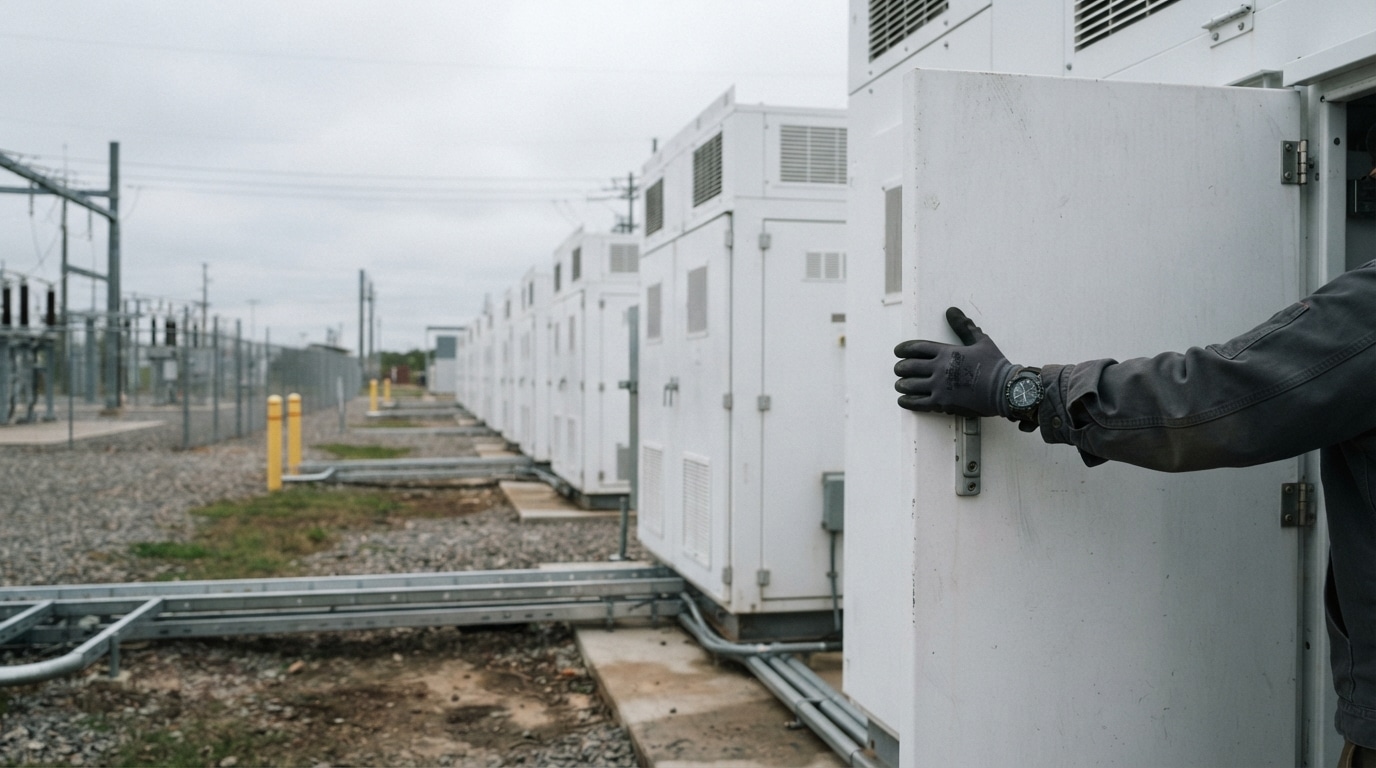
The United States is on pace to close out 2026 with nearly 65 gigawatts of utility-scale battery storage connected to the grid, a figure that would represent more than a doubling of installed capacity from the first quarter of 2025, according to the Energy Information Administration’s August 2026 Short-Term Energy Outlook.
What the August STEO shows
US utility-scale battery storage capacity is projected to reach almost 65 GW by the end of 2026, a rapid rise from 17 GW in the first quarter of 2024.
Counting projects larger than 1 MW in the electric power sector, the EIA puts domestic storage capacity at 64.9 GW by year-end, up from roughly 28 GW at the close of the first quarter of 2025.
The EIA published the trajectory in its August 2026 Short-Term Energy Outlook. The agency released the report on August 11, with forecasts completed as of August 6.
New solar projects and increased use of natural gas-fired power plants are identified as the leading sources of generation growth in 2026. Battery storage is expanding in tandem with that solar buildout, absorbing daytime generation surpluses and dispatching power during evening demand peaks.
According to the August 2026 STEO, solar, hydropower, and wind generation grew by 21 percent, 9 percent, and 6 percent, respectively, in the first half of 2026 compared with the first half of 2025. The EIA expects continued growth in renewable energy capacity additions to sustain that pace through 2027.
Texas demand revision clouds near-term load picture
One notable shift in the August outlook involves the largest single-state electricity market in the country. On August 3, 2026, Texas Governor Greg Abbott directed the Public Utility Commission of Texas and the Electric Reliability Council of Texas (ERCOT) to conduct a “comprehensive verification and audit” of all data centers advancing through ERCOT’s interconnection process before any additional data centers may move forward, and as a result the EIA has lowered its forecast for electricity demand in Texas. The agency now projects load growth of 6 percent in 2027 for Texas, down from a previous forecast of 14 percent.
The amount of electricity generated in the United States has been growing to meet increasing power demand from data centers. That demand signal has been a primary driver of new battery storage procurement contracts, as operators and grid planners have sought firm capacity to backstop variable renewable output.
The Texas revision is a reminder that the pace of load growth remains sensitive to state-level policy decisions, even as national storage deployment continues on its current trajectory.
The storage buildout is also navigating a tightening regulatory environment. On Feb. 12, 2026, the IRS released interim guidance in the form of IRS Notice 2026-15, on the new prohibited foreign entity (PFE) regime and its material assistance cost ratio (MACR) test applicable to clean energy projects claiming tax credits. The restrictions generally took effect on January 1, 2026, meaning every battery energy storage system beginning construction after December 31, 2025, is subject to them.
The rules make supply chain compliance a condition of investment tax credit eligibility, adding a new layer of diligence for developers racing to commission projects before year-end. GCN has tracked how storage cell shipments nearly doubled in the first half of 2026 as lithium iron phosphate chemistry tightened its grip on the market.
Capacity costs and installation trends
The EIA publishes a battery storage market trends report that includes data on large-scale battery storage systems by region and ownership type, co-located systems, applications served, installation costs, and small-scale storage trends.
Installation costs have fallen sharply over the past decade, a key factor behind the acceleration in utility-scale procurement.
Import tariffs have raised equipment costs in recent years, partially offsetting those long-run cost declines and adding pressure to project economics. Developers have responded by accelerating construction starts ahead of stricter foreign-entity sourcing thresholds that take effect on later cohorts.
FEOC-compliant battery storage projects retain access to investment tax credits, with the material assistance cost ratio threshold keyed to the year construction begins.
Grid operators absorbing the new capacity
All six regional transmission organizations and independent system operators, CAISO, MISO, SPP, PJM, NYISO, and ISO-NE, now have market rules in place to allow electric storage resource owners to participate in their markets.
That regulatory foundation, established under FERC Order 841, means the gigawatts now coming online have clear pathways to earn revenue from energy, capacity, and ancillary services markets.
Grid operators are simultaneously managing a surge of interconnection requests from large industrial and data center loads, a pressure point that regulators are actively addressing. The six US grid operators faced a FERC deadline in August to justify their large-load connection rules, underscoring how quickly new demand is stressing existing interconnection processes alongside the storage boom.
The EIA’s next Short-Term Energy Outlook is scheduled for release on September 9, 2026, and will reflect any further revisions to both storage capacity additions and electricity demand as the fall season approaches.
