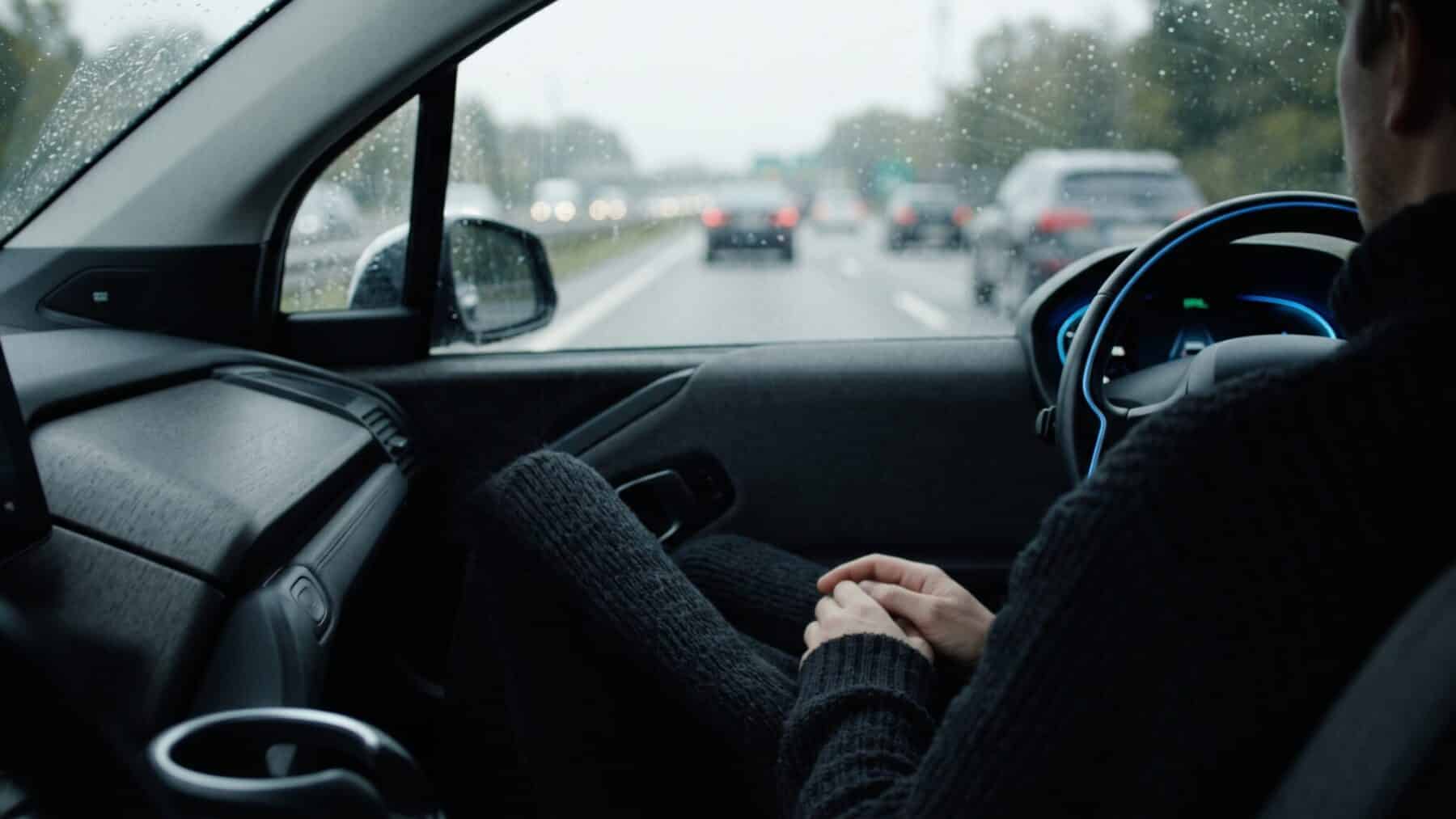
Picture a long, flat interstate in the middle of the afternoon.
The road ahead looks clear. The driver’s hands rest in their lap, and a small cabin camera watches their eyes. The system is doing the driving. Then traffic stops half a mile ahead, and the car never slows down.
How did the camera miss it?
Why the eye-tracking camera cannot tell a focused gaze from a distracted one
The core promise of a hands-free driver-assist system is a continuous loop of supervision: the car steers and maintains speed while a driver-facing camera tracks where the driver’s eyes are pointed, ready to alert them the moment attention drifts. The mechanism sounds airtight. But federal investigators confirmed that pointing your eyes forward and actually watching the road are two different things the camera cannot separate.
The driver monitoring system was found to be ineffective at detecting distraction, allowing off-road glances to go unnoticed and failing to distinguish between attention to the road and attention to a phone held directly in front of the windshield. To the camera, both look identical.
There is a second flaw underneath the first. An NHTSA engineering analysis flags a design choice that would inhibit braking responses to stationary objects when the vehicle’s approach speed is at or above 62 mph. That is the speed of any normal US highway cruise. So when the camera fails and a stopped car appears, the automatic braking system is also not designed to respond.
What the system actually covers, and where the confidence gap opens up
Ford markets BlueCruise as a hands-free driving system operating on 97 percent of controlled-access highways across Canada and the United States, with no intersections or traffic signals. The coverage map is genuinely broad. It uses cameras, radar, and software to handle steering, speed, and braking, paired with an in-cabin eye tracker meant to confirm the driver is paying attention.
The system costs $495 a year, with a one-time purchase option available at vehicle order for $2,495. That price, and the marketing language around it, creates a strong impression: the car is watching you, so you can relax.
That impression, federal investigators concluded, is exactly the problem. NTSB Chair Jennifer Homendy warned against a “hands-off” approach to hands-free technology, stating that manufacturers and regulators must ensure these systems are designed to protect all road users. Yet the subscription fee and coverage map remain the loudest parts of most marketing, while monitoring limits are buried in fine print. It’s also worth knowing that used sedan prices are climbing, meaning more buyers stretching into new-car financing feel those subscription costs acutely.
Two crashes, three deaths, and what the federal record now shows
The NTSB investigated two fatal 2024 crashes in which vehicles using Ford’s hands-free partial automation system, BlueCruise, failed to stop for stationary vehicles. The NTSB concluded that the drivers’ overreliance on the automated system contributed to both crashes. The board meeting took place March 31 in Washington.
Both crashes involved 2022-model-year Ford Mustang Mach-E vehicles operating in partial automation mode. The vehicles struck stationary objects at highway speeds in San Antonio and Philadelphia, killing three people in total.
The NTSB says the probable cause of the San Antonio crash was the driver’s failure to respond to the stationary vehicle ahead due to distraction, likely from the in-vehicle navigation system. In Philadelphia, a Ford on Interstate 95 struck two stationary vehicles, causing them to collide with a passing Toyota Corolla; the drivers of a Prius and an Elantra were killed. The Pennsylvania driver appeared focused on a cellphone held on top of the steering wheel, directly in front of her face. The in-cabin eye tracker registered neither driver as inattentive.
In January 2025, NHTSA upgraded its probe to an engineering analysis. As part of that analysis, Ford provided technical responses to the agency’s questions.
Where the system’s limits do not appear in the pitch
The NTSB found that the driver monitoring failed to detect inattention in both crashes, and that the system permitted drivers to disable automatic emergency braking. Investigators also noted that the NTSB made future-state suggestions for product design but found no defect with the functionality of the current BlueCruise system.
Heavy rain, snow, or fog can degrade forward-camera visibility and reduce system performance. System performance may also be limited when there is poor visibility due to insufficient illumination. Stacked on top of the stationary-object speed floor, those conditions mean three independent failure modes can coexist on a single ordinary highway drive.
The NTSB also noted that forward-collision warning and automatic emergency braking were not required equipment on these Mach-E vehicles and that there were no performance standards. There are currently no federal minimum performance standards a hands-free system must pass before reaching the market. Drivers looking for independent reliability context can also check how these systems perform on routes where charging infrastructure reliability matters to a road-trip decision.
What investigators are now asking for, and what drivers can do in the meantime
The NTSB is calling for greater federal oversight of hands-free driving systems and adopting standardized performance requirements to improve the safety of the technology. Investigators also recommended that automakers not allow drivers to disable automatic emergency braking while a hands-free system is active, and that adaptive cruise control not be permitted to operate at speeds more than 20 mph above the posted speed limit. Those recommendations carry weight but not legal force. The agency can advise; only NHTSA can compel a recall, and that investigation remains open.
The agency is urging stronger federal standards and clearer communication to consumers. No mandatory standard yet requires automakers to disclose stationary-object detection limits at highway speeds on the same page as the coverage map. What clearer disclosure looks like in practice is still undefined.
For drivers using any hands-free system right now, the federal record points to one consistent finding: hands-free systems free your hands but not your responsibility. The camera watching your eyes is far less sophisticated than most buyers assume, and the braking system it backs up has hard speed floors where it simply stops trying.
Treating the system as a fatigue-reducing aid, not a substitute for attention, remains the only approach the evidence fully supports.
