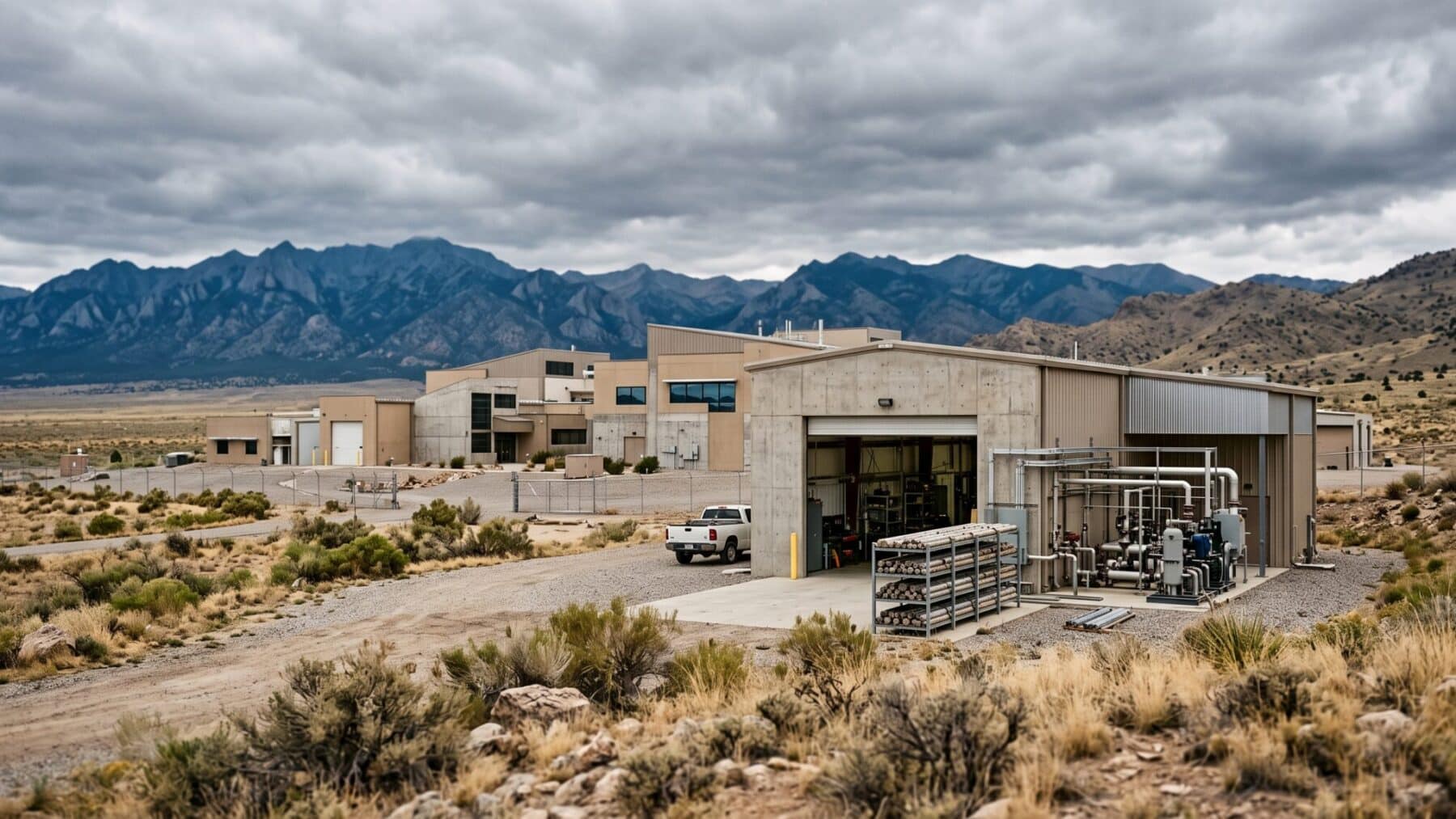
The Utah Frontier Observatory for Research in Geothermal Energy launched its most demanding test of an enhanced geothermal system on August 12, setting fluid circulating through deep hot rock for upwards of four months to answer questions that shorter experiments have never been able to resolve.
What the test is measuring
Utah FORGE, the world’s only full-scale field laboratory for de-risking and testing the tools and technologies necessary to advance Enhanced Geothermal Systems, began the extended circulation at its site located approximately 10 miles northeast of the town of Milford, Utah.
The test is an “extended circulation” which will allow the FORGE team to evaluate reservoir performance under continuous flow over the course of 90 days, potentially extended to 120 days.
Utah FORGE is ramping injection from a few barrels per minute up to 10 barrels per minute over approximately 48 hours to ensure system stability. The system consists of cooler, non-potable water being pumped into the injection well and drawn back to the surface through the production well.
The specific targets are thermal decline and water loss, two variables that determine whether an EGS reservoir can sustain commercial output over the 20- or 30-year life of a power project.
Dr. Kristie McLin, Principal Investigator of Utah FORGE, said: “This extended circulation will allow us to study heretofore unknown variables required to ensure long term EGS production remains commercially viable.” There is still much the industry does not know, she added, and the extended circulation will provide answers to pressing questions about thermal decline and water loss.
What earlier tests showed
In April 2024, the team successfully stimulated the production and injection wells, creating the fracture network that forms the reservoir. They followed that work with a 30-day circulation test in August 2024, injecting cool water at a consistent rate of 10 barrels per minute and recording produced temperatures of roughly 370°F.
During that earlier test, more than 90 percent of the produced fluid was recovered and the temperature held at approximately 370°F. Those results provided positive indications of the long-term behavior of the reservoir and the amount of heat that can be extracted.
But a month-long run leaves the commercially decisive questions unanswered. Investors and power purchasers need to know whether a reservoir slowly cools, loses working fluid to rock fractures, or demands water treatment systems that would erode project economics over a 20- or 30-year operating life.
A 30-day circulation test cannot provide the same crucial information as an extended circulation test. The ability to observe pressure and production stability, as well as water recovery and heat extraction, provides engineers with realistic operating data needed to determine project economics and design future geothermal power plants with greater confidence. The DOE-funded Utah FORGE project functions as a dedicated underground field laboratory for developing, testing, and accelerating breakthroughs in EGS technologies. The site’s results feed directly into the engineering and financial models used by commercial developers, making a sustained multi-month data set a resource the entire industry will draw on, as GCN has previously reported in its coverage of unsolved geothermal challenges.
Why long-duration data matters now
The timing puts the FORGE results alongside the industry’s first major commercial efforts. The Defense Innovation Unit has partnered on this geothermal development initiative with the U.S. Air Force, Army, Navy, and Marines, with six geothermal developers holding ongoing agreements for the effort: Eavor, Fervo Energy, Greenfire Energy, Sage Geosystems, Teverra, and Zanskar.
Each of those projects will need to demonstrate reservoir durability to secure financing and offtake agreements.
If EGS project costs continue to decline, the IEA has projected that geothermal energy could play a significantly larger role in meeting global electricity demand through 2050. Reaching that scale depends on convincing utilities and project financiers that EGS reservoirs are as durable as they appear in short-cycle tests. The multi-month run in Milford is the most direct field answer the industry has yet attempted to produce.
Next steps and industry context
Demonstrating sustained circulation is a critical step that can help to determine the longevity of an EGS reservoir for commercial electricity generation. FORGE researchers plan to publish findings as the test progresses, with the full dataset expected to inform both the DOE’s geothermal research program and private developers planning projects across the American West.
The extended test lands against a broader push to quantify geothermal’s grid contribution, including the DOE’s Geothermal Center of Excellence in Golden, Colorado, launched on September 3, 2026, to unite expertise and world-class capabilities from across DOE’s National Laboratories to accelerate the discovery and development of gigawatt-scale geothermal energy.
The circulation test, expected to run upwards of four months, will specifically track thermal breakthrough and water loss over time, giving developers the kind of long-run production curve that project finance models require before capital can be committed at commercial scale.
