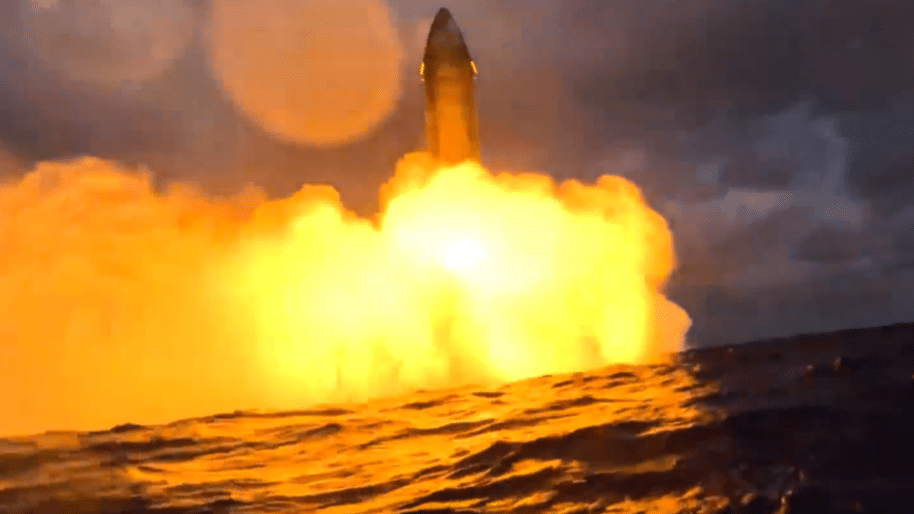
On Monday, September 28, at 7:48 a.m. CT, SpaceX’s Starship lifted off from Starbase, Texas on its 14th flight and first attempt to reach orbit. The mission was the first orbital Starship flight and the first to deliver meaningful payload to orbit, carrying 26 Starlink V3 satellites.
The milestone closes a chapter of suborbital test flights that began in 2023 and opens Starship as an operational launch vehicle for SpaceX’s growing satellite network.
How the mission unfolded
The mission began with the Super Heavy booster igniting all 33 of its Raptor 3 engines and ascending over the Gulf of America. During the initial climb to space, a single Raptor engine on the booster shut down.
A hot-staging maneuver followed, with Starship’s upper stage igniting all six of its Raptor engines to continue onward to space.
Out of an abundance of caution given the engine issue experienced during ascent, the flight control team decided to limit the duration spent on orbit and proceeded with deorbiting Starship to a splashdown location in the northern Pacific Ocean. Starship relit a single Raptor sea-level engine and performed its first-ever deorbit burn, which successfully brought the vehicle out of orbit and through atmospheric reentry to the intended splashdown point. The upper stage, Ship 41, splashed down in the northern Pacific Ocean.
After deploying its payload, Starship released all 26 of its Starlink V3 satellites, including three tasked with pointing a set of cameras back at the Ship upper stage to inspect for heat tile damage. Contact was made soon after with every satellite over laser links, ground stations, and Starlink user terminals.
The satellites will now conduct on-orbit checkouts and raise their orbits before they begin serving customers.
What Starlink V3 brings to the constellation
SpaceX’s new V3 satellites, produced at a facility in Redmond, Washington, are equipped with solar arrays that generate twice as much power as prior generations. They are also larger and designed to be more powerful, transmitting data more rapidly than earlier versions to Starlink subscribers.
Each V3 satellite is designed to support 1 Tbps of downlink capacity, adding a combined 26 Tbps to the Starlink constellation from this mission alone. Each Starship launch can carry enough V3 satellites to deploy roughly 20 times the capacity added per Falcon 9 launch, according to SpaceX.
That throughput multiplier is central to SpaceX’s plan to scale Starlink far beyond what its workhorse Falcon 9 could achieve. Starlink was the company’s only profitable segment in the second quarter.
To gather heat shield data, SpaceX equipped three of the Starlink V3 satellites with cameras to photograph the spacecraft’s exterior tile surface once the satellites had separated.
SpaceX said it made hardware and software changes to the Super Heavy booster to address engine issues seen during Flight 13. The Starship upper stage also tested several heat shield improvements, including additional tile retention mechanisms and a curved tile design intended to reduce heating in gaps between tiles.
What comes next for Starship
SpaceX COO Gwynne Shotwell said during the All-In Summit earlier this month that the company also plans to use Starship to put “supercompute in space,” launching “AI compute satellites” into orbit in 2027. That ambition puts Starship at the intersection of the satellite broadband and AI infrastructure markets, two of the fastest-moving areas in the technology industry.
Analysts have flagged the growing link between orbital compute capacity and the AI cloud buildout. Finnish AI cloud startup Verda’s $189 million Series B earlier this year underscored how intensely capital is chasing compute at every layer of the stack.
NASA is also invested in Starship. The space agency picked Starship to be the first crewed lander for its Artemis program, which aims to build a base near the moon’s south pole. Previous Starship flights had been suborbital, making Monday’s mission the definitive transition from test program to operational launch vehicle.
SpaceX’s Falcon rockets have dominated the global launch industry for years, but now that the company is phasing out Falcons in favor of focusing on Starship, there is no guarantee Starship will fill the void left behind. No such commercial booking offering currently exists for Starship, and it is not clear that SpaceX will open the rocket up for external customers.
The rapid expansion of low-Earth-orbit constellations is already driving massive investment decisions across the technology sector, from the AI cloud layer to the AI factory infrastructure that processes the data those satellites beam to the ground.
