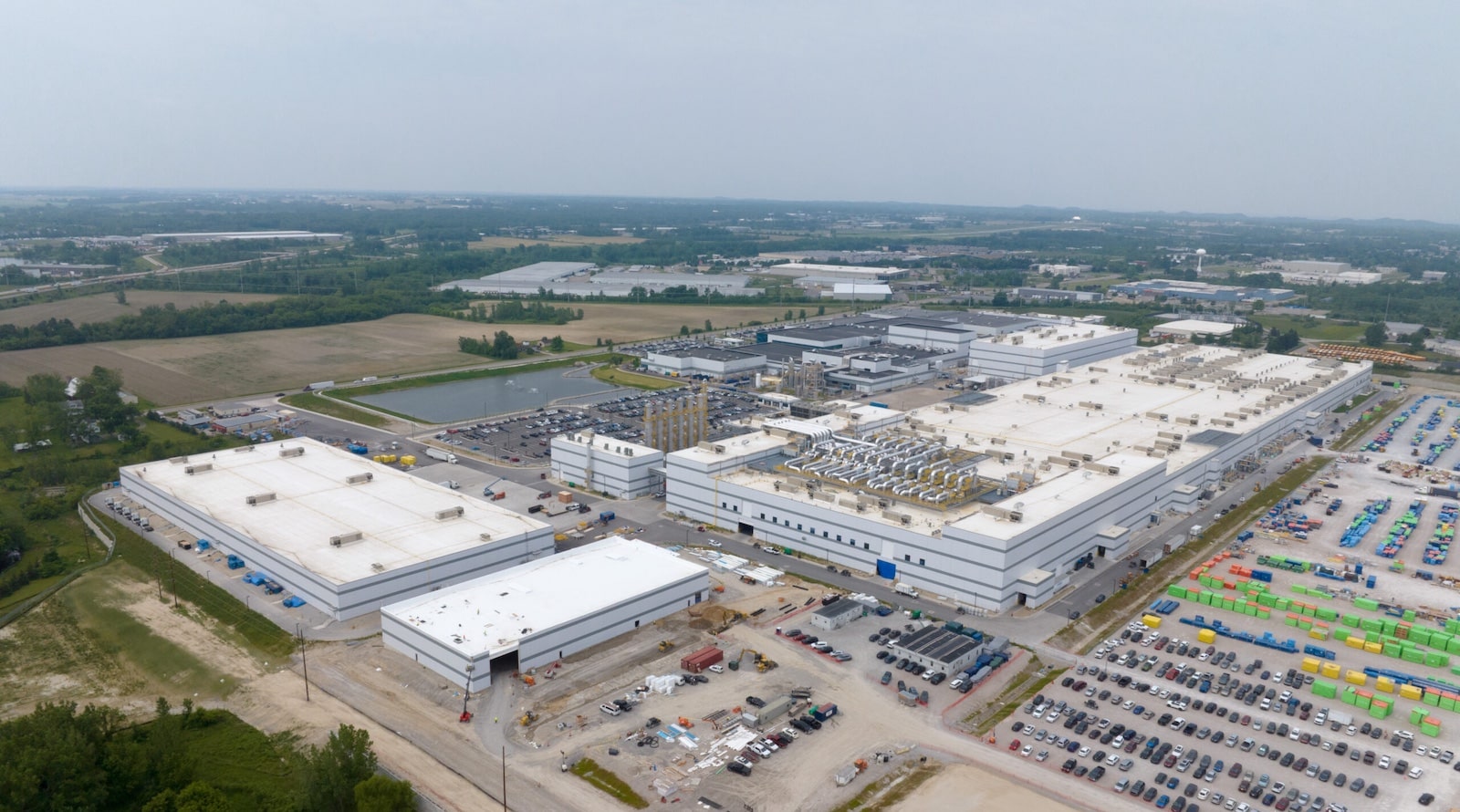
Two South Korean battery giants are retooling electric-vehicle production lines in the United States to produce grid-scale energy storage cells, a manufacturing pivot that coincides with record first-half US battery storage deployments and slowing growth in EV demand.
Production lines retooled for the grid
L-H Battery Company, a US-based joint venture between South Korean battery maker LG Energy Solution and Japanese automaker Honda Motor, has begun mass production of batteries for energy storage systems at its plant in Jeffersonville, Ohio. The 50:50 joint venture was established at the beginning of 2023 to produce lithium-ion batteries mainly for Honda and Acura battery electric vehicles sold in North America. The Ohio plant was originally built primarily to manufacture batteries for Honda electric vehicles; the partners adjusted the factory’s production strategy as growth in the electric-vehicle market slowed and changes in the US regulatory and policy environment increased uncertainty for automakers and battery manufacturers. L-H Battery confirmed that it will maintain a flexible production portfolio at its Ohio plant by producing batteries for hybrid-electric vehicles alongside ESS batteries.
Samsung SDI is on track to begin production of lithium iron phosphate (LFP) battery cells for stationary battery energy storage systems in the US in the third quarter of this year; in an earnings call to explain Q2 2026 results, executive VP Yonghui Cho said the US prismatic LFP cell line for ESS applications is currently undergoing mass production quality validation, with cell production set to begin in October and customer deliveries of its Samsung Battery Box (SBB) 2.0 to begin before the end of this year. Samsung SDI said in November last year that it aimed to open 30 GWh of annual BESS cell production capacity in the US by the end of 2026. The company is converting some existing lines at its EV manufacturing plant in Indiana to make ESS batteries; it operates out of the StarPlus Energy factory in Kokomo, Indiana, a joint venture between Samsung SDI and automaker Stellantis that was initially estimated to have a 34 GWh annual production capacity.
The shift is part of a broader industry move, with manufacturers including Samsung SDI and LG Energy Solution repurposing EV cell production lines to produce BESS cells.
Samsung SDI has highlighted the FEOC-compliant nature of its prismatic LFP cell supply chain as a competitive advantage for US system integrators, describing itself as the only non-Chinese prismatic LFP battery manufacturer with a US production base. The company has secured LFP cathode materials through partnerships with Korean and US suppliers and established a compliant supply chain for other key components through localization.
Record deployments drive the pivot
In the first half of 2026, just under 31 GWh and 10.3 GW of battery energy storage systems entered operation across the utility-scale and behind-the-meter markets, a year-on-year increase of 23 percent in energy terms, according to the Solar Energy Industries Association’s Energy Storage Market Outlook Q3 2026, produced with Benchmark Mineral Intelligence.
The utility-scale market continued to underpin growth, with 26 GWh and 8.1 GW installed, with ten states bringing more than 500 MWh of new capacity online. Battery energy storage supplied more electricity to the grid in the first eight months of 2026 than in all of 2025, and during periods of extreme heat in states like Texas and California, storage helped provide power when demand was highest.
The SEIA report raised its cumulative US storage capacity forecast through 2030 by 11.5 percent to 683 GWh, reflecting stronger-than-expected demand; more than 10 percent of all energy storage capacity currently installed in the US came online in Q2 alone.
That surge in grid storage appetite is coinciding with an EV slowdown that has left battery factory capacity underutilized, creating an opening that domestic and allied-nation producers are racing to fill.
Those supply-chain shifts are feeding directly into interconnection queues; how storage projects reach the grid in practice is shaped by rules that FERC is currently requiring all six US grid operators to justify or reform.
EV credit expiry reshapes both sides of the equation
Under the One Big Beautiful Bill Act, three clean vehicle credits were terminated for vehicles acquired after September 30, 2025: the New Clean Vehicle Credit (Section 30D), the Previously-Owned Clean Vehicles Credit (Section 25E), and the Qualified Commercial Clean Vehicle Credit (Section 45W).
Since July 2025, sales of electric vehicles reached record highs as a reaction to the termination of the clean vehicle credits under the One Big Beautiful Bill Act. With the credits expired as of September 30, 2025, EV demand subsequently declined, leaving battery plants underutilized and accelerating the pivot toward stationary storage.
The demand story for commercial EV charging is evolving in parallel, as utilities reprice large depot loads in response to uncertain fleet growth timelines.
For battery manufacturers, the grid storage market is now the primary growth channel. Samsung SDI reported that its earnings recovery was driven by strong demand from AI data center applications, particularly high-power products for utility-scale battery energy storage systems. In the Q2 2026 earnings call, executive VP Yonghui Cho said the US prismatic LFP cell line for ESS applications is currently undergoing mass production quality validation. Cho added that even if the pace of data center construction were to slow, the structural growth trend in the US ESS market would remain intact.
Supply chain and outlook
Cell production at Samsung SDI’s US facility is scheduled to begin in October, with customer deliveries of its SBB 2.0 battery storage product expected before the end of this year.
SEIA and Benchmark Mineral Intelligence have revised their outlook for predicted US storage capacity additions to 71 GWh in 2026, around 20 percent greater than the 59 GWh installed in 2025, and raised their target for total installed capacity by 2030 to 683 GWh. Project delays and cancellations remain a risk even as underlying demand is robust.
Samsung SDI expects demand to exceed available production capacity from 2028 onward, a signal that the current manufacturing pivot by South Korean battery makers is unlikely to reverse course regardless of near-term EV market fluctuations.
