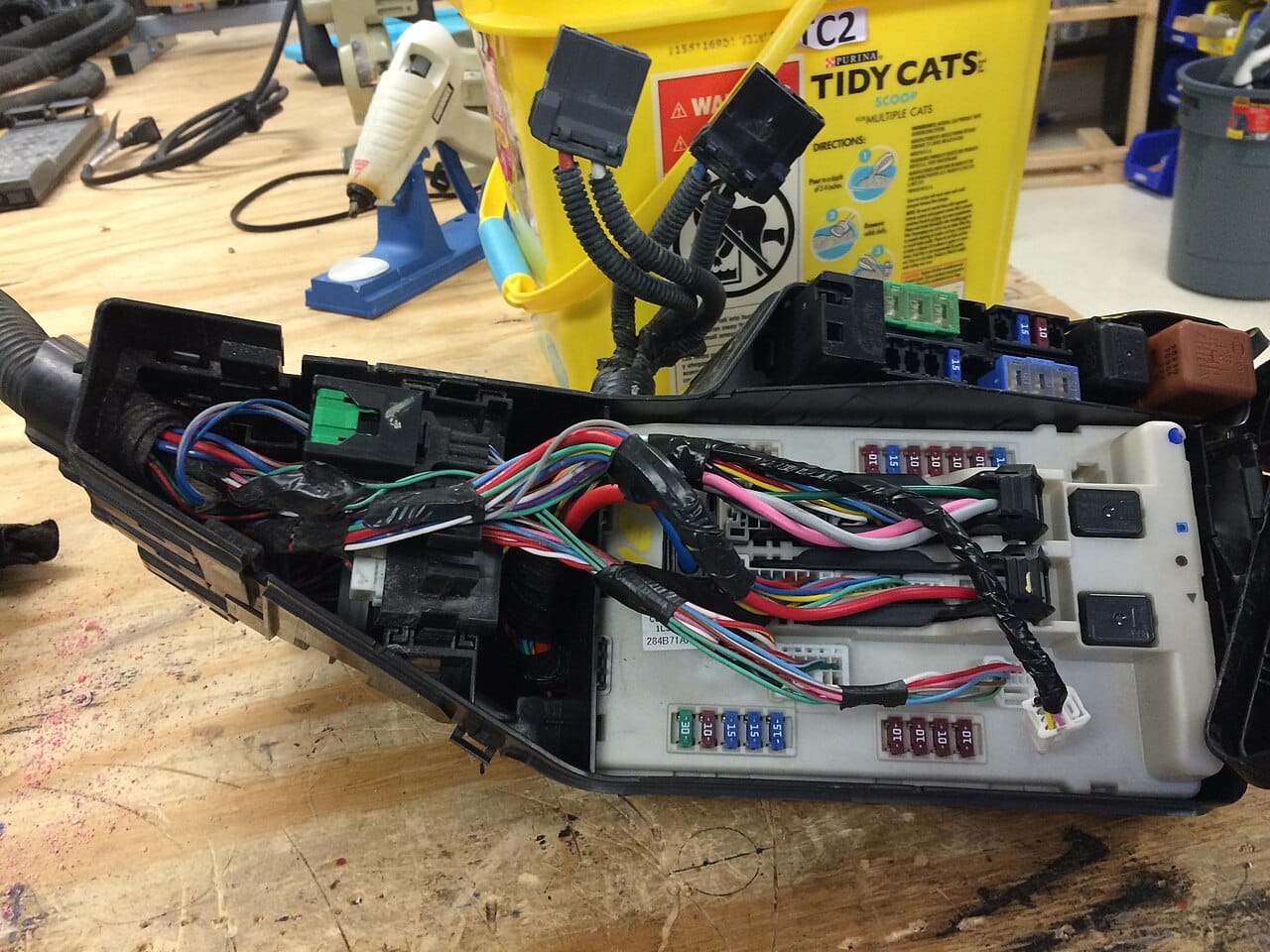
Slide under almost any new car and you will find it: a bundle of copper wire thick as a forearm.
It branches into hundreds of smaller runs that snake to every corner of the vehicle, stretching for miles inside a single model. It is one of the heaviest non-structural parts on the car.
And the chip strategy that created it is, right now, being torn out and rebuilt from scratch.
How a zone controller trades a mile of wire for one powerful chip
The zonal approach breaks the old logic entirely. Instead of grouping electronics by function, it groups them by their physical location in the car, clustering ECUs into geographic zones such as front-left, front-right, and rear. Each zone gets one powerful local controller chip that handles every sensor and actuator within its corner, then speaks back to a single central brain over a high-speed Ethernet backbone.
The physics is straightforward: shorter cable runs mean less copper, less weight, and fewer connectors that can corrode or fail. The zonal architecture organizes ECUs by their physical location inside the vehicle and leverages a new generation of ECUs with powerful processing functions and a central High-Performance Computing Unit that supports fast communication protocols like Ethernet.
What the numbers look like inside a real vehicle on sale today
The clearest proof is already on American roads. Rivian’s new zonal electrical architecture uses just seven ECUs compared to 17 before, and the company says this helped it remove some 1.6 miles of wiring from each vehicle and reduce 44 pounds of weight. Forty-four pounds is roughly the weight of a full set of winter tires, stripped from the curb weight by a chip-layout decision made years before the truck reached a dealership.
Tesla was first to market with this technology. In the case of the Model 3, the zonal architecture contributed to a saving of 50% in wiring, simplifying manufacturing and lowering vehicle weight. According to S&P Global, it is one of the reasons Tesla can build the Model 3 in 10 hours compared to peers who need 20 or more hours. Faster assembly is not just a factory bragging right; it directly affects the sticker price a buyer sees.
BMW’s Neue Klasse platform uses a zonal wiring harness architecture that is 30% lighter and uses 600 meters less wiring than the previous generation, with the harness divided into four zones: front end, center, rear, and roof. Within those zones, high-speed data highways connect the four Superbrains with smaller zonal controllers, so each zone has its own cables, shorter, thinner, and lighter. That modular division also makes the harness simpler to install and opens the door to greater factory automation.
How widespread the shift already is, and what the market data confirm
The transition is no longer a roadmap ambition; it is a procurement reality reshaping which chip suppliers win contracts this decade. Industry analysts tracking software-defined vehicle adoption report that a large majority of automakers are now committed to zonal architecture, with many already in active migration.
Market research firms project the zonal electronics segment is growing at a strong double-digit annual rate, with the total addressable market expected to reach tens of billions of dollars within a decade. Modern zonal platforms demand high-performance chips capable of supporting advanced graphics, AI workloads, voice interaction, and complex software stacks.
Chips now determine everything from power management to advanced driver-assistance systems, pushing chip sourcing to the center of every automaker’s product strategy. You can see that play out in US EV sales data, where the brands gaining ground fastest are precisely those that moved earliest to software-defined platforms underpinned by zonal hardware.
Where zonal architecture hits a wall, and why lead times are climbing again
The consolidation trade-off is real. Less copper in the harness means more dependence on one central brain. A distributed system with 100 ECUs could absorb a shortage of one part; a zonal system cannot absorb a shortage of its master controller.
That vulnerability is not theoretical. Automotive semiconductor lead times have climbed back well above their post-shortage lows in recent quarters, driven by longer waits for power devices, memory, and discrete semiconductors, erasing several years of supply-chain improvement in a short window.
The most exposed programs are those transitioning mid-cycle, where a new zonal platform is designed but supply relationships for its central controller chips are not yet locked in. That gap is where production delays quietly happen. The broader EV market shift, visible in recent sales rankings, is partly a story of which brands cleared that gap first.
What changes for drivers, and what the industry still has to solve
For most buyers, zonal architecture is invisible, which is exactly the point.
The benefits arrive as software: a feature that did not exist when the car shipped gets added over the air, because the zone controller has spare computing headroom that 17 separate ECUs never would. That headroom is what makes a car feel current three years after purchase rather than frozen in the software state it left the factory in.
The next frontier is a full cabin-and-driving fusion: one chip family handling the instrument cluster, the driver-assistance radar, the voice assistant, and the parking system simultaneously, rather than routing data between four separate domain modules.
The wiring harness that workers once spent hours threading by hand is shrinking toward something a robot can place in minutes. Getting the supply chain for those critical zone controller chips stable enough to support that future is the problem the industry has not yet solved, and the companies that crack it first will have a durable edge that no rebate spending can quickly close.
