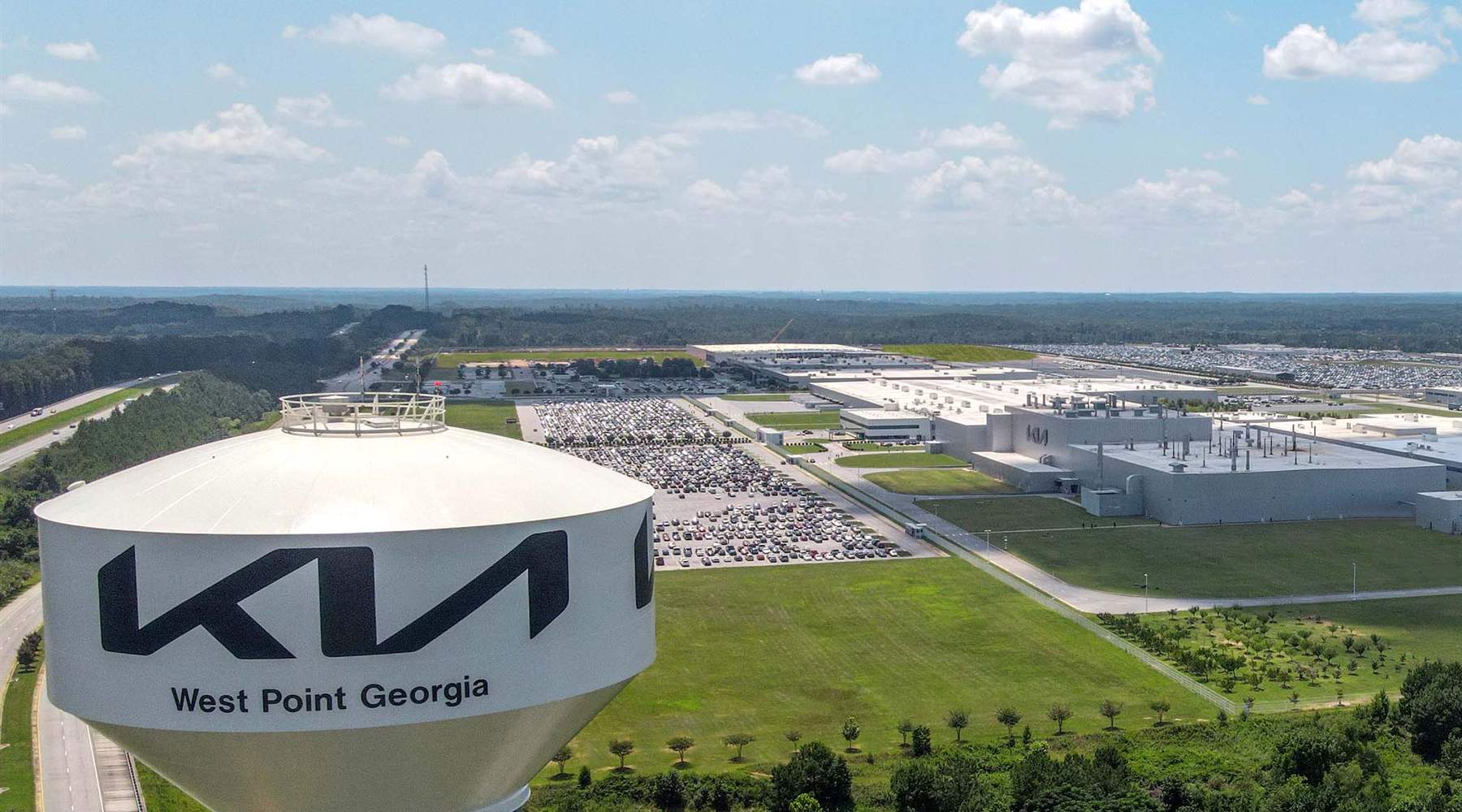
Walk the floor of the Kia Georgia plant in West Point on any given shift this year and the newest thing rolling down the line is a three-row SUV with a 1.65-kWh lithium-ion battery tucked into its hybrid powertrain.
The line runs around the clock. Demand is already ahead of supply. Every other vehicle rolling off the end wears an electrified badge, not because anyone mandated it, but because buyers keep ordering that way.
The question hanging over the rest of the industry is whether competitors left the door open too long.
How adding one powertrain to one SUV reshapes an entire brand’s market position
A hybrid drivetrain does something subtle to a popular model: it turns every shopper already considering that nameplate into a potential hybrid buyer, whether they set out to buy one or not. Kia has initiated production of its Telluride hybrid SUV at its West Point production line in Georgia, in a key milestone for the carmaker as the first hybrid model ever produced at the plant. Kia Georgia began production of the 2027 Kia Telluride at its West Point facility on Feb. 24, 2026. When compared trim to trim, there is a $2,700 price gap between the EX trims on both versions.
Each trim comes standard with a turbocharged 2.5-liter four-cylinder engine and hybrid componentry that combine to produce 329 horsepower and 339 lb-ft of torque. Because the Telluride is one of the most decorated three-row SUVs in America, every existing buyer became a potential hybrid convert overnight.
Kia has indicated the hybrid will account for a substantial share of total Telluride sales going forward, meaning the gas-only version is on track to become the minority choice in its own showroom.
What the Telluride Hybrid’s Georgia debut looks like on the sales ledger
Kia’s growth stood out across the whole market: second-quarter hybrid registrations rose by roughly 36,000 vehicles year over year, a gain that amounts to 130 percent year-over-year hybrid growth. That brought Kia to a 9 percent hybrid market share. That is not incremental growth. That is a brand rewriting its own category weight in a single quarter.
Strong growth from key models in June drove overall sales performance: the Sportage hybrid up 165 percent, Sorento hybrid up 114 percent, Seltos up 56 percent, and Carnival hybrid up 54 percent. Notably, strong momentum from Kia’s electrified lineup continued to drive overall growth, with hybrid models surging 187 percent and the broader electrified lineup increasing 118 percent year-over-year.
The West Point facility simultaneously marked three milestones: the new-generation Telluride launch, the first hybrid electric vehicle assembled in the state of Georgia, and the plant’s 5 millionth vehicle. Three milestones in one shift.
The record market numbers and which brands own the scoreboard
Hybrids now hold a record share of the US market, 16.3 percent, the highest ever recorded, according to new data from Cox Automotive. In 2023, hybrids made up around 5 percent of the market. That figure grew to 13 percent in mid-2025 before jumping another 3.3 percentage points this year, with hybrid volume up 23 percent in the past year.
The electrified vehicle story in the first half of 2026 is increasingly a story about hybrids. While the overall US new-vehicle market is expected to decline by about 2 percent compared to a year ago, hybrid sales are forecast to increase by approximately 9 percent. EV sales accounted for approximately 5.8 percent of total new-vehicle volume in the second quarter, putting hybrids at nearly three times that share. “Hybrids are having their moment and are moving into the mainstream,” said Stephanie Valdez Streaty, Cox Automotive Director of Industry Insights. “Roughly one out of every six vehicles is now a conventional hybrid.”
One dominant Japanese automaker held 44 percent of the US hybrid market as of the second quarter, though its share has declined more than four percentage points over the past year. Kia and Hyundai are gaining ground quickly, with Kia posting the largest year-over-year gain, adding roughly 36,000 hybrid registrations, a 130 percent surge that is the biggest share gain of any brand in that same window, and it came from a broad hybrid lineup anchored by a new model rolling off a single American line.
Where the shift creates a real problem for brands without a hybrid lineup
Three automakers control the majority of one of the hottest segments in the US car market, and none of them are American companies. A handful of domestic hybrid entries exist, but no US automaker holds a position in the hybrid top three. That asymmetry is now visible in the numbers.
The structural problem is time. Building a competitive hybrid lineup requires years of powertrain investment and model-cycle planning. Pivoting now means at least two to three model years of lost ground, during which leading brands keep compounding their advantage. As covered here on GCN, legacy automakers saw drops of 60 percent or more in US EV sales in a single quarter, leaving them exposed on both ends of the electrification spectrum at once.
