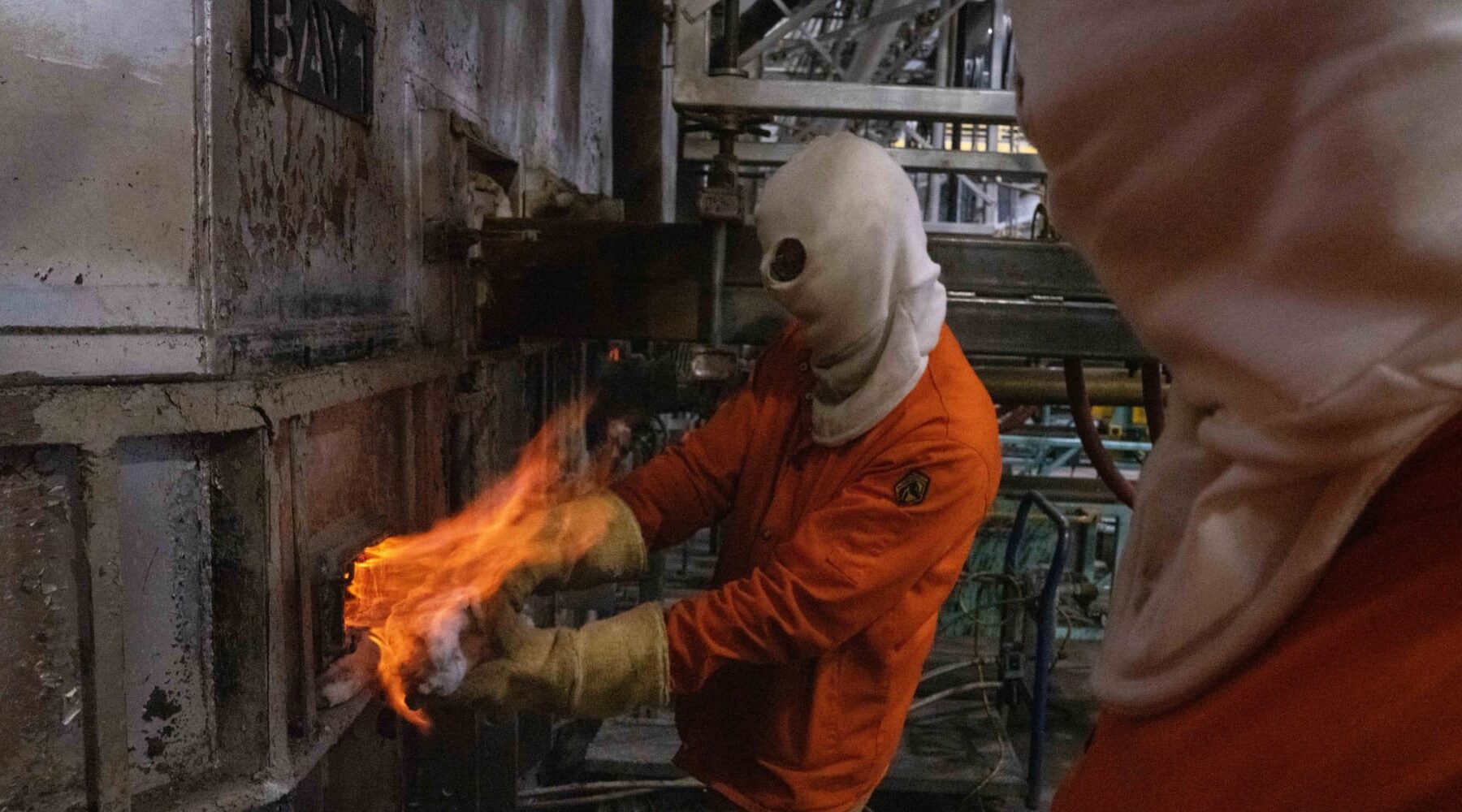
Every solar panel bolted to a rooftop or staked into a field starts as something closer to a window pane than a piece of electronics.
That pane has to be almost perfectly clear, barely a millimeter off true, and tough enough to survive hail for a quarter century.
Until recently, almost none of it was made in America.
A factory in rural Ohio just changed that math by itself.
So how does a sheet of glass become the single hardest part of a panel to source at home?
The glass is the bottleneck nobody talks about
Solar manufacturing conversations tend to fixate on silicon wafers and cells, the semiconductor heart of a panel. But every crystalline panel is actually a sandwich, and the top and bottom layers of that sandwich are glass, not silicon, bonded to the cells with a plastic sealant in a process called lamination. That glass has to be low iron, so it does not tint green and block light, and it is typically textured with a pyramidal surface pattern on one side to bend sunlight into the cell rather than let it bounce away.
Making that kind of glass at scale means running a continuous float glass furnace, where molten material is poured onto a bed of liquid tin so it cools into a perfectly flat sheet. Building one from scratch costs hundreds of millions of dollars.
That gap is why the recent US module boom outran domestic glass supply. Assembly lines kept buying front and back glass almost entirely from overseas mills, even as cells and modules got built here.
Inside the plant that is trying to close the gap
The company behind the fix is Stewart Glass, a division of a float glass engineering firm with nearly four decades in the furnace business, working out of a 267,000 square foot building in Logan, Ohio, an hour southeast of Columbus. The site is a former General Electric manufacturing facility, repurposed rather than built new.
Stewart began shipping its first ultra-clear glass this spring, describing itself as the “first fully operational solar glass facility in the United States.”
At full output the line is designed to run roughly 150 tons of glass through the furnace every single day.
Company estimates translate that into enough front panes for thousands of finished modules leaving assembly lines daily, feeding directly into the kind of module production that crossed 100 cumulative gigawatts this summer, a milestone decades in the making that still leaves the glass supply behind it thin. One furnace cannot cover a market this size alone, which is the gap the rest of the chain is now racing to close.
The order book already proves the demand is real
A module maker named Heliene, which builds panels in both the US and Canada, began testing Stewart’s glass this past summer as a potential domestic alternative. Its chief executive told the trade press the shortage was not a pricing problem so much as a physical one, since domestic solar glass production had not kept pace with the recent growth in US module manufacturing.
There had been no supply of non-iron content glass, the executive said.
That early customer trial matters. It is the clearest sign this is not a speculative factory chasing subsidy headlines, but a direct answer to module builders who have cells and assembly lines ready with nowhere domestic to buy the casing around them.
The federal government backed the project too. The U.S. Department of Agriculture reports it loaned Stewart Glass $16.4 million through its Business and Industry Loan Guarantee program, which the agency said will help renovate and purchase equipment for the company’s new Logan, Ohio, solar glass facility. A second production line is now planned for next year, which would lift Stewart’s output from 150 tons daily to roughly 250 tons by mid 2027.
Why one factory still cannot solve the whole chain
None of this erases how thin the overall US glass base still is. Industry estimates have put the country’s dedicated solar float lines in the single digits, against roughly three dozen general purpose float lines making windows and architectural glass instead.
That imbalance matters because glass is heavy, fragile and expensive to ship across oceans, making it one of the few solar components where distance itself is a cost. A broken pallet of imported glass can stall an entire module line for days.
Meanwhile, the same forces reshaping other parts of the solar chain are pressing on glass too. Trade actions resetting costs elsewhere in the industry, including the price floor on polysilicon imports, have made domestic sourcing more attractive on paper even when the plants to deliver it barely exist yet.
So Stewart’s ramp is best read as a first crack in a wall, not a finished wall. A second line next year will help, but matching true national demand would likely require several more furnaces of similar size scattered across the country.
What it means for panels still years away
For an ordinary buyer, none of this changes a rooftop quote next spring. Glass sourcing shifts happen upstream, quietly reshaping supply chains years before they show up as a different sticker on a showroom panel.
But the symbolism carries further than the tonnage does right now. A country that spent two decades losing manufacturing capacity across almost every link of the solar chain just reopened one of the more physically demanding ones, inside a factory that used to build something else entirely.
That is also the story running through adjacent corners of the grid, where new domestic plants for batteries and cells chase the same goal of weaning US clean energy manufacturing off long supply lines. It echoes the logic behind projects like the Vermont utility funding geothermal loops, where local infrastructure gets built to cut reliance on anything trucked in from far away.
If the second Ohio line comes online on schedule, the plant will be producing nearly enough tonnage to matter at a national scale rather than a demonstration one. Until then, it stands as working proof that the missing piece of the American solar supply chain can be melted and poured at home.
