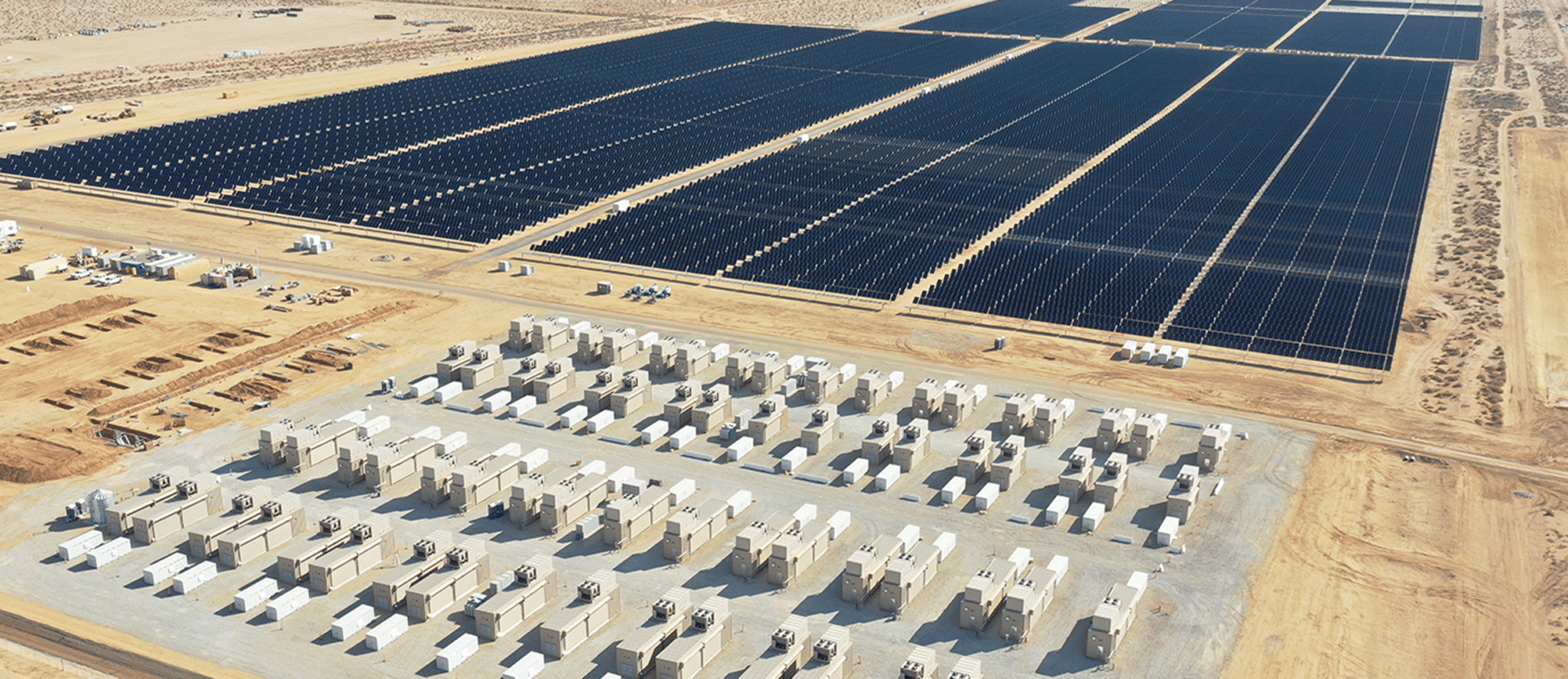
Late afternoon sun hits a flat stretch of scrubland outside Rosamond, California.
Rows of gray steel containers hum quietly in the heat. Inside them sit enough lithium cells to light a small city after dark. The containers look ordinary from the road. What they do after sunset does not.
For years, a single number has defined how US grid batteries behave once the sun goes down.
How a battery plant doubled its own discharge window
Most grid batteries built in the United States are designed around a simple limit: four hours of continuous discharge at full power before the cells run dry. That number is not an accident of chemistry. It reflects where equipment costs and market rules have historically lined up, since grid operators pay batteries to cover the evening demand spike.
Four hours has usually been enough to bridge that gap. The Tumbleweed facility in Kern County broke that pattern by adding capacity rather than reinventing it.
Developer Rev Renewables built the site in two phases, first activating 125 megawatts with four hours of duration back in the summer of 2024. Then, instead of building a second site elsewhere, the company went back to the same footprint.
So how do you stretch a battery’s discharge window without new chemistry or a breakthrough material? You add more boxes. Rev Renewables’ storage department leader Cody Hill told Canary Media that the company “literally doubled the number of battery boxes on the site,” and said “Technology-wise, the differences are pretty trivial. ” compared to the scale of the result. That plainness is the real story: nothing exotic made this possible, just more of what already works.
What an eight-hour discharge actually looks like on the ground
Picture the daily rhythm the plant now runs. California gets strong solar generation from around 8 a.m. to 6 p.m. , and Tumbleweed fills up on that surplus solar power at low cost because it sits close to the sun-drenched fields that feed it.
Then, as the sun drops and rooftop and utility solar output collapses, the plant starts pushing that stored energy back onto the wires. Reporting on the project describes discharge running from roughly 6 p.m. to 2 a.m., covering the entire evening demand peak and much of the night that follows.
Twice the duration means the plant can carry the grid through hours that four-hour batteries simply cannot reach. That is the stretch when solar has vanished but demand has not, a gap other grid battery records have struggled to cover.
The facility connects into the grid through the nearby Desert Flower Substation, which converts and sends stored energy to the nearby Desert Flower Substation, which connects to Southern California Edison’s Whirlwind Substation. It delivers power to community choice aggregators serving 4.7 million customers in Northern California. None of that required a new substation design, just a bigger battery sitting on the same wires.
The record, confirmed and dated
Here is where the claim gets specific rather than vague. On June 1, the Tumbleweed project in California’s Kern County became the first major battery installation in the U.S. that can discharge power for up to eight hours at a time, twice as long as typical energy-storage facilities. Outlets including Canary Media and the California Public Utilities Commission have since called it the first major US installation to reach that duration at meaningful scale.
The CPUC held a ribbon cutting on site on June 18, 2026, in Rosamond, Calif., where CPUC Executive Director Leuwam Tesfai attended in person.
Context matters for a record like this. Tumbleweed is far bigger than the 6-megawatt, eight-hour battery installed in Nantucket in 2019 for a special-case island power role, and larger than the 50-megawatt, eight-hour battery that went live in Australia in May.
At 125 megawatts, Tumbleweed is the first US project large enough to test what eight-hour duration means for a major interconnected grid rather than a special case. The project traces back to a 2021 state directive, when California regulators ordered power companies to procure longer-duration storage as part of the state’s planned transition to zero-carbon energy.
California Community Power, a consortium of local nonprofit power providers, issued a contract for Tumbleweed back in 2022 to fulfill this obligation. Ava Community Energy also holds a share of the project’s capacity, paying for 50 megawatts to serve its capacity obligations.
Where the limits still show up
Even with the record, Tumbleweed is not a complete answer to round-the-clock clean power. At 125 megawatts of instantaneous capacity, it is modest compared with the multi-hundred-megawatt batteries getting built elsewhere in the West , not far from the expanding Kern County solar farm nearby.
