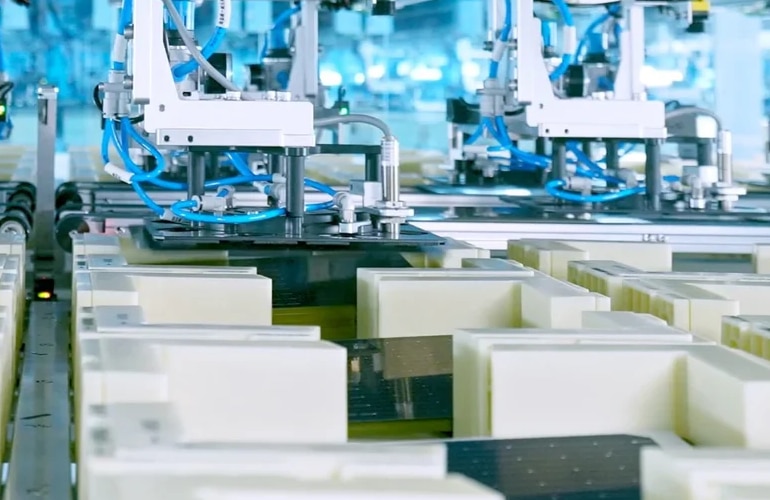
Japanese solar manufacturer Toyo Co., Ltd. celebrated the expansion of its Humble, Texas module assembly plant on October 6, even as a federal trade investigation threatens to complicate its supply chain.
The ceremony marked the facility’s growth to 2 gigawatts of annual module capacity, alongside plans for a new domestic solar cell production line.
Ribbon cutting marks Texas expansion
In a ceremony that featured appearances from U.S. and foreign dignitaries alongside company executives and industry professionals, Japanese solar manufacturer Toyo Co., Ltd celebrated the expansion of its Humble, Texas solar module assembly plant, according to pv magazine.
The facility, which first became operational in Oct. 2025, now boasts 2 GW of annual module capacity.
The company plans a $357 million expansion of the site to include a 1.5 GW heterojunction (HJT) solar cell manufacturing line it expects to be operational by Q1 2028.
The project reflects a broader wave of domestic solar manufacturing investment, a trend GCN has tracked as US module factories crossed 100 gigawatts of cumulative output this summer even as cell production remains concentrated overseas.
Supply chain audit and trade inquiry
Shortly before the ribbon cutting event, Toyo announced the results of an Intertek CEA factory audit, the outcome of which the company described as a strong result.
Intertek CEA, a quality assurance and inspection firm that routinely evaluates global photovoltaic manufacturing facilities, assigns letter grades based on an extensive review process.
Paul Wormser, Senior Vice President of Intertek CEA, said “our team conducts a rigorous, independent review of every element of a factory’s operations, quality systems, processes, and risk controls. We check a thousand different things in twelve major areas. And in those twelve major areas, we have never found perfection, but Toyo has gotten our highest grade.”
But the celebration came alongside discussion of a pending federal trade inquiry. Immediately preceding the event, Toyo held an “Analyst Day” webinar in which the company described its recent financial performance and plans for the near term. During the call, Toyo executives discussed the planned buildout of the company’s domestic cell line (currently in the permitting and approvals stage), and its response to the Ethiopia circumvention inquiry initiated by the U.S. Department of Commerce in July, 2026, which followed from a petition filed in May by several domestic solar companies.
The inquiry seeks to determine whether cells made using Chinese silicon wafers illegally circumvent import tariffs on Chinese solar products. Toyo says it is seeking clarification on whether its cells, which the company says are made using non-Chinese polysilicon and wafers sourced from Indonesia , will be subject to penalties if Commerce finds that circumvention has occurred. The inquiry centers on cells assembled at facilities in Ethiopia using Chinese-origin components; the Alliance for American Solar Manufacturing and Trade has asked the US Department of Commerce to open an anti-circumvention probe into solar imports from Ethiopia, alleging they bypass existing duties through the use of Chinese components.
Supply agreements and policy backdrop
Ahead of the ribbon cutting, Toyo disclosed a string of commercial announcements tied to its Texas operations.
The company announced binding module supply agreements with multiple U.S. offtakers representing an aggregate value of approximately $240 million, with modules manufactured at its Texas facility tabbed for projects including utility-scale power generation, commercial and industrial projects, community solar and data-center applications.
Jeffrey I. Kessler, Under Secretary of Commerce for Industry and Security, attended the ceremony and framed the expansion as validation of current trade policy. “Toyo’s announcement is the direct result of the Trump Administration’s bold policies to bring manufacturing and jobs back to America,” he said. “By investing hundreds of millions of dollars to expand its Texas factory, onshoring overseas production, and committing to use exclusively US polysilicon, Toyo is making an important contribution to America’s manufacturing renaissance.”
The circumvention case adds uncertainty to a manufacturing sector already reshaped by trade enforcement. Commerce has separately moved to close other import loopholes, a pattern evident when regulators finalized dumping duties reaching 249.13% on solar cells from several Southeast Asian countries earlier this year.
Toyo’s reliance on Indonesian-sourced wafers for its Ethiopia-made cells places the company squarely inside the zone Commerce investigators are now scrutinizing, even as the company disputes that its supply chain is implicated.
Why the expansion matters
The Humble facility’s growth illustrates both the opportunity and the risk facing solar manufacturers racing to localize production under federal tax incentives and tariff pressure.
Toyo’s cell line, still in permitting, would mark a rare instance of an upstream manufacturing step moving onshore rather than remaining overseas.
Until the Commerce Department resolves its inquiry, however, Toyo and similarly structured manufacturers face a period of regulatory ambiguity that could affect pricing, offtake agreements and future investment decisions across the industry.
